


Table of Contents
ToggleMicrobiology Testing Market Size
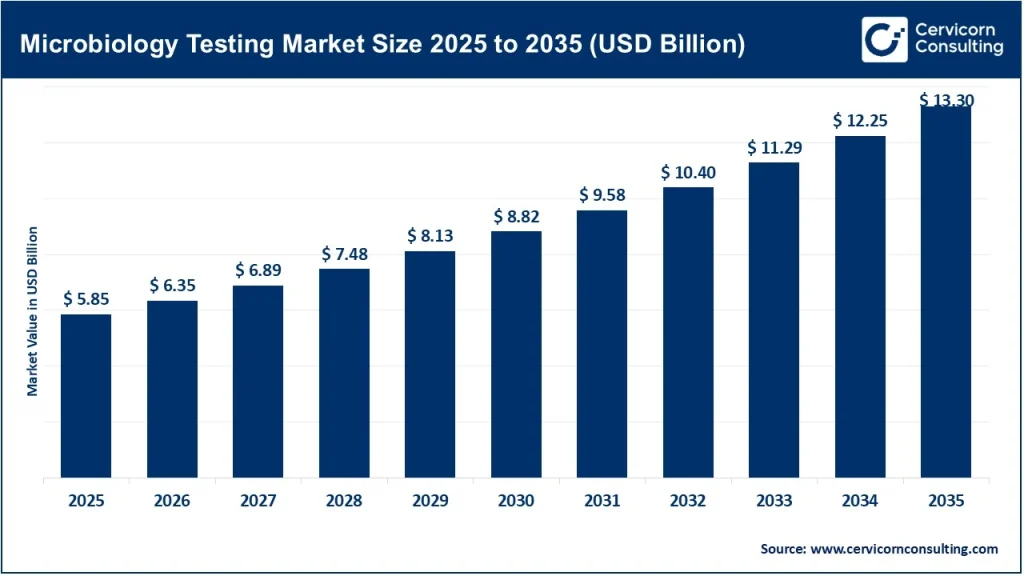
The global microbiology testing market reached approximately USD 5.85 billion in 2025 and is projected to grow to nearly USD 13.30 billion by 2035, expanding at a strong compound annual growth rate (CAGR) of 8.6% during the forecast period.
What Is the Microbiology Testing Market?
The microbiology testing market refers to the global ecosystem of technologies, instruments, reagents, consumables, and laboratory services used to detect, identify, and analyze microorganisms such as bacteria, viruses, fungi, and parasites across healthcare, pharmaceutical, biotechnology, food safety, environmental monitoring, and industrial applications. These testing solutions support pathogen identification, sterility testing, antimicrobial resistance monitoring, and contamination detection across multiple sectors.
Microbiology testing plays a critical role in diagnosing infectious diseases, supporting vaccine development, ensuring pharmaceutical product sterility, maintaining food safety standards, and monitoring environmental contamination. The market includes traditional culture-based testing techniques as well as advanced molecular diagnostic platforms such as PCR-based testing systems, next-generation sequencing technologies, automated microbial identification platforms, and rapid microbiological detection solutions designed to improve diagnostic speed and accuracy.
The increasing adoption of automation technologies, expansion of pharmaceutical manufacturing infrastructure, and growing demand for rapid infectious disease detection are supporting continuous expansion of the microbiology testing market worldwide.
Why the Microbiology Testing Market Is Important
The microbiology testing market plays a foundational role in protecting global public health systems, ensuring pharmaceutical manufacturing safety, supporting biotechnology innovation, and maintaining food supply chain quality standards. Microbiology testing enables early detection of infectious pathogens and supports targeted treatment decisions that help reduce hospital stays and healthcare costs.
Healthcare institutions rely heavily on microbiology diagnostics to detect bloodstream infections, respiratory diseases, gastrointestinal infections, and hospital-acquired pathogens. Rapid identification of infectious microorganisms allows physicians to prescribe appropriate antimicrobial therapies and prevent the spread of infection within clinical environments.
Pharmaceutical and biotechnology companies depend on microbiology testing for sterility assurance, contamination monitoring, and environmental control during biologics production. These testing procedures ensure compliance with strict regulatory guidelines and protect product quality during manufacturing workflows.
In addition, microbiology testing supports food safety programs by detecting harmful bacteria such as Salmonella and Listeria in production environments. Environmental monitoring programs also rely on microbiological testing to ensure safe drinking water and wastewater treatment outcomes.
As global health systems continue strengthening pandemic preparedness strategies and antimicrobial resistance monitoring frameworks, microbiology testing technologies are becoming increasingly essential components of healthcare infrastructure worldwide.
Get a Free Sample: https://www.cervicornconsulting.com/sample/2930
Microbiology Testing Market Growth Factors
The microbiology testing market is expanding due to several major growth drivers including the rising prevalence of infectious diseases worldwide, increasing antimicrobial resistance concerns, growing pharmaceutical and biotechnology manufacturing activities, and stricter regulatory requirements for contamination monitoring across healthcare, food safety, and environmental sectors; rapid technological advancements such as automated microbiology platforms, molecular diagnostic systems, and next-generation sequencing technologies are improving detection speed and testing accuracy, encouraging broader adoption across laboratories; expanding healthcare infrastructure in emerging economies and increasing government investments in infectious disease surveillance programs are strengthening laboratory networks globally; the growing demand for biologics production, vaccine development, and personalized medicine solutions is further increasing the need for microbial quality testing during manufacturing processes; and the integration of artificial intelligence-enabled diagnostic platforms and digital laboratory information management systems is enhancing operational efficiency and workflow automation across microbiology laboratories, collectively supporting long-term expansion of the microbiology testing market worldwide.
Leading Companies in the Microbiology Testing Market
Below is a structured overview of key companies operating in the microbiology testing market, including specialization areas, focus technologies, and global presence.
Hologic Inc.
| Category | Details |
|---|---|
| Company | Hologic Inc. |
| Specialization | Molecular diagnostics and women’s health testing technologies |
| Key Focus Areas | Infectious disease detection platforms and automated molecular testing |
| Notable Features | Panther automated molecular diagnostic system |
| 2024 Revenue | Approx. USD 4+ billion |
| Market Share | Emerging contributor in microbiology molecular diagnostics |
| Global Presence | North America, Europe, Asia-Pacific |
Hologic continues expanding its microbiology diagnostics footprint through automated molecular platforms designed for high-throughput infectious disease detection.
Shimadzu Corporation
| Category | Details |
|---|---|
| Company | Shimadzu Corporation |
| Specialization | Analytical instrumentation and laboratory diagnostics technologies |
| Key Focus Areas | Microbial identification using mass spectrometry platforms |
| Notable Features | Advanced chromatography and spectroscopy solutions |
| 2024 Revenue | Approx. USD 3–4 billion |
| Market Share | Strong presence in analytical microbiology instrumentation |
| Global Presence | Japan, North America, Europe, Asia |
Shimadzu supports microbiology laboratories through precision analytical solutions widely used in clinical research and pharmaceutical quality testing environments.
Thermo Fisher Scientific
| Category | Details |
|---|---|
| Company | Thermo Fisher Scientific |
| Specialization | Life sciences research tools and microbiology diagnostic systems |
| Key Focus Areas | Microbial detection kits, sequencing platforms, laboratory automation |
| Notable Features | Integrated microbiology workflow solutions and global supply network |
| 2024 Revenue | Approx. USD 40+ billion |
| Market Share | Leading global supplier of microbiology testing solutions |
| Global Presence | Operations in more than 50 countries worldwide |
Thermo Fisher Scientific remains one of the most influential companies in the microbiology testing market with a comprehensive portfolio covering reagents, instruments, and digital laboratory platforms.
bioMérieux
| Category | Details |
|---|---|
| Company | bioMérieux |
| Specialization | Clinical microbiology diagnostics and infectious disease testing |
| Key Focus Areas | Automated microbial identification and antimicrobial resistance testing |
| Notable Features | VITEK automated pathogen identification platforms |
| 2024 Revenue | Approx. USD 4+ billion |
| Market Share | One of the global leaders in clinical microbiology diagnostics |
| Global Presence | Presence in more than 160 countries |
bioMérieux plays a central role in advancing automated microbiology laboratory workflows across hospital and diagnostic laboratory environments.
Merck KGaA
| Category | Details |
|---|---|
| Company | Merck KGaA |
| Specialization | Life science tools and pharmaceutical microbiology testing solutions |
| Key Focus Areas | Sterility testing technologies and contamination monitoring systems |
| Notable Features | Rapid microbial detection and pharmaceutical quality assurance platforms |
| 2024 Revenue | Approx. USD 22+ billion |
| Market Share | Among the leading suppliers in pharmaceutical microbiology testing |
| Global Presence | Europe, Americas, Asia-Pacific |
Merck KGaA continues strengthening its position in pharmaceutical microbiology workflows through advanced contamination detection technologies.
Leading Trends and Their Impact on the Microbiology Testing Market
Automation in Microbiology Laboratories
Laboratory automation technologies are transforming microbiology testing by improving workflow efficiency and reducing manual intervention. Automated culture handling systems and digital colony counting technologies are significantly improving laboratory throughput.
Impact:
- Faster diagnostic turnaround times
- Improved testing accuracy
- Reduced laboratory staffing requirements
Rapid Molecular Diagnostic Technologies
PCR-based pathogen detection platforms are enabling faster and more accurate identification of infectious organisms compared to traditional testing methods.
Impact:
- Early disease detection
- Improved infection control programs
- Expansion of point-of-care microbiology testing
Rising Demand for Antimicrobial Resistance Monitoring
Antimicrobial resistance surveillance programs are expanding globally as healthcare systems prioritize infection control strategies.
Impact:
- Increased microbiology testing volumes
- Strong government surveillance initiatives
- Growth in susceptibility testing technologies
Integration of Artificial Intelligence in Diagnostics
Artificial intelligence technologies are improving microbial image recognition and laboratory workflow optimization.
Impact:
- Faster diagnostic interpretation
- Reduced laboratory workload
- Enhanced clinical decision-making accuracy
Expansion of Biopharmaceutical Manufacturing
Biologics production facilities require extensive microbial contamination monitoring throughout manufacturing workflows.
Impact:
- Increased sterility testing demand
- Growth in environmental monitoring technologies
- Expansion of rapid microbiology detection systems
Successful Examples of the Microbiology Testing Market Around the World
United States – Hospital Laboratory Automation Programs
Healthcare institutions across the United States have widely adopted automated microbiology testing platforms to strengthen infectious disease detection capabilities and improve patient outcomes.
Outcome:
- Faster bloodstream infection detection
- Improved antimicrobial stewardship programs
- Reduced hospitalization duration
Germany – Pharmaceutical Microbial Quality Control Leadership
Germany’s pharmaceutical industry maintains strong microbiology testing infrastructure supporting biologics production quality assurance.
Outcome:
- Strong compliance with pharmaceutical manufacturing standards
- Improved product safety
- Increased export competitiveness
India – National Infectious Disease Surveillance Expansion
India has strengthened microbiology laboratory infrastructure through national surveillance programs focused on antimicrobial resistance monitoring and infectious disease tracking.
Outcome:
- Improved laboratory testing accessibility
- Expanded disease monitoring capabilities
- Strengthened public health preparedness
Japan – Advanced Analytical Microbiology Integration
Japan’s clinical laboratories have integrated advanced microbial identification technologies to improve diagnostic efficiency.
Outcome:
- Faster pathogen detection timelines
- Improved infection control management
- Expanded hospital diagnostic automation adoption
Global Regional Analysis Including Government Initiatives and Policies Shaping the Market
North America
North America represents one of the most advanced microbiology testing markets globally due to strong diagnostic infrastructure and regulatory compliance requirements.
Government initiatives shaping the market include:
- National antimicrobial resistance surveillance programs
- Accelerated diagnostic approval pathways
- Government-funded infectious disease research initiatives
Impact:
- Rapid adoption of molecular diagnostics
- Expansion of automated laboratory workflows
- Growth of personalized medicine platforms
Europe
Europe maintains a mature microbiology testing market supported by strict pharmaceutical manufacturing regulations and food safety monitoring frameworks.
Government initiatives shaping the market include:
- Antimicrobial resistance action plans
- Biomedical innovation funding programs
- Pharmaceutical sterility compliance regulations
Impact:
- Growth of clinical diagnostic automation
- Expansion of pharmaceutical microbiology testing
- Increased environmental pathogen monitoring programs
Asia-Pacific
Asia-Pacific is the fastest-growing microbiology testing market due to expanding healthcare infrastructure and increasing infectious disease burden.
Government initiatives shaping the market include:
- National laboratory modernization programs
- Infectious disease surveillance infrastructure expansion
- Diagnostic research funding initiatives
Impact:
- Rapid laboratory capacity expansion
- Increased adoption of automated microbiology systems
- Growth in pharmaceutical contamination testing demand
Latin America
Latin America is experiencing steady growth in microbiology testing adoption supported by healthcare infrastructure development.
Government initiatives shaping the market include:
- National disease surveillance strengthening programs
- Food safety modernization strategies
Impact:
- Expansion of diagnostic laboratory networks
- Improved contamination monitoring compliance
Middle East and Africa
The Middle East and Africa microbiology testing market is expanding through healthcare modernization initiatives and infectious disease monitoring programs.
Government initiatives shaping the market include:
- Healthcare infrastructure expansion strategies
- Regional pathogen surveillance programs
Impact:
- Improved laboratory testing accessibility
- Increased adoption of automated diagnostic platforms
To Get Detailed Overview, Contact Us: https://www.cervicornconsulting.com/contact-us
Read Report: Industrial AI Market Revenue, Trends, and Strategic Insights by 2035