


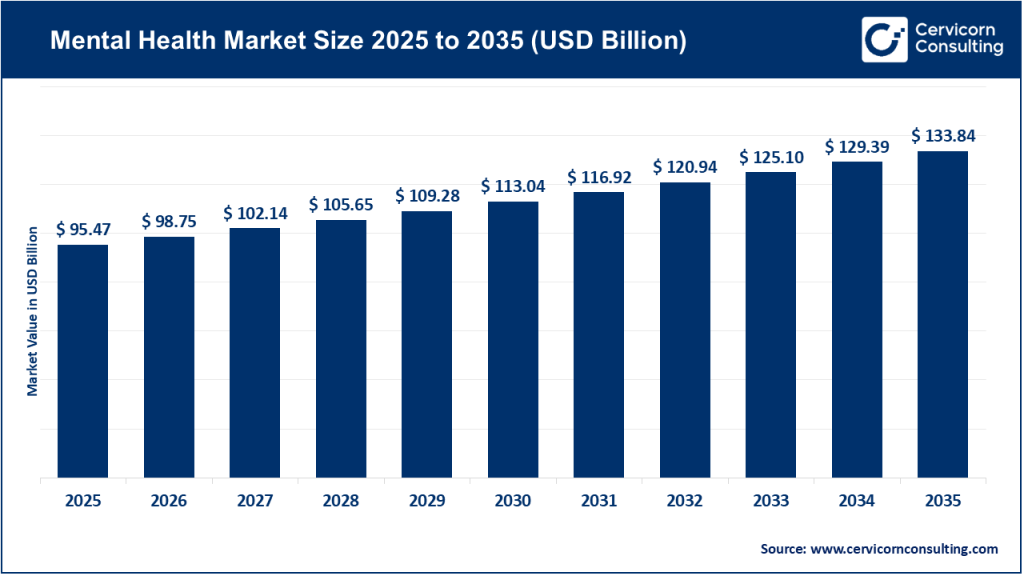
Mental Health Market Size
The global mental health market size was worth USD 95.47 billion in 2025 and is anticipated to expand to around USD 133.84 billion by 2035, registering a compound annual growth rate (CAGR) of 3.4% from 2026 to 2035.
Mental Health Market Growth Factors
The mental health market is expanding due to a combination of rising global prevalence of mental-health conditions, greater awareness and reduced stigma, improved insurance coverage and parity laws, rapid growth of tele-mental health and digital therapy platforms, increased employer demand for mental wellness solutions, integration of behavioral health into primary care, advancements in AI-driven triage and measurement-based care, and intensified government investments in community services and early intervention. These forces collectively enhance access, improve affordability, diversify care channels (in-person, virtual, app-based), and attract significant capital to scale hybrid behavioral-health models.
What Is the Mental Health Market?
The mental health market encompasses the entire range of services, products, and technologies used to prevent, diagnose, treat, and manage mental, emotional, behavioral, neurological, and substance-use conditions. Key components include:
- Clinical Services: Psychiatric hospitals, outpatient clinics, psychologists, counselors, community mental-health centers, addiction treatment centers.
- Digital Solutions: Teletherapy platforms, digital CBT programs, AI-driven triage systems, mental-health apps, remote monitoring tools.
- Pharmaceuticals & Therapeutics: Medications for psychiatric and neurological disorders.
- Employer Solutions: Employee assistance programs (EAPs), workforce resilience platforms, wellness coaching.
- Supportive & Preventive Services: Case management, early intervention, community support programs, school-based mental health initiatives.
This market blends traditional healthcare services with digital innovations and public-sector programs, creating an increasingly hybrid ecosystem.
Get a Free Sample: https://www.cervicornconsulting.com/sample/2838
Why the Mental Health Market Is Important
The importance of the mental health market stems from its profound impact on individuals, economies, and societies. Mental-health conditions influence physical health, increase healthcare costs, reduce workplace productivity, and contribute to disability and mortality. Untreated mental illness drives emergency visits, hospitalization, substance abuse, homelessness, and long-term chronic disease complications. Early intervention and accessible mental-health services reduce long-term economic burden, improve workforce performance, enhance quality of life, and support healthier communities. As mental health becomes recognized as equal in importance to physical health, the market is gaining unprecedented policy support and investment momentum.
Top Companies in the Mental Health Market
1. Universal Health Services (UHS)
Specialization:
One of the largest providers of hospital and behavioral healthcare services, operating acute-care and inpatient psychiatric facilities.
Key Focus Areas:
- Inpatient psychiatric treatment
- Acute behavioral health services
- Expansion of behavioral hospital networks
- Integration of behavioral and general medical care
Notable Features:
- Extensive national network of behavioral hospitals
- Strong operational model for facility-based care
- Partnerships with health systems to expand behavioral capacity
2024 Revenue:
Approximately $15.8 billion (consolidated annual revenue).
Market Share & Global Presence:
A dominant U.S. player in facility-based behavioral healthcare with hundreds of inpatient beds nationwide and a growing footprint across states. Primarily U.S.-focused.
2. Acadia Healthcare
Specialization:
A leading pure-play behavioral healthcare company with inpatient hospitals, detox facilities, and outpatient centers.
Key Focus Areas:
- Psychiatric inpatient beds
- Addiction treatment
- Adolescent behavioral programs
- Joint ventures with health systems
Notable Features:
- Rapid expansion through facility openings and joint ventures
- Focused exclusively on behavioral healthcare
- Strong operational scale in specialized treatment
2024 Revenue:
Approximately $3.2 billion.
Market Share & Global Presence:
Primarily U.S.-based with over hundreds of facilities nationwide, and select international operations. A top leader in inpatient behavioral health.
3. Centene Corporation
Specialization:
A major U.S. managed-care organization with significant behavioral health integration in Medicaid, Medicare, and Marketplace plans.
Key Focus Areas:
- Behavioral health benefits
- Integrated physical + mental health care
- Medicaid behavioral programs
- Value-based behavioral health contracts
Notable Features:
- Large influence on behavioral-health access via insurance coverage
- Wide provider network
- Emphasis on population health and whole-person care
2024 Revenue:
Approximately $145.5 billion (premium and service revenues).
Market Share & Global Presence:
Extensive U.S. footprint across Medicaid and government-sponsored programs. Influences reimbursement and access for millions of beneficiaries.
4. Teladoc Health
Specialization:
A global virtual-care leader and one of the largest providers of teletherapy and digital mental-health services.
Key Focus Areas:
- Teletherapy and telepsychiatry
- Digital mental-health programs
- AI-informed triage and virtual first care
- Direct-to-consumer therapy services (BetterHelp)
Notable Features:
- One of the world’s most recognized telehealth brands
- Scalable virtual behavioral health services
- Hybrid integration with physical telemedicine
2024 Revenue:
Approximately $2.57 billion.
Market Share & Global Presence:
Operations across North America, Europe, Latin America, and other global regions. A major driver of tele-mental-health adoption.
5. CVS Health
Specialization:
An integrated healthcare enterprise with pharmacy services, primary care clinics, and payer offerings through Aetna.
Key Focus Areas:
- Integrating behavioral health into primary care
- Pharmacy-based mental-health screening
- Teletherapy services through digital programs
- Employer mental-health benefits
Notable Features:
- National footprint via retail pharmacies and MinuteClinics
- Ability to offer mental-health care at convenient community locations
- Growth in digital behavioral-health partnerships
2024 Revenue:
Approximately $372.8 billion.
Market Share & Global Presence:
Primarily a U.S. presence with a massive national network of clinics, pharmacies, and insurance members influencing access to mental-health services.
Leading Trends and Their Impact on the Mental Health Market
1. Telehealth and Digital Mental Health Become Mainstream
Teletherapy, remote psychiatric consultations, and app-based mental-health tools have become essential for expanding access, especially in rural and underserved regions. This shift lowers barriers, improves appointment flexibility, and scales care delivery.
2. Integration of Mental Health Into Primary Care
Health systems and insurers increasingly embed behavioral health clinicians into primary care clinics. This improves early detection, reduces stigma, and lowers total healthcare costs.
3. Growing Employer Demand for Workforce Mental Wellbeing
Companies now invest heavily in mental wellness programs due to heightened burnout, turnover, and stress. Digital platforms targeting workplaces are growing rapidly.
4. AI and Measurement-Based Care
AI-powered triage, digital biomarkers, clinical decision support, and standardized outcomes measurement are reshaping how providers assess progress and personalize care.
5. Workforce Shortages and Task-Shifting
Severe shortages of psychiatrists and psychologists are pushing new models that rely on therapists, coaches, community workers, and supervised digital tools.
6. Consolidation of Behavioral Health Providers
Large behavioral-health operators continue to acquire clinics and expand bed capacity. Meanwhile, payers and retail-health companies partner or acquire mental-health solutions to integrate services.
7. Rising Policy Support for Mental-Health Parity
Governments worldwide are reinforcing mental-health parity, telehealth reimbursement, and youth mental-health funding — all accelerating market expansion.
Successful Mental Health Market Models Around the World
United Kingdom — IAPT Program
The UK’s Improving Access to Psychological Therapies (IAPT) initiative is a global benchmark. It standardized CBT-based therapy, integrated digital triage, and made outcome measurement mandatory — significantly boosting access.
United States — Integrated Behavioral Care
Models connecting behavioral clinicians to primary care networks, retail clinics, and telehealth platforms are improving early detection and lowering hospital utilization.
Australia — Medicare-Supported Teletherapy
Australia’s mental-health coverage allows a streamlined reimbursement pathway for psychotherapy, enabling national access at scale.
WHO’s mhGAP Program (Global)
The WHO’s Mental Health Gap Action Programme trains non-specialist health workers to provide basic mental-health care in resource-limited settings. It’s widely used across Africa, Asia, and Latin America.
Israel — National Digital Mental Health Initiatives
Israel’s digital-first health system uses telepsychiatry and digital triage to reduce wait times and streamline referrals across the country.
Nordic Countries — Publicly Funded Mental-Health Systems
Countries like Finland, Sweden, and Denmark provide universal mental-health access integrated with primary and youth services.
Global Regional Analysis and Government Initiatives
North America
Key Drivers:
- Mental-health parity enforcement
- Telehealth regulations supporting virtual therapy
- Medicaid expansion for behavioral health
- Significant employer investments
Government Influence:
Federal and state programs fund crisis-care systems, youth mental health, opioid treatment, and tele-mental-health expansions.
Europe
Key Drivers:
- Strong national mental-health strategies
- Universal health coverage systems
- Government procurement of digital therapy solutions
- Standardized clinical pathways
Government Influence:
Programs like IAPT shape evidence-based, outcome-driven models. European nations invest heavily in early intervention and youth mental-health services.
Asia-Pacific
Key Drivers:
- High digital adoption
- Increasing national mental-health policies
- Rapid growth in telemedicine
- Workforce shortages leading to digital-first approaches
Government Influence:
Many APAC countries are incorporating mental health into national health policies, school programs, and community health worker training.
Latin America
Key Drivers:
- Urban demand for mental-health services
- Increasing telehealth adoption
- NGO partnerships for community mental health
Government Influence:
Several nations are developing national mental-health strategies and scaling training via WHO-supported programs.
Middle East & Africa
Key Drivers:
- Rising awareness, especially in youth
- Growing private-sector digital-health participation
- Community-led and NGO-supported mental-health initiatives
Government Influence:
Governments collaborate with global health agencies to expand basic mental-health infrastructure, crisis lines, and training.
Summary View of the Market Landscape
- Providers like UHS and Acadia dominate inpatient and facility-based care.
- Payers like Centene and CVS/Aetna shape access and reimbursement, influencing millions of covered lives.
- Digital leaders like Teladoc are revolutionizing virtual therapy and hybrid care models.
- Governments worldwide are investing more in mental-health programs, prevention strategies, telehealth expansion, and youth services.
This combination of public pressure, technology innovation, rising demand, and policy reform is creating one of the fastest-evolving markets in healthcare.
To Get Detailed Overview, Contact Us: https://www.cervicornconsulting.com/contact-us
Read Report: Augmented Intelligence Market Revenue, Global Presence, and Strategic Insights by 2034