


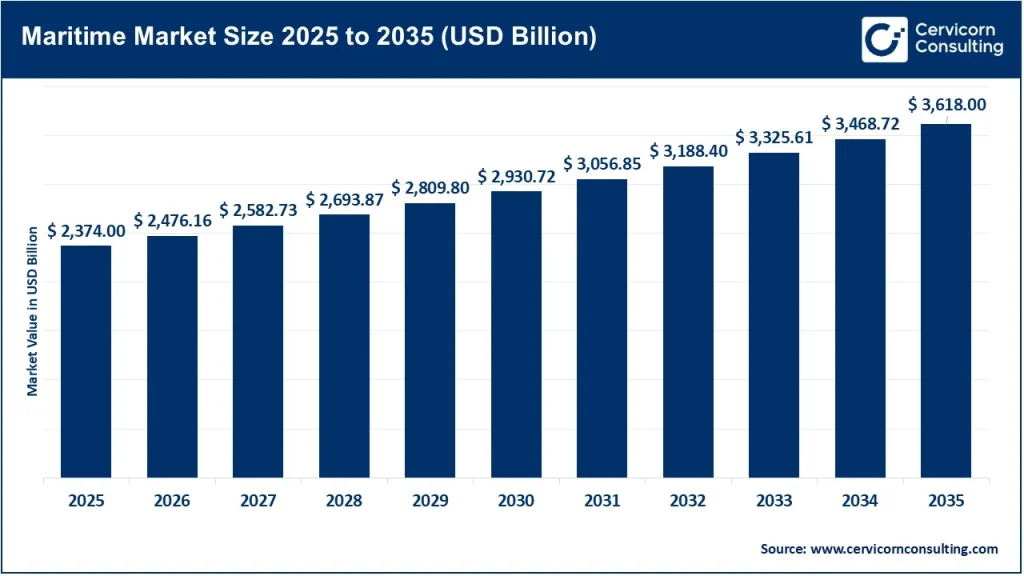
Maritime Market Size
The global maritime market was valued at approximately USD 2,374 billion in 2025 and is projected to reach nearly USD 3,618 billion by 2035, growing at a CAGR of 4.3%.
Maritime Market Growth Factors
The maritime market is witnessing substantial growth due to the rapid expansion of global trade activities, increasing demand for containerized cargo transportation, rising investments in port infrastructure modernization, growing adoption of digital shipping technologies, increasing offshore energy exploration projects, and expanding international supply chains. The implementation of smart ports, autonomous vessels, blockchain-based logistics solutions, and artificial intelligence-powered fleet management systems is enhancing operational efficiency across the maritime ecosystem.
Furthermore, government investments in maritime infrastructure, rising seaborne trade volumes, increasing LNG transportation demand, growth in renewable energy projects such as offshore wind farms, and stricter environmental regulations encouraging sustainable shipping practices are creating significant opportunities for market expansion. The emergence of green shipping technologies, alternative fuels, and decarbonization strategies is further accelerating innovation and long-term growth within the industry.
What is the Maritime Market?
The maritime market refers to the global ecosystem involved in the transportation of goods, passengers, and resources through oceans, seas, rivers, and inland waterways. It includes shipping companies, ports, shipyards, logistics providers, maritime technology developers, marine equipment manufacturers, offshore service providers, and regulatory authorities.
The market encompasses several major segments:
- Container shipping
- Bulk cargo transportation
- Tanker shipping
- Offshore support vessels
- Port and terminal operations
- Maritime logistics
- Shipbuilding and repair
- Maritime technology and digital solutions
- Marine insurance and financing
- Cruise and passenger shipping
Maritime transportation remains the most economical method for moving large volumes of goods over long distances, making it an essential component of global commerce.
Get a Free Sample: https://www.cervicornconsulting.com/sample/2990
Why is the Maritime Market Important?
Facilitates Global Trade
The maritime industry enables international trade by transporting raw materials, consumer goods, industrial products, and energy resources between continents. Without maritime transportation, global supply chains would struggle to function efficiently.
Supports Economic Development
Ports, shipping companies, shipyards, and logistics operations contribute significantly to employment generation, economic growth, and industrial development in both developed and emerging economies.
Ensures Energy Security
A substantial portion of global oil, natural gas, and LNG supplies are transported via maritime routes. The industry plays a critical role in maintaining energy security and supporting industrial activities worldwide.
Enables Global Supply Chains
Manufacturing industries depend heavily on maritime transportation for sourcing raw materials and distributing finished products across international markets.
Drives Infrastructure Development
Investments in ports, shipping terminals, logistics hubs, and maritime technology encourage regional economic development and international competitiveness.
Supports Sustainability Goals
Modern maritime innovations are helping reduce carbon emissions through cleaner fuels, energy-efficient vessels, digital route optimization, and green port initiatives.
Major Maritime Market Companies
The global maritime industry is highly competitive, with several multinational shipping companies controlling significant portions of global container transportation capacity.
| Company | Specialization | Key Focus Areas | Notable Features | Estimated 2025 Revenue | Approximate Market Share | Global Presence |
|---|---|---|---|---|---|---|
| A.P. Moller – Maersk A/S | Integrated container logistics and shipping | End-to-end supply chain solutions, digital logistics, sustainable shipping | World’s leading integrated logistics provider with extensive shipping network | USD 82-85 Billion | ~14-15% container shipping capacity | More than 130 countries |
| Mediterranean Shipping Company (MSC) | Container shipping and logistics | Global container transportation, terminal operations, fleet expansion | Largest container shipping fleet globally by capacity | Privately held (estimated USD 90+ Billion) | ~20% global container shipping capacity | Over 155 countries |
| CMA CGM Group | Shipping, logistics, air freight | Integrated transportation and logistics services | Strong investments in logistics and digital transformation | USD 55-60 Billion | ~12% container shipping market | More than 160 countries |
| COSCO Shipping Holdings Co., Ltd. | Shipping and port operations | Container shipping, terminals, supply chain services | Extensive government-backed global shipping network | USD 30-35 Billion | ~11% global container capacity | More than 140 countries |
| Hapag-Lloyd AG | Container shipping and logistics | Fleet modernization, sustainability, global trade routes | Strong presence across transatlantic and Asian trade lanes | USD 20-25 Billion | ~7% container shipping capacity | More than 130 countries |
Competitive Landscape
The maritime market is characterized by strategic alliances, vessel-sharing agreements, mergers, acquisitions, and extensive investments in digital transformation. Major players are increasingly focusing on:
- Fleet modernization programs
- Low-carbon fuel adoption
- LNG-powered vessels
- Smart shipping technologies
- Supply chain integration
- Port terminal acquisitions
- Artificial intelligence applications
- Global route expansion
Shipping companies are also strengthening resilience against supply chain disruptions by investing in diversified logistics capabilities and advanced predictive analytics platforms.
Leading Maritime Market Trends and Their Impact
1. Decarbonization and Green Shipping
Environmental regulations from international authorities are driving the transition toward low-emission shipping operations. Companies are investing heavily in alternative fuels such as:
- Liquefied Natural Gas (LNG)
- Green Methanol
- Biofuels
- Green Hydrogen
- Ammonia-based fuels
Impact
- Reduced greenhouse gas emissions
- Improved regulatory compliance
- Enhanced sustainability performance
- Increased investments in vessel upgrades
2. Digitalization of Maritime Operations
Digital technologies are transforming shipping operations through:
- Artificial Intelligence
- Internet of Things (IoT)
- Blockchain
- Digital twins
- Predictive maintenance systems
Impact
- Improved operational efficiency
- Reduced downtime
- Better cargo visibility
- Lower operating costs
- Enhanced customer satisfaction
3. Smart Ports Development
Ports worldwide are adopting automation technologies, intelligent cargo handling systems, and real-time monitoring solutions.
Impact
- Faster cargo processing
- Reduced congestion
- Increased throughput capacity
- Improved trade competitiveness
4. Autonomous and Remote-Controlled Vessels
Technological advancements are accelerating the development of autonomous shipping systems capable of reducing human intervention.
Impact
- Enhanced safety
- Reduced labor costs
- Improved fuel efficiency
- Greater route optimization
5. Supply Chain Integration
Shipping companies are evolving into integrated logistics providers by offering warehousing, inland transportation, and supply chain management services.
Impact
- End-to-end logistics solutions
- Improved customer retention
- Enhanced revenue diversification
- Stronger competitive positioning
6. Cybersecurity Investments
As maritime operations become increasingly digitalized, cyber threats are becoming a major concern.
Impact
- Increased cybersecurity spending
- Enhanced operational resilience
- Better protection of critical infrastructure
- Reduced business interruption risks
Successful Maritime Market Examples Around the World
Port of Singapore
Singapore operates one of the world’s most advanced maritime ecosystems. The country has invested heavily in automation, digitalization, and smart port technologies.
Success Factors
- Automated container terminals
- Strategic geographic location
- Government-backed maritime innovation programs
- Extensive global connectivity
Impact
Singapore remains one of the world’s busiest transshipment hubs and a leading maritime innovation center.
Port of Rotterdam, Netherlands
The Port of Rotterdam serves as Europe’s largest seaport and a benchmark for smart port implementation.
Success Factors
- Digital twin technology
- AI-powered traffic management
- Automated logistics operations
- Sustainability initiatives
Impact
The port has significantly improved cargo handling efficiency while reducing environmental impact.
Shanghai Port, China
Shanghai Port consistently ranks among the world’s busiest container ports.
Success Factors
- Massive infrastructure investments
- Automated container terminals
- Government support
- Integration with Belt and Road Initiative
Impact
Shanghai has become a key gateway for global trade and manufacturing exports.
Jebel Ali Port, UAE
Jebel Ali Port is the largest port in the Middle East and a major logistics hub connecting Asia, Europe, and Africa.
Success Factors
- Advanced logistics infrastructure
- Free trade zones
- Strong government support
- Strategic trade location
Impact
The port has attracted significant foreign investment and strengthened regional trade.
Port of Los Angeles, United States
The Port of Los Angeles handles substantial trade volumes between Asia and North America.
Success Factors
- Advanced cargo tracking systems
- Sustainability programs
- Infrastructure modernization
- Digital logistics solutions
Impact
The port remains critical to U.S. supply chains and international commerce.
Global Regional Analysis of the Maritime Market
North America
North America remains a major maritime market supported by strong international trade activities, advanced port infrastructure, and growing digital transformation initiatives.
Key Growth Drivers
- High container traffic volumes
- E-commerce growth
- Port modernization projects
- LNG export expansion
Government Initiatives and Policies
The United States government has introduced infrastructure funding programs aimed at upgrading ports, improving supply chain resilience, and enhancing transportation efficiency. The Maritime Administration (MARAD) continues to support domestic shipping and port development projects.
Canada is investing in port capacity expansion, sustainable transportation systems, and Arctic shipping route development to strengthen international trade competitiveness.
Europe
Europe is at the forefront of sustainable shipping and maritime innovation.
Key Growth Drivers
- Green shipping initiatives
- Offshore wind energy expansion
- Advanced port automation
- Strong intra-European trade
Government Initiatives and Policies
The European Union’s Green Deal and Fit for 55 package are driving investments in low-carbon shipping technologies. The EU Emissions Trading System (ETS) now includes maritime transport, encouraging shipping companies to reduce emissions.
European governments are also supporting hydrogen infrastructure, alternative fuel development, and smart port technologies.
Asia-Pacific
Asia-Pacific represents the largest maritime market globally due to its dominant manufacturing base and export-driven economies.
Key Growth Drivers
- Expanding international trade
- Growing industrialization
- Large-scale port infrastructure investments
- Rising e-commerce demand
Government Initiatives and Policies
China’s Belt and Road Initiative continues to strengthen maritime connectivity through investments in ports and shipping infrastructure worldwide.
Japan is promoting green shipping technologies and autonomous vessel development through various maritime innovation programs.
South Korea supports smart shipbuilding initiatives and digital maritime transformation through government-backed research and development programs.
Singapore continues investing heavily in maritime innovation, sustainability projects, and advanced port infrastructure.
Latin America
Latin America’s maritime sector is expanding due to increasing commodity exports and infrastructure development projects.
Key Growth Drivers
- Agricultural exports
- Mining activities
- Energy transportation
- Port modernization investments
Government Initiatives and Policies
Brazil is implementing port concession programs to attract private investments and improve logistics efficiency. Several Latin American governments are encouraging public-private partnerships to strengthen maritime infrastructure.
Middle East and Africa
The Middle East and Africa are emerging as strategically important maritime regions due to energy exports and global trade connectivity.
Key Growth Drivers
- Oil and gas transportation
- Strategic trade routes
- Port expansion projects
- Logistics hub development
Government Initiatives and Policies
The UAE continues investing in world-class maritime infrastructure through long-term logistics and transportation strategies.
Saudi Arabia’s Vision 2030 program includes substantial investments in ports, logistics zones, and maritime transportation to diversify the economy beyond oil revenues.
African governments are increasingly collaborating with international organizations to modernize ports, improve trade corridors, and enhance maritime security.
Future Opportunities in the Maritime Market
The maritime market is expected to witness significant opportunities through the expansion of autonomous shipping technologies, green fuel adoption, smart ports, digital logistics platforms, offshore renewable energy projects, and AI-powered fleet management solutions. Growing global trade volumes, evolving supply chain requirements, and increasing environmental sustainability goals will continue to shape investment strategies across the industry. Companies that successfully integrate digital innovation, sustainability initiatives, and operational efficiency improvements are expected to gain a substantial competitive advantage in the rapidly evolving maritime landscape.
To Get Detailed Overview, Contact Us: https://www.cervicornconsulting.com/contact-us
Read Report: Red Biotechnology Market Revenue, Trends, and Strategic Insights by 2035