


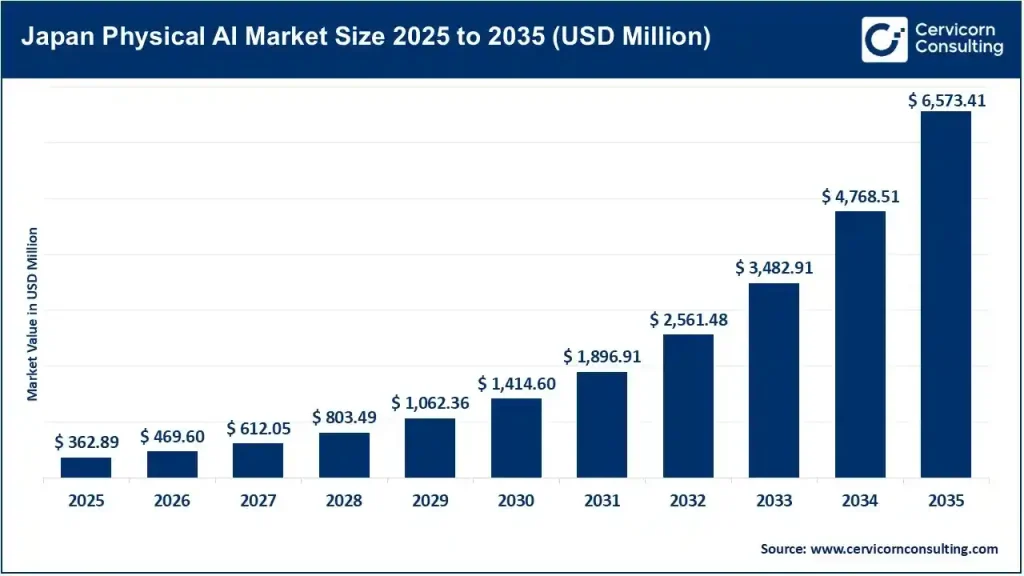
Japan Physical AI Market Size
The Japan physical AI market was valued at approximately USD 307.30 million in 2025 and is projected to reach USD 6,764.02 million by 2035, expanding at a CAGR of 36.2% during the forecast period.
What is the Japan Physical AI Market?
The Japan Physical AI market refers to the ecosystem of intelligent machines, robots, autonomous systems, and AI-powered physical devices that combine artificial intelligence with sensors, robotics, embedded systems, computer vision, edge AI, and machine learning to perform real-world physical actions.
Unlike traditional AI software that analyzes data or generates digital outputs, Physical AI interacts directly with the surrounding environment. These systems can observe, understand, learn, and make decisions while performing physical tasks.
Physical AI technologies include:
- Industrial robots
- Humanoid robots
- Collaborative robots (Cobots)
- Autonomous Mobile Robots (AMRs)
- Autonomous Guided Vehicles (AGVs)
- AI-powered manufacturing systems
- Service robots
- Medical robots
- Agricultural robots
- Warehouse automation robots
- AI drones
- Intelligent inspection robots
- Autonomous construction equipment
These systems continuously collect environmental data using cameras, LiDAR, radar, tactile sensors, microphones, GPS, force sensors, and IoT devices while AI algorithms enable adaptive decision-making in dynamic environments.
Get a Free Sample: https://www.cervicornconsulting.com/sample/3000
Japan Physical AI Market Growth Factors
Japan’s Physical AI market is expanding rapidly due to the country’s severe labor shortages, aging population, growing investments in smart manufacturing, increasing Industry 5.0 adoption, widespread deployment of industrial and collaborative robots, advancements in computer vision and edge AI, strong automotive automation demand, government support for AI innovation, rising warehouse automation, expanding healthcare robotics, rapid development of autonomous mobility solutions, and continuous R&D investments by leading Japanese robotics and electronics companies that are accelerating intelligent machine deployment across industrial and commercial sectors.
Why is the Japan Physical AI Market Important?
Physical AI is becoming one of Japan’s most strategic technology sectors because it directly addresses some of the country’s biggest economic and demographic challenges.
Solving Labor Shortages
Japan faces one of the world’s oldest populations, resulting in persistent workforce shortages across manufacturing, logistics, healthcare, and agriculture. AI-powered robots help bridge these labor gaps by automating repetitive and physically demanding tasks.
Strengthening Manufacturing Leadership
Japan has historically been a global leader in precision manufacturing. Physical AI enables factories to become smarter by integrating robotics, predictive maintenance, intelligent inspection, and autonomous production systems.
Enhancing Healthcare Services
Healthcare institutions increasingly use intelligent robotic systems for rehabilitation, surgery, elderly care, patient monitoring, and hospital logistics, improving care quality while reducing caregiver burden.
Accelerating Smart Logistics
Physical AI enables warehouses to automate inventory movement, package sorting, order fulfillment, and transportation using autonomous mobile robots and AI-powered warehouse systems.
Supporting Autonomous Mobility
Japanese automakers are integrating Physical AI into autonomous vehicles, intelligent transportation systems, advanced driver assistance, and connected mobility platforms.
Increasing National Competitiveness
Japan’s leadership in robotics provides significant export opportunities as global demand for intelligent autonomous machines continues to rise.
Major Companies Driving the Japan Physical AI Market
| Company | Specialization | Key Focus Areas | Notable Features | 2025 Revenue* | Estimated Market Position* |
|---|---|---|---|---|---|
| Toyota Motor Corporation | Automotive AI & Robotics | Autonomous vehicles, factory automation, mobility robots | Woven City initiative, AI mobility platform | Approximately USD 320+ Billion | Strong automotive AI leader |
| Fanuc Corporation | Industrial Robotics | Factory automation, CNC systems, AI robots | World’s leading industrial robot manufacturer | Approximately USD 5–6 Billion | Global industrial robotics leader |
| Sony Group Corporation | AI, Sensors & Robotics | AI vision, imaging sensors, entertainment robotics | Industry-leading CMOS image sensors supporting Physical AI | Approximately USD 85–90 Billion | Major AI technology provider |
| SoftBank Robotics | Service Robotics | Humanoid robots, customer service, healthcare | Pepper and Whiz robots deployed globally | Approximately USD 6–7 Billion (SoftBank Robotics business estimates within parent ecosystem) | Leading service robotics innovator |
| Yaskawa Electric Corporation | Motion Control & Robotics | Industrial automation, AI robotics, servo systems | Strong presence in manufacturing automation | Approximately USD 4–5 Billion | Major industrial automation company |
Leading Trends Shaping the Japan Physical AI Market
1. Humanoid Robot Development
Japan continues to lead global humanoid robotics innovation. New generations of robots are becoming capable of natural conversation, object manipulation, autonomous navigation, and human collaboration.
Impact
- Greater healthcare assistance
- Improved retail customer service
- Enhanced elderly care
- Increased hospitality automation
2. AI-Powered Smart Factories
Manufacturers are integrating Physical AI into production environments through AI vision systems, predictive maintenance, autonomous inspection, and robotic assembly.
Impact
- Higher productivity
- Reduced downtime
- Improved product quality
- Lower manufacturing costs
3. Autonomous Mobile Robots (AMRs)
Warehouses are increasingly replacing manual transportation with AI-powered autonomous robots.
Impact
- Faster logistics operations
- Improved warehouse safety
- Reduced labor dependence
- Greater inventory accuracy
4. Collaborative Robots (Cobots)
Unlike conventional industrial robots, collaborative robots safely work alongside human workers.
Impact
- Easier automation for SMEs
- Flexible production
- Improved worker safety
- Reduced installation costs
5. Edge AI Computing
Instead of relying solely on cloud processing, robots increasingly perform AI inference locally.
Impact
- Faster decision-making
- Lower latency
- Better security
- Reliable autonomous operation
6. AI Vision Systems
Computer vision is dramatically improving robot perception capabilities.
Applications include:
- Quality inspection
- Object recognition
- Defect detection
- Autonomous navigation
- Inventory monitoring
Impact
Manufacturers achieve better quality control while reducing manual inspection costs.
7. AI in Elderly Care
Japan is becoming the global leader in care robotics.
Physical AI supports:
- Patient monitoring
- Medication reminders
- Mobility assistance
- Rehabilitation
- Companion robots
Impact
Improved quality of life while reducing pressure on healthcare workers.
8. Autonomous Vehicles
Japanese automotive manufacturers continue investing heavily in Physical AI technologies.
Applications include:
- Self-driving vehicles
- Autonomous buses
- AI delivery robots
- Intelligent traffic systems
Impact
Safer transportation with greater operational efficiency.
What Are Some Successful Examples of Japan Physical AI Market Around the World?
Fanuc Smart Factory Automation
Fanuc industrial robots are deployed in automotive, electronics, aerospace, food processing, and semiconductor factories across North America, Europe, China, South Korea, and Southeast Asia. These AI-enabled robotic systems deliver high-speed manufacturing, predictive maintenance, and precision assembly, helping manufacturers improve productivity while reducing defects and operational costs.
Toyota’s Autonomous Mobility Ecosystem
Toyota’s Physical AI initiatives extend beyond vehicle automation through autonomous logistics, AI-powered manufacturing, and the Woven City smart city project. The company is testing integrated mobility platforms that combine robotics, autonomous driving, and connected infrastructure, influencing next-generation urban mobility solutions worldwide.
SoftBank Robotics’ Pepper
Pepper became one of the world’s first commercially successful humanoid robots used in:
- Banks
- Airports
- Retail stores
- Hospitals
- Hotels
- Educational institutions
Countries including France, Singapore, the United Kingdom, and the United States adopted Pepper for customer engagement and information services.
Sony AI Vision Technologies
Sony’s advanced imaging sensors serve as foundational components in autonomous vehicles, drones, industrial robots, surveillance systems, and intelligent inspection equipment worldwide. These sensors significantly enhance machine perception, enabling more accurate navigation, object detection, and real-time decision-making in Physical AI applications.
Yaskawa Industrial Robotics
Yaskawa’s intelligent robotic systems are widely used across automotive manufacturing, semiconductor fabrication, metal processing, electronics assembly, and food production facilities worldwide. Their AI-driven motion control and precision robotics improve operational efficiency and manufacturing quality across multiple industries.
Government Initiatives and Policies Shaping the Japan Physical AI Market
Japan’s government continues to play a central role in accelerating Physical AI adoption through strategic investments, national AI roadmaps, and industrial transformation programs.
Society 5.0 Vision
Society 5.0 serves as Japan’s national strategy for creating a human-centered digital society. The initiative promotes the integration of AI, robotics, IoT, cloud computing, and big data across industries to address societal challenges while improving economic productivity. Physical AI technologies are considered a cornerstone of this vision, enabling intelligent automation in manufacturing, healthcare, transportation, agriculture, and public services.
AI Strategy 2022 and Beyond
Japan’s AI Strategy focuses on strengthening AI research, talent development, responsible AI governance, and commercialization. The policy encourages collaboration among universities, research institutes, startups, and established enterprises to accelerate AI deployment. Physical AI benefits through increased funding for robotics research, autonomous systems, and advanced computing technologies.
Moonshot Research and Development Program
The Moonshot R&D Program supports ambitious long-term research projects in robotics, artificial intelligence, and human-machine collaboration. The initiative funds the development of next-generation intelligent robots capable of adapting to dynamic environments, assisting elderly populations, and performing complex industrial and service tasks.
Robot Revolution Initiative
Japan’s Robot Revolution Initiative aims to strengthen the country’s leadership in industrial robotics and smart manufacturing. The program encourages the adoption of AI-powered robots across factories, logistics centers, healthcare facilities, and agricultural operations while supporting interoperability standards and digital transformation.
Green Transformation (GX) and Digital Transformation (DX)
National GX and DX policies encourage industries to modernize operations through automation, AI, and energy-efficient technologies. Physical AI contributes by optimizing manufacturing processes, reducing waste, improving energy management, and enabling predictive maintenance across industrial facilities.
Semiconductor and AI Infrastructure Investments
Recognizing the importance of advanced computing hardware, Japan is investing heavily in semiconductor manufacturing, AI chips, and high-performance computing infrastructure. These investments strengthen the technological foundation required for sophisticated Physical AI systems, supporting faster processing, real-time inference, and greater autonomy in robots and intelligent machines.
Smart Manufacturing and SME Digitalization Support
The government provides financial incentives, grants, and technical assistance to help small and medium-sized enterprises adopt robotics, AI, and factory automation. These programs lower implementation barriers, enabling broader deployment of collaborative robots, AI inspection systems, and autonomous material-handling solutions across Japan’s industrial sector.
Healthcare Robotics Promotion
To address the growing demand for eldercare, Japan supports the development and adoption of nursing-care robots, rehabilitation devices, and AI-assisted medical technologies. Funding programs and regulatory guidance encourage hospitals and care facilities to integrate Physical AI solutions that improve patient outcomes while reducing caregiver workloads.
Public–Private Collaboration
Japan actively fosters collaboration between government agencies, universities, research institutions, and leading technology companies. Joint initiatives accelerate innovation in autonomous mobility, robotics, AI ethics, and human–robot interaction, ensuring that Physical AI technologies are developed responsibly while maintaining Japan’s competitive advantage in the global robotics industry.
To Get Detailed Overview, Contact Us: https://www.cervicornconsulting.com/contact-us
Read Report: AI in Oncology Market Revenue, Trends, and Strategic Insights by 2035