


Industrial Valves Market: Where Should Manufacturers Focus to Capture the Next Wave of Industrial Investment?
The industrial valves market is evolving alongside investments in oil and gas, liquefied natural gas (LNG), power generation, water infrastructure, chemical processing, and industrial automation. For valve manufacturers and suppliers, the commercial opportunity lies not just in rising industrial expenditure, but in identifying which projects require specialized valve technologies, where procurement demand is emerging, and which customer segments offer sustainable revenue potential.
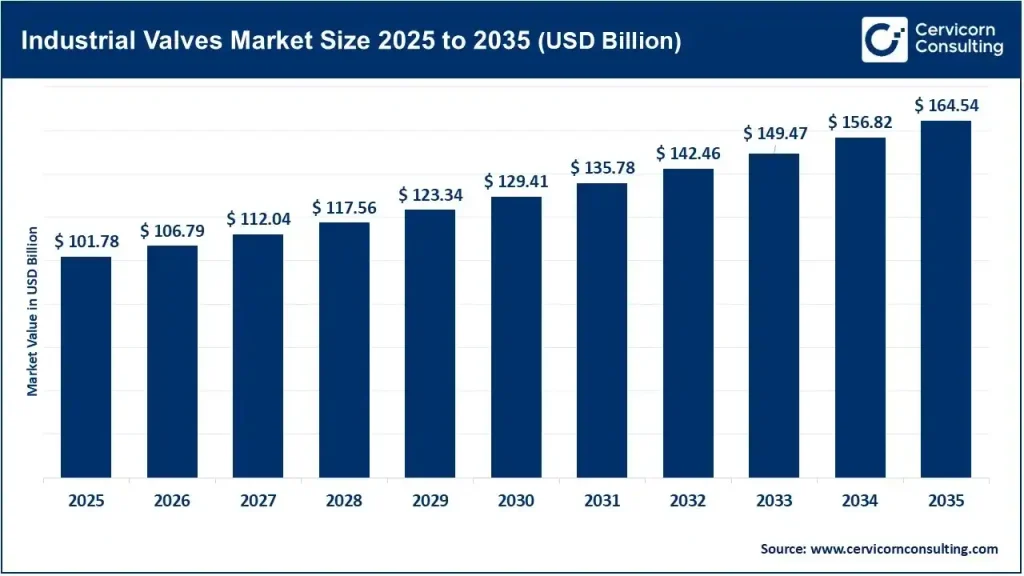
The global industrial valves market was estimated at USD 101.78 billion in 2025 and is projected to reach USD 164.54 billion by 2035, growing at a CAGR of 5.1% from 2026 to 2035. Asia Pacific accounted for 38% of global market revenue in 2025, highlighting the importance of regional manufacturing expansion and infrastructure development.
However, market growth does not translate equally across valve types, applications, or geographies. Manufacturers need to evaluate project pipelines, technical requirements, qualification barriers, pricing pressures, and competitive positioning before committing additional production capacity or entering new markets.
1. Which Industrial Investments Could Generate the Strongest Valve Demand?
Investment activity across energy and infrastructure creates different opportunities depending on the type of valve required, its operating conditions, and the stage of project development.
Oil and gas and LNG infrastructure
Oil and gas facilities require valves for isolation, flow regulation, pressure management, and emergency shutdown across upstream production, pipelines, refineries, and processing plants. LNG infrastructure adds requirements associated with cryogenic temperatures, demanding operating conditions, and stringent safety specifications.
The International Energy Agency’s October 2026 LNG capacity tracker indicates that more than 330 billion cubic metres per year of new LNG export capacity is scheduled to come online between 2025 and 2030 from projects that had reached final investment decision and were under construction as of 2025.
For manufacturers, this creates a reason to assess opportunities in cryogenic valves, high-pressure ball valves, control valves, and other products designed for critical process applications. Yet project announcements alone are insufficient: the timing of engineering contracts, vendor approvals, construction schedules, and actual equipment procurement determines when demand converts into orders.
Business decision: Identify LNG terminals, gas processing facilities, pipeline expansions, and refinery projects where product specifications match existing capabilities. Suppliers with the required certifications, testing facilities, and project references may be better positioned than manufacturers competing primarily on price.
Water and wastewater infrastructure
Water distribution networks, sewage treatment facilities, desalination plants, and industrial water systems require valves across pumping stations, pipelines, treatment processes, and distribution networks.
These applications create demand for gate, butterfly, check, and control valves, with product selection influenced by pipeline diameter, pressure requirements, water chemistry, maintenance access, and operating life.
For suppliers, large infrastructure projects can support recurring orders, but public procurement often involves competitive tendering, strict technical specifications, and pressure on project margins.
Business decision: Evaluate municipal infrastructure spending, project awards, engineering and procurement contractor relationships, and replacement demand. Manufacturers should compare the economics of high-volume standard valves with more specialized products that offer greater differentiation.
Power generation and industrial energy systems
Thermal power plants, nuclear facilities, renewable energy infrastructure, and industrial energy systems require valves for steam, cooling water, fuel, and other process fluids. High-temperature and high-pressure applications can impose demanding requirements on materials, sealing performance, reliability, and maintenance.
As power systems expand and existing facilities undergo upgrades, opportunities may arise in control valves, safety valves, steam-service valves, and specialized isolation products.
Business decision: Prioritize applications that align with manufacturing expertise and applicable quality requirements. Entering highly regulated or safety-critical segments may require substantial investment in certification, engineering, and product validation, so expected contract value must be assessed against qualification costs.
Get a Free Sample: https://www.cervicornconsulting.com/sample/3057
2. Which Valve Categories Offer the Best Strategic Fit?
Not every manufacturer should pursue the same product portfolio. The most attractive category depends on technical capabilities, customer relationships, production economics, and the level of differentiation the business can sustain.
- Ball valves: Relevant to oil and gas, chemical processing, gas distribution, and applications requiring reliable shut-off. Manufacturers should evaluate pressure ratings, sealing performance, materials, and automation compatibility.
- Butterfly valves: Used across water treatment, HVAC, industrial processing, and large-diameter pipeline applications. Competitive positioning depends on size range, pressure class, material selection, and lifecycle performance.
- Gate valves: Commonly used for isolation in water networks, pipelines, and industrial systems. Cost-efficient production, dependable sealing, and tender competitiveness can be important purchasing factors.
- Globe and control valves: Relevant where accurate flow regulation is essential. Engineering expertise, actuator integration, control performance, and application-specific customization can help differentiate suppliers.
- Check valves: Used to prevent reverse flow across water, energy, and industrial processes. Product reliability, pressure loss, installation requirements, and maintenance considerations influence selection.
- Safety and specialized valves: Serve applications with demanding pressure, temperature, fluid compatibility, or safety requirements. Qualification barriers can be higher, but these products may offer manufacturers opportunities to compete through technical expertise rather than price alone.
The strategic question is not simply which valve category is growing fastest. It is which product category offers the best combination of addressable demand, attainable market share, margins, and manufacturing fit.
3. Smart Valves and Automation: Is the Premium Worth the Investment?
Industrial facilities increasingly use automation to improve process consistency, monitor operating conditions, and reduce unplanned downtime. This creates opportunities for actuated valves, digitally enabled control systems, and valve assemblies that integrate with plant automation infrastructure.
However, smart functionality does not guarantee a commercial advantage. Buyers may be unwilling to pay a premium if the technology does not demonstrate measurable operational benefits, straightforward integration, or lower maintenance requirements.
Manufacturers considering investments in smart valve products should assess:
- Compatibility with common industrial control and communication systems.
- Demand for electric, pneumatic, and other actuator configurations.
- Retrofit opportunities in existing facilities.
- Service, calibration, and replacement requirements.
- The willingness of end users and EPC contractors to pay for monitoring and diagnostic capabilities.
A phased strategy may be more commercially viable than a broad technology investment. Manufacturers can begin with automated versions of established products, develop partnerships with actuator and control-system suppliers, and expand into more advanced solutions as customer demand becomes clearer.
4. India as a Manufacturing and Market-Expansion Opportunity
India offers industrial valve manufacturers opportunities across oil and gas, power, chemicals, water infrastructure, and industrial manufacturing. Domestic demand is supported by infrastructure development, while international opportunities depend on product quality, certifications, delivery performance, and competitiveness against established suppliers.
An August 2026 market assessment published by Mordor Intelligence and listed by Research and Markets estimates that India’s industrial valves market will increase from USD 1.56 billion in 2025 to USD 2.34 billion by 2031, representing a CAGR of 6.96% over 2026–2031.
For manufacturers evaluating expansion, the opportunity extends beyond increasing domestic sales. Businesses can assess whether their capabilities support import substitution, supply to international EPC contractors, or entry into selected export markets.
Key considerations include:
- Domestic demand: Identify end-use industries and geographic clusters with sustained project activity.
- Export competitiveness: Compare landed costs, lead times, technical compliance, and distributor access across target countries.
- Manufacturing economics: Assess machining capacity, casting and forging access, testing infrastructure, and production flexibility.
- Customer qualification: Determine the certifications, approved-vendor registrations, and documented project experience needed to secure contracts.
- Product specialization: Evaluate whether higher-value applications offer a more defensible position than undifferentiated standard products.
Expanding capacity before validating customer demand can increase fixed costs without guaranteeing higher utilization. A more disciplined approach connects investment decisions to identifiable projects, target accounts, and achievable order volumes.
5. Competitive Positioning: Where Can Manufacturers Differentiate?
The industrial valve market includes global engineering companies, established domestic manufacturers, specialized product suppliers, and lower-cost competitors. Their relative advantages vary by application and geography.
Buyers typically evaluate more than the initial purchase price. Reliability, compliance, delivery schedules, pressure and temperature performance, spare-parts availability, and after-sales support can influence supplier selection.
Manufacturers should examine five areas of competitive positioning:
- Technical capability: Which pressure classes, materials, diameters, and operating conditions can the business support reliably?
- Certification and approvals: Which industries and projects can the company serve with its existing qualifications?
- Production economics: Where can manufacturing scale, sourcing advantages, or process improvements strengthen margins?
- Service capability: Can the business provide installation support, maintenance, replacement parts, and rapid response?
- Customer access: Does the company have relationships with end users, distributors, engineering firms, and EPC contractors that influence purchasing decisions?
Competitive analysis should also distinguish between suppliers that compete on standard product pricing and those that win through engineering, application knowledge, reliability, or specialized manufacturing. This distinction helps businesses determine whether to invest in cost reduction, technical differentiation, geographic expansion, or strategic partnerships.
6. What Should Procurement and Business Development Teams Evaluate?
For buyers, selecting a valve supplier is a balance between upfront cost, operational risk, compliance, and long-term maintenance. For manufacturers, understanding these purchasing priorities helps shape product development and sales strategies.
Before committing to a new supplier, product line, or target market, decision-makers should evaluate:
- Total cost of ownership rather than purchase price alone.
- Product suitability for the fluid, pressure, temperature, and operating cycle.
- Supplier delivery performance and manufacturing capacity.
- Certification, inspection, testing, and traceability requirements.
- Spare-parts availability and maintenance support.
- Exposure to raw-material price fluctuations and supply-chain disruptions.
- Project timelines, approved-vendor lists, and tender qualification requirements.
Manufacturers can use these factors to refine their value proposition. For example, a supplier serving critical process applications may benefit from demonstrating lower maintenance requirements and dependable delivery, while a supplier targeting municipal infrastructure may need to prioritize tender compliance, standardized products, and competitive production costs.
7. A Practical Framework for Identifying Market-Entry Opportunities
Before entering a new segment or investing in additional capacity, industrial valve companies should compare opportunities using a consistent evaluation framework.
First, validate demand. Track announced and approved infrastructure projects, capital expenditure plans, procurement notices, and project schedules. Separate announced investments from projects that have secured funding and moved toward equipment purchasing.
Second, assess product-market fit. Match the company’s valve portfolio, materials expertise, pressure ratings, testing capabilities, and certifications against the technical requirements of target applications.
Third, measure commercial attractiveness. Estimate addressable demand, competitor concentration, expected pricing, qualification costs, sales-cycle length, and likely order volumes.
Fourth, evaluate market access. Identify the EPC contractors, distributors, system integrators, and end users that influence specifications and supplier selection.
Finally, establish investment milestones. Link capacity expansion, new product development, and geographic entry to measurable evidence such as customer qualification, project awards, pilot orders, and repeat business.
This approach reduces the risk of pursuing large but poorly matched markets and helps management direct resources toward opportunities the company can realistically win.
Conclusion
The industrial valves market is expected to expand as investment continues across energy, water infrastructure, industrial processing, and automation. Yet the strongest commercial opportunities will differ according to product requirements, project timing, technical qualifications, and competitive conditions.
For manufacturers, the priority is to identify the intersection between growing demand and existing or attainable capabilities. For procurement teams, supplier selection must account for operational reliability, lifecycle costs, compliance, and delivery risk. For business development leaders, understanding project pipelines and purchasing structures can improve account prioritization and sales planning.
Companies that connect market demand with product-level economics, customer qualification requirements, and competitor positioning will be better equipped to make disciplined decisions on capacity expansion, product development, and market entry.
To Get Detailed Overview, Contact Us: https://www.cervicornconsulting.com/contact-us
Read Report: Data Center Energy Storage Systems Market: Where Should Companies Invest as AI Power Demand Reshapes Infrastructure?