


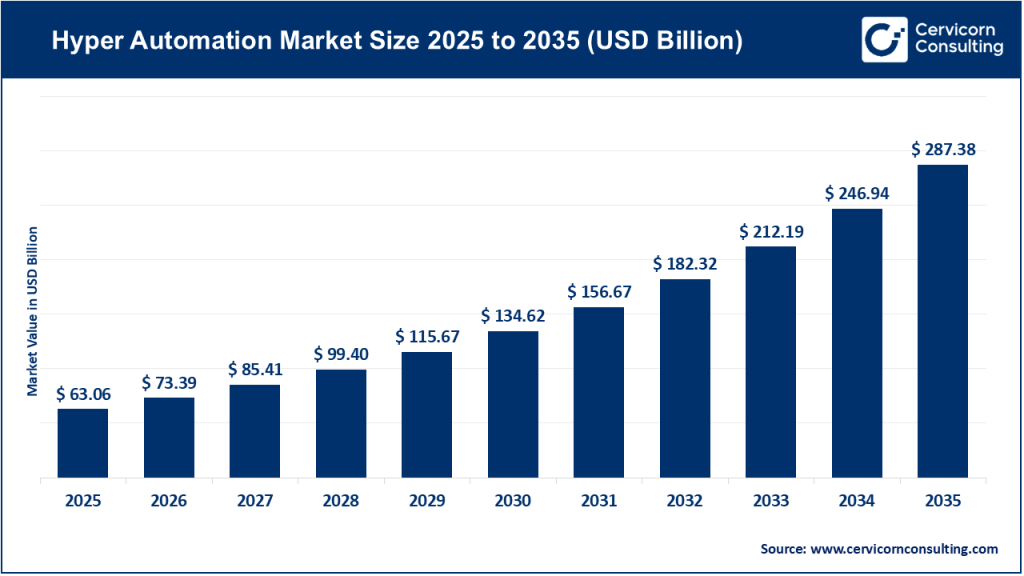
Hyperautomation Market Size
The global hyperautomation market size was worth USD 63.06 billion in 2025 and is anticipated to expand to around USD 287.38 billion by 2035, registering a compound annual growth rate (CAGR) of 16.4% from 2026 to 2035.
Hyperautomation Market – What It Is and Why It Matters
At its core, hyperautomation refers to the use of multiple technologies — such as RPA, AI, ML, process mining, low-code/no-code platforms, and smart analytics — to automate business processes in ways that humans previously couldn’t. It doesn’t stop at automating a single task; it orchestrates workflows across departments, systems, and data sources to create integrated and adaptive systems that can decide, optimize, and learn.
Traditional automation often automates routine, rule-based tasks. Hyperautomation, on the other hand:
-
Automates complex processes that combine structured and unstructured data
-
Uses AI/ML to make context-aware decisions rather than just follow scripts
-
Includes process discovery and mining to identify opportunities for automation before implementation
-
Provides analytics and monitoring to constantly refine and optimize workflows
The importance of hyperautomation cannot be overstated: it helps organizations reduce errors, optimize operational costs, improve scalability, accelerate digital transformation, and enhance customer satisfaction. In industries such as banking, insurance, healthcare, manufacturing, and telecom, where transactional volumes are huge and decision complexity is high, hyperautomation delivers measurable ROI through faster cycle times, reduced risk, and improved compliance.
Get a Free Sample: https://www.cervicornconsulting.com/sample/2906
Hyperautomation Market Growth Factors
The hyperautomation market is expanding rapidly due to a convergence of technological, organizational, and competitive forces. Some of the key growth factors driving this market include the increasing demand for process efficiency, a surge in cloud adoption, the need to handle both structured and unstructured data, rising digital transformation investments, and the adoption of AI and ML to support intelligent decision-making. As organizations continue to expand automation beyond isolated tasks into enterprise-wide orchestration, hyperautomation becomes essential to deliver agility, resilience, and scale. Businesses are also under pressure to reduce operational costs, manage distributed workforces, and meet customer expectations for speed and quality — all of which feed directly into hyperautomation adoption. Furthermore, the expansion of cloud infrastructure, availability of low-code platforms, and growing integration of AI agents that can interpret natural language are creating fertile ground for hyperautomation to flourish across industries and regions.
Key Hyperautomation Companies (Profiles)
1. UiPath
-
Specialization & Key Focus Areas: UiPath is a pure-play automation provider focused on enterprise robotic process automation (RPA) and hyperautomation platforms. Its strength lies in end-to-end automation orchestration, including process discovery, task mining, AI-assisted workflow generation, and integration with cloud and AI services. It targets industries such as financial services, healthcare, telecommunications, and manufacturing.
-
Notable Features: UiPath’s platform includes intuitive drag-and-drop automation design, AI Center for integrating ML models, AI-driven Autopilot features, and governance tools that make enterprise-grade deployments manageable.
-
2024 Revenue & Market Share: In 2024, UiPath generated approximately USD 1.4 billion in revenue, capturing around 7% of the global hyperautomation market.
-
Global Presence: Headquartered in the USA, UiPath operates globally with users across North America, Europe, Asia Pacific, and beyond, and maintains strong partnerships with cloud providers like Microsoft and Google.
2. Automation Anywhere
-
Specialization & Key Focus Areas: Automation Anywhere specializes in cloud-native RPA and intelligent automation solutions designed for both enterprise and SME customers. The company emphasizes agent-based automation, AI integration, and cloud-first deployment models.
-
Notable Features: Its Intelligent Automation Platform embeds AI and analytics, offers bot orchestration and lifecycle management, and supports automation discovery and analytics.
-
2024 Revenue & Market Share: Automation Anywhere reported revenues in the realm of USD 0.92 billion in 2024, with a market share of around 4.6%.
-
Global Presence: With headquarters in North America, Automation Anywhere serves a global customer base with strong footprints in Europe, Asia Pacific, and Latin America, supported by a growing partner ecosystem.
3. Microsoft
-
Specialization & Key Focus Areas: Microsoft is a major force in the hyperautomation market through its Power Platform, including Power Automate, Power Apps, and AI-infused tools. Its integration with Microsoft 365, Azure, and Copilot capabilities makes it a go-to choice for enterprises leveraging Microsoft ecosystems.
-
Notable Features: Microsoft’s Power Automate extends automation beyond bots — offering AI builders, connectors across hundreds of applications, and low-code automation features that non-developers can use.
-
2024 Revenue & Market Share: Microsoft as a whole reported revenue exceeding USD 245 billion in FY24; its automation and Power Platform segments contribute significantly to the broader hyperautomation ecosystem, accounting for an estimated 18% market share in 2024.
-
Global Presence: Microsoft’s hyperautomation offerings have a worldwide presence, powered by Azure data centers and a broad enterprise user base spanning North America, EMEA, Asia Pacific, and emerging markets.
4. IBM
-
Specialization & Key Focus Areas: IBM’s hyperautomation strategy is centered on enterprise-grade automation across business and IT processes. Its IBM Cloud Pak for Business Automation integrates RPA, workflow, document processing, and AI capabilities.
-
Notable Features: Focus on intelligent document processing, AI-driven workflows, and automated decision-making tools. IBM also emphasizes secure, scalable automation for regulated industries.
-
2024 Revenue & Market Share: IBM contributed around USD 2.2 billion in automation-related revenues in 2024, with an estimated 11% share of the global market.
-
Global Presence: IBM operates across more than 170 countries, and its hyperautomation solutions are deployed in banking, healthcare, retail, and government sectors globally.
5. SAP
-
Specialization & Key Focus Areas: SAP’s approach to hyperautomation revolves around integrating process automation directly into enterprise resource planning (ERP) and business suite systems. Its SAP Build Process Automation allows users to automate workflows that bridge front-office and back-office systems.
-
Notable Features: Deep integration with SAP S/4HANA ERP, extensible automation workflows that support business processes like order-to-cash, procure-to-pay, and HR operations.
-
2024 Revenue & Market Share: SAP’s automation segment generated roughly USD 1.1 billion in relevant revenues in 2024, capturing around 5.5% of the market.
-
Global Presence: SAP’s enterprise automation footprint spans Europe, Asia Pacific, North America, and Latin America, with strong adoption among large enterprises and global corporations.
Leading Trends in the Hyperautomation Market & Their Impact
1. AI-Driven Automation and Generative AI Integration
AI and machine learning are central to hyperautomation. Intelligent automation tools now incorporate predictive analytics, natural language understanding, and generative AI to interpret unstructured data, build workflows from written instructions, and respond to customer needs autonomously.
Impact: Enterprises can reduce manual exceptions, increase accuracy, and accelerate automation deployment without extensive coding. It also enables self-healing workflows that identify and correct issues automatically.
2. Cloud-Based Automation Platforms
Cloud deployments are dominating hyperautomation because they deliver scalability, remote access, pay-as-you-grow pricing, and rapid updates.
Impact: Cloud adoption democratizes access to advanced automation tools, enabling organizations of all sizes to implement intelligent workflows faster and with lower upfront costs.
3. Intelligent Document Processing (IDP)
Automation technologies now include IDP tools that extract insights from unstructured content — such as invoices, contracts, emails, and PDFs — using computer vision and NLP.
Impact: IDP expands automation into knowledge work and accelerates processing cycles in areas like finance, HR, and customer support where unstructured data dominates.
4. Process Discovery and Task Mining
Platforms are increasingly capable of discovering automation opportunities by analyzing user behavior, system logs, and process details.
Impact: This reduces guesswork, shortens implementation times, and increases ROI by automating high-impact areas.
Successful Hyperautomation Use Cases Around the World
1. Banking & Financial Services
Banks use hyperautomation to streamline KYC (Know Your Customer), loan processing, fraud detection, AML compliance, and customer onboarding. Combining RPA with AI analytics and NLP accelerates approval times while minimizing risk.
2. Healthcare Administration
Hospitals and health systems leverage hyperautomation to automate patient registration, claims processing, billing reconciliation, and clinical documentation. AI-driven IDP tools have reduced administrative bottlenecks and improved patient care delivery.
3. Manufacturing & Supply Chain
Manufacturers use hyperautomation to coordinate production planning, inventory forecasting, quality control, and logistics orchestration. Intelligent bots monitor IoT sensor data, trigger maintenance workflows, and optimize resource allocation.
4. Telecom & Customer Support
Telecom companies use hyperautomation for network monitoring, ticket routing, automated troubleshooting bots, and customer service chatbots powered by generative AI, reducing support costs and improving time-to-resolution metrics.
Global Regional Analysis, Government Initiatives & Policies
North America
North America is the largest regional hyperautomation market, accounting for approximately 36–38% of global revenue. Strong enterprise digital maturity, capital investment, and broad adoption of AI and cloud services drive growth. Government initiatives, including digital infrastructure investments, AI research funding, and supportive regulatory frameworks, encourage adoption.
Europe
Europe represents the second largest share (around 25–30%), driven by manufacturing and financial services adoption. European governments promote Industry 5.0 and digital transformation initiatives, encouraging automation, smart factories, and workforce productivity. Regulatory frameworks such as GDPR and responsible AI policies shape implementation with accountability and privacy in mind.
Asia Pacific
Asia Pacific is one of the fastest-growing regions, fueled by digital transformation in manufacturing, telecommunications, retail, and government sectors, especially in China, India, Japan, and South Korea. National initiatives prioritize automation technologies for industrial competitiveness, and India’s SME and IT services adoption also drive growth.
Latin America
Latin America, with around 6–10% of global share, is growing in Brazil, Mexico, and Colombia, particularly in financial services and public sector digitization. Digital banking transformation, e-government strategies, and cloud adoption accelerate implementations.
Middle East & Africa
Middle East & Africa’s share is smaller (~4–6%) but growing rapidly in nations like UAE and Saudi Arabia. National visions such as UAE Vision 2031 and Saudi Vision 2030 promote digital transformation, AI adoption, and automation in governance, utilities, and urban services.
Summary
The global hyperautomation market continues to expand, driven by AI integration, cloud-native deployments, and enterprise demand for efficiency and agility. Organizations worldwide are transforming operational landscapes, while key players like UiPath, Automation Anywhere, Microsoft, IBM, and SAP are shaping the market with specialized product portfolios and global footprints. With governments and industries embracing digital modernization, hyperautomation is set not just to automate processes but to reinvent how work gets done at scale, enabling smarter decisions, faster outcomes, and pervasive innovation across sectors.
To Get Detailed Overview, Contact Us: https://www.cervicornconsulting.com/contact-us
Read Report: Lubricants Market Revenue, Trends, and Strategic Insights by 2035