


Humanoid robot batteries: What manufacturers need to solve before scaling from prototypes to commercial deployment
Humanoid robots are moving from research demonstrations toward industrial and commercial deployment, but scaling a capable robot is not simply a matter of improving AI, actuators, or dexterity. The battery increasingly determines how long the robot can work, how much it can carry, how quickly it can recharge, and how economically it can operate.
This is creating a different set of requirements for battery suppliers and humanoid robot manufacturers. A battery designed for an electric vehicle cannot automatically be optimized for a humanoid robot, where weight, volume, center of gravity, peak power, thermal management, safety, and mechanical movement all interact.
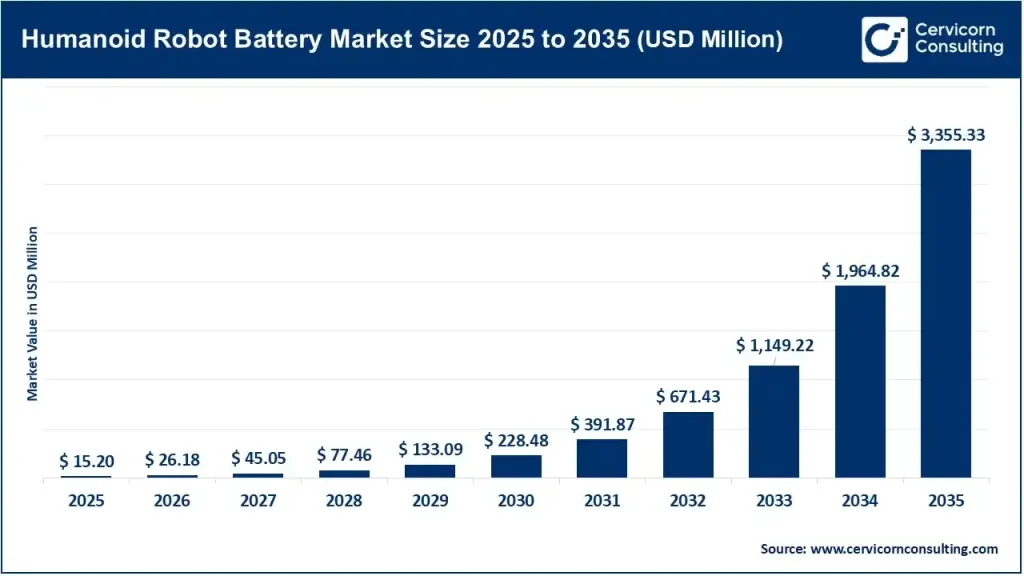
The global humanoid robot battery market was valued at USD 15.20 million in 2025 and is projected to reach nearly USD 3.36 billion by 2035, expanding at a CAGR of 71.5% from 2026 to 2035.
The important question for companies is therefore not simply which battery chemistry will win? It is which battery architecture can deliver commercially useful operating time without making the robot too heavy, expensive, or difficult to manufacture?
Runtime is becoming a system-level constraint
Many current humanoid robots operate with relatively small battery packs because the robot has to carry its own energy source while simultaneously allocating weight and space to motors, actuators, sensors, computing hardware and structural components.
Independent industry analysis indicates that many current humanoid robots operate for only around two to four hours, while battery capacities are often below 2 kWh. Increasing operating time therefore requires either substantially higher energy density or operational strategies such as battery swapping.
This creates a difficult trade-off.
Increasing battery capacity can extend operating time, but additional cells also add mass. A heavier robot requires more energy to move, potentially reducing some of the runtime gained from the larger battery.
For manufacturers, battery development therefore needs to be evaluated alongside:
- Robot weight and payload
- Actuator power requirements
- Walking and movement patterns
- Computing and AI workload
- Charging infrastructure
- Thermal conditions
- Required operating cycle
- Battery replacement or swapping strategy
A battery target should consequently be derived from the robot’s mission profile, rather than selected independently as a component specification.
Get a Free Sample: https://www.cervicornconsulting.com/sample/3049
The 1–2.5 kWh battery is dominant today, but higher capacity is gaining ground
The 1–2.5 kWh battery capacity segment accounted for 58% of the humanoid robot battery market in 2025. Its position reflects the need to balance energy availability with weight, size and portability.
However, this balance is beginning to shift as humanoid robots move toward industrial applications.
The 2.5–5 kWh segment is projected to increase from 24% of the market in 2025 to 38% by 2035. Longer working cycles in manufacturing, logistics and other high-utilization environments are likely to increase the value of additional onboard energy.
For battery developers, this suggests that future demand may not simply mean producing larger versions of today’s packs. The opportunity is to increase usable energy while controlling:
energy density → pack weight → thermal load → charging time → usable operating hours.
That equation will become increasingly important as robots move from demonstrations to paid work environments.
High-nickel batteries lead, but solid-state is changing the technology roadmap
High-nickel NMC/NCA batteries accounted for 72% of the humanoid robot battery chemistry market in 2025, supported by their energy density, power characteristics and established manufacturing ecosystem.
This gives conventional lithium-ion technology a strong near-term position.
However, the longer-term technology roadmap looks different. Cervicorn’s analysis projects solid-state and semi-solid-state batteries to increase from 5% of the market in 2025 to 30% by 2035.
The reason is straightforward: humanoid robots have unusually tight constraints on both weight and available internal volume.
A technology capable of storing more energy in the same physical envelope could allow manufacturers to extend operating time without proportionally increasing robot mass.
Recent industry developments are reinforcing this direction. In March 2026, Samsung SDI presented a pouch-type all-solid-state battery sample under development for physical-AI applications such as humanoid robots.
Research published in 2026 also points to the scale of the challenge: commercial humanoid applications could require 10+ kWh of energy, potentially demanding next-generation systems with specific energy above 1,000 Wh/L.
This does not mean solid-state batteries will immediately replace high-nickel lithium-ion systems. Instead, companies need to determine where conventional lithium-ion reaches its practical limits and where next-generation chemistry becomes economically justified.
Battery form factor is becoming an engineering decision
The cell itself is only part of the equation. How those cells are packaged inside a humanoid robot can affect weight distribution, thermal performance, structural design and available space.
Cylindrical cells held the largest share of the market in 2025 at 42%, while pouch cells accounted for 38%. Cervicorn projects pouch cells to increase to 44% by 2035, compared with 36% for cylindrical cells.
This shift is significant because humanoid robots have irregular internal spaces that are very different from conventional battery applications.
Pouch technology can provide greater packaging flexibility, while cylindrical cells benefit from standardized manufacturing and mechanical durability.
For robot manufacturers, the decision should therefore consider more than cell cost. Key questions include:
- How efficiently can the battery occupy available internal volume?
- Where should the battery mass be positioned?
- How will the pack affect the robot’s center of gravity?
- Can individual modules be replaced easily?
- How will heat be removed during high-load movement?
- Can the architecture be scaled into mass production?
The best-performing cell on paper may not necessarily produce the best-performing robot.
Battery management systems are becoming more important
As battery packs become more tightly integrated with robotic systems, battery management cannot remain a secondary function.
Battery cells represented 68% of the battery component market in 2025, while battery management systems accounted for 12%.
For humanoid robots, the BMS has to monitor more than conventional charging and discharge parameters. It can become an important part of managing temperature, battery health, available power and operating safety while the robot is performing unpredictable physical tasks.
A robot carrying a load, climbing stairs, walking continuously or performing repetitive high-force movements can produce very different power profiles.
That makes real-time battery intelligence increasingly relevant to:
- State-of-charge estimation
- Thermal monitoring
- Cell balancing
- Fast-charging control
- Remaining useful life estimation
- Peak-power management
- Fault detection
- Safe battery operation
The strategic implication is that battery suppliers may increasingly compete on battery-plus-management architecture, rather than cells alone.
Thermal management cannot be separated from fast charging
Fast charging sounds attractive for industrial robots because shorter charging periods can increase utilization. But charging speed and thermal performance are closely connected.
A battery that can accept high charging power must also manage the heat generated during charging and subsequent high-load operation.
This is particularly important when robots are expected to work multiple shifts or operate with limited downtime.
Recent developments already show this direction. Figure AI’s F.03 battery system incorporates a custom BMS and active cooling alongside a focus on energy density, safety and fast charging.
For manufacturers, the relevant metric is therefore not simply charging time.
A more useful evaluation is:
charging time + thermal recovery + usable runtime + cycle life + productivity per shift.
This provides a better basis for comparing battery technologies for real industrial deployment.
Battery swapping could become a bridge technology
There is another way to address the runtime problem: instead of requiring a single battery to support an entire shift, manufacturers can design robots around replaceable or swappable battery packs.
This approach can reduce the immediate requirement for extremely high energy density while allowing continuous operation.
Research into next-generation humanoid batteries also identifies standardized and swappable battery packs as an important interim solution while higher-capacity technologies mature.
For industrial operators, however, swapping introduces additional considerations:
- How quickly can the pack be replaced?
- Does the battery require cooling before removal?
- How many spare packs are required per robot?
- What charging infrastructure is needed?
- How does frequent swapping affect battery life?
- Can packs be standardized across robot models?
Battery swapping may therefore become less of a workaround and more of an operational architecture for early commercial humanoid fleets.
Industrial applications will put the greatest pressure on battery performance
The industrial/manufacturing segment accounted for 42% of the humanoid robot battery market in 2025, while logistics and warehousing represented 28%.
These applications have a common requirement: robots need to perform useful work repeatedly rather than simply demonstrate mobility.
A robot operating inside a factory may need to pick components, move materials, perform inspection or assist with assembly. In a warehouse, it may repeatedly walk, pick, sort and transport items.
That changes how battery performance should be measured.
Instead of asking only:
How many hours can the robot run?
Companies increasingly need to ask:
How much productive work can the robot complete per charge?
This distinction matters because two robots with identical battery capacities may deliver very different productivity depending on their mechanical efficiency, payload, movement patterns and AI workload.
Regional battery strategies are also diverging
Asia-Pacific accounted for 50% of the humanoid robot battery market in 2025, making it the leading regional market, and is projected to reach 57% by 2035. North America followed with a 37% share in 2025.
Asia-Pacific benefits from the combination of battery manufacturing, electronics supply chains, industrial automation and robotics development.
North America, meanwhile, has strong investment across AI, robotics, advanced manufacturing and technology companies developing commercial humanoid platforms.
This creates different strategic opportunities for suppliers.
Battery manufacturers in Asia-Pacific can leverage established cell and electronics ecosystems to support customized robotic battery production. North American companies may place greater emphasis on localized supply, high-performance systems and integration with emerging robotics platforms.
For global suppliers, understanding where robot production will scale and where battery manufacturing capacity is available may become as important as tracking battery chemistry.
What battery companies should prioritize before the humanoid market scales
The rapid growth forecast for the humanoid robot battery market creates an attractive opportunity, but it also increases the risk of investing in the wrong technology too early.
A more practical development framework is to evaluate battery solutions across five dimensions:
1. Energy density versus robot weight
Higher capacity has limited value if additional battery mass significantly increases energy consumption during movement.
2. Peak power versus continuous power
A humanoid may require short periods of high power for movement while needing lower continuous power for computing, sensing and control.
3. Charging speed versus thermal performance
Fast charging can improve utilization, but only when heat generation and battery degradation remain manageable.
4. Battery technology versus production readiness
Solid-state and other advanced technologies may offer substantial performance advantages, but manufacturing scale, yield, cost and reliability remain important commercialization variables.
5. Battery performance versus total robot economics
The most advanced battery is not necessarily the best commercial battery. The relevant measure is whether the additional battery cost produces enough additional productivity, runtime or reliability to justify the investment.
The battery opportunity is shifting from component supply to system integration
The humanoid robot battery market is growing rapidly, but the larger opportunity may be in designing batteries around the robot’s complete operating architecture.
Battery suppliers are already moving in this direction. CATL announced in June 2026 that its batteries were being used in Galbot’s S1 humanoid robot, which the company said could support up to eight hours of continuous operation in production-line material handling and picking applications.
Meanwhile, battery companies including LG Energy Solution, Samsung SDI and others are increasingly exploring robotics as an application beyond traditional electric vehicles and energy storage.
This suggests that the next competitive advantage may not come from simply producing a battery with higher energy density.
It may come from answering a broader question:
Can the battery, thermal system, BMS, charging architecture and robot design work together to deliver predictable productivity at an acceptable cost?
For humanoid robot manufacturers, battery selection is becoming a product-design decision. For battery companies, humanoid robotics is becoming an application-specific market where customization, integration and production scalability could matter as much as cell chemistry.
The companies that understand this transition early will be better positioned to determine which battery technologies are commercially viable now, which require further development, and where the next wave of demand is likely to emerge.
To Get Detailed Overview, Contact Us: https://www.cervicornconsulting.com/contact-us
Read Report: Where are the biggest growth opportunities in data center IT as AI scales?