


Healthcare Supply Chain Management: 6 Decisions That Can Help Companies Reduce Costs and Prevent Disruptions
A hospital runs short of a critical medical device. A pharmaceutical distributor holds excess inventory of a slow-moving product while another item faces a supply shortage. A manufacturer receives an unexpected order but cannot secure the components needed to meet delivery commitments.
These problems may appear unrelated, but they often point to the same underlying issue: healthcare supply chains need to balance product availability, cost control, traceability and operational resilience at the same time.
Healthcare supply chain management covers everything from sourcing medicines, medical devices and consumables to storing, tracking and delivering them to the point of use. As healthcare networks expand and product portfolios become more complex, managing these activities through disconnected systems and manual processes becomes increasingly difficult.
The financial implications are significant. Poor inventory visibility can tie up working capital, expired products can create avoidable losses, and unreliable suppliers can interrupt clinical operations or manufacturing schedules.
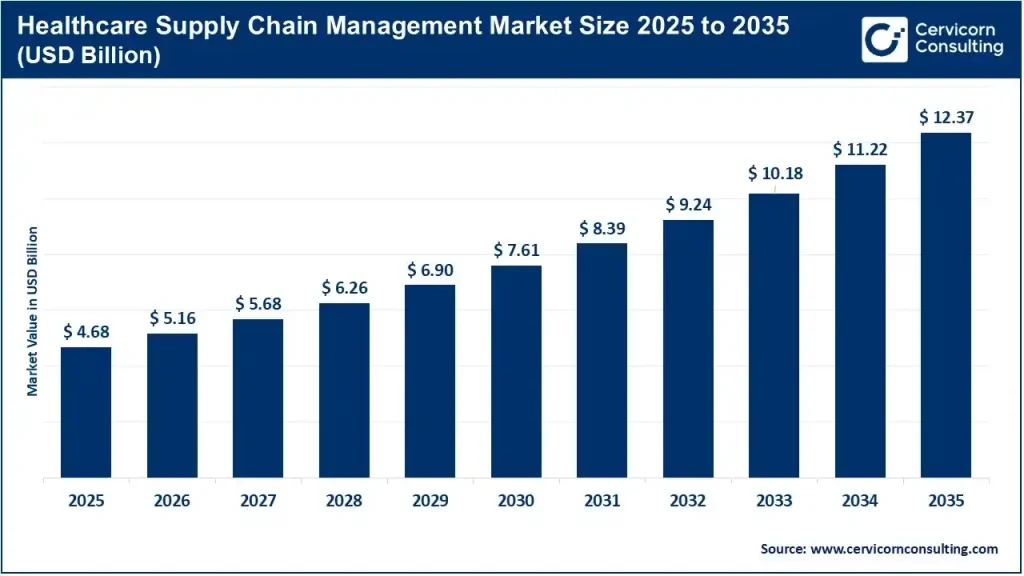
The global healthcare supply chain management market was valued at $4.68 billion in 2025 and is projected to reach $12.37 billion by 2035, growing at a compound annual growth rate (CAGR) of 10.2% from 2026 to 2035.
For healthcare providers, pharmaceutical companies, medical-device manufacturers and logistics providers, the important question is not simply whether to digitize supply chain operations. It is which decisions will produce measurable improvements in cost, availability and reliability.
1. Should Inventory Be Optimized for Cost or Product Availability?
Inventory decisions are particularly difficult in healthcare because the cost of running out of a product can be much greater than the cost of storing it.
Hospitals need to maintain access to critical medicines, surgical instruments and emergency supplies. Pharmaceutical manufacturers must secure raw materials and packaging components, while distributors need sufficient stock to respond to changing customer demand.
However, maintaining excessive inventory creates its own problems, including storage expenses, working-capital pressure, product expiry and obsolescence.
Companies should begin by distinguishing products according to their operational importance rather than applying the same inventory policy across every item.
Three considerations can help:
- Clinical or operational criticality: Which products could interrupt patient care or production if unavailable?
- Demand variability: Which products experience seasonal fluctuations, unpredictable orders or sudden increases in consumption?
- Supply risk: Which items depend on a single supplier, long lead times or temperature-controlled transportation?
Critical products with uncertain replenishment times may justify higher safety-stock levels or alternative suppliers. Predictable, frequently used consumables may be better suited to automated replenishment and tighter inventory controls.
The objective is not to minimize inventory indiscriminately. It is to maintain the right products, in the right quantities, at the right locations.
Decision for companies: Review stockout frequency, inventory turnover, expiry losses and days of inventory on hand together. A lower inventory balance is not necessarily an improvement if shortages become more frequent.
Get a Free Sample: https://www.cervicornconsulting.com/sample/3063
2. Is Procurement Delivering the Lowest Cost or the Best Total Value?
Healthcare procurement teams often negotiate prices across large volumes of medicines, medical devices, diagnostic products and consumables. Yet the lowest purchase price does not always translate into the lowest operating cost.
A supplier offering a lower unit price may have inconsistent delivery performance, higher rejection rates or longer replenishment times. These issues can lead to emergency purchases, production delays, additional inspections and excess safety stock.
Procurement decisions should therefore consider total cost of ownership rather than purchase price alone.
Companies can evaluate suppliers using a broader set of criteria:
- Unit price and contract terms.
- On-time delivery and order fulfilment rates.
- Product quality and regulatory documentation.
- Lead-time consistency and capacity availability.
- Geographic exposure and dependence on critical suppliers.
- Responsiveness during unexpected disruptions.
Supplier diversification also deserves attention. Relying on a single source may simplify purchasing and improve negotiated pricing, but it can leave an organization exposed when that supplier experiences production problems or transportation delays.
Dual sourcing is not automatically the right solution for every product. Qualification costs, quality requirements and regulatory obligations may make additional suppliers impractical for some categories.
Decision for companies: Identify the products for which supplier failure would have the greatest financial or operational consequences. Prioritize those categories for supplier-risk assessments, contract reviews and contingency planning.
3. Can Demand Forecasting Improve Before More Inventory Is Purchased?
Demand forecasting is difficult in healthcare because consumption does not always follow predictable patterns. Seasonal illnesses, treatment schedules, changing clinical preferences, new product introductions and unexpected patient volumes can all affect demand.
Forecasting problems become more serious when purchasing teams, warehouse managers and suppliers work with different data. A hospital may record consumption in one system while its procurement team relies on historical purchase orders that do not accurately reflect actual usage.
Better forecasting starts with better inputs.
Companies should combine historical consumption with current inventory, outstanding orders, supplier lead times, planned procedures, seasonal trends and relevant changes in demand. Where appropriate, analytics and artificial intelligence can help identify unusual patterns and improve replenishment recommendations.
However, predictive tools are only as useful as the information available to them. Incomplete product records, inconsistent units of measurement and inaccurate stock balances can undermine even sophisticated forecasting models.
A practical approach is to begin with product categories that have high spending, frequent shortages or substantial demand variability. Improvements can then be measured before the approach is extended across the wider supply chain.
Decision for companies: Measure forecast accuracy alongside stockout rates and emergency purchasing. Better forecasting should help the organization make more reliable replenishment decisions, not simply produce more detailed reports.
4. Is Supply Chain Visibility Sufficient Across the Entire Network?
Knowing how much inventory is held in a central warehouse is not the same as knowing where every critical product is, whether it is usable and when it will reach its destination.
This distinction matters when healthcare organizations operate multiple hospitals, distribution centres, manufacturing sites and third-party logistics networks.
Limited visibility can lead to one facility purchasing additional stock while another holds surplus inventory. Shipments may be delayed without early warning, and temperature-sensitive products can be exposed to conditions that compromise their quality.
Digital supply chain platforms can connect procurement, inventory, order management and transportation data. Barcode scanning, RFID, IoT sensors and shipment-tracking systems can improve the accuracy and timeliness of product information.
Yet companies should avoid investing in technology simply to collect more data. Visibility is valuable when it enables teams to take action.
For example, a system that identifies an impending shortage should help the relevant team determine whether stock can be transferred from another facility, an order can be expedited or an approved alternative supplier can be used.
Decision for companies: Map the journey of selected critical products from supplier to point of use. Identify where status information becomes unavailable, where records are updated manually and where delays are discovered too late.
5. Which Supply Chain Technologies Justify Investment First?
The range of available technologies can make investment decisions difficult. Healthcare organizations may be considering cloud-based supply chain software, warehouse automation, predictive analytics, RFID, integrated procurement systems or advanced logistics monitoring.
Implementing every available technology at once can increase costs and create additional integration challenges.
The better approach is to connect each investment to a clearly defined operational problem.
For example:
- Inventory management software can help when stock records are inaccurate or replenishment is inconsistent.
- Procurement automation can help reduce manual purchase-order processing and improve contract compliance.
- Demand forecasting tools can support planning when demand patterns are difficult to predict.
- RFID and barcode systems can improve product identification and inventory accuracy.
- Temperature-monitoring solutions can help maintain appropriate conditions during storage and transportation.
- Cloud-based platforms can support coordination across multiple sites, subject to security, integration and compliance requirements.
Cervicorn Consulting’s market analysis estimates that software accounted for 48% of healthcare supply chain management market revenue in 2025, while cloud-based deployment represented 58%. Procurement and purchasing management was the largest functional segment, with a 28% share.
These figures indicate where spending is concentrated, but market share alone does not establish which solution will deliver the strongest return for a particular organization.
Before approving an investment, decision-makers should evaluate implementation costs, integration requirements, training, cybersecurity, ongoing maintenance and expected operational savings.
Decision for companies: Establish a baseline for the problem being addressed, define measurable success criteria and test the solution in a focused operational setting before expanding deployment.
6. How Should Companies Prepare for Future Supply Chain Disruptions?
Healthcare supply chains face risks that extend beyond routine purchasing and transportation. Supplier capacity constraints, geopolitical uncertainty, regulatory changes, product recalls and interruptions in the availability of specialized materials can affect the entire network.
For pharmaceutical and biotechnology companies, temperature-sensitive products and specialized manufacturing inputs introduce additional complexity. Medical-device manufacturers may depend on components sourced from a limited number of qualified suppliers. Healthcare providers must also ensure that essential products remain available across departments and facilities.
Resilience requires more than holding additional inventory. It involves understanding where vulnerabilities exist and deciding how the organization will respond when normal supply arrangements fail.
Companies can strengthen preparedness by:
- Mapping critical products to their upstream suppliers and manufacturing locations.
- Identifying single-source dependencies and long replenishment cycles.
- Establishing alternative supply arrangements where commercially and operationally feasible.
- Defining minimum service levels and escalation procedures for critical shortages.
- Reviewing cold-chain requirements, product traceability and recall procedures.
- Testing contingency plans through realistic disruption scenarios.
The financial trade-off deserves attention. Additional suppliers, reserve inventory and alternative logistics arrangements can increase operating costs. However, these expenses should be assessed against the potential consequences of prolonged shortages, interrupted production or emergency procurement.
Decision for companies: Rank supply chain risks by likelihood, operational impact and recovery time. Direct resilience investments toward the vulnerabilities that could cause the greatest disruption rather than treating every product and supplier as equally risky.
What Should Healthcare Companies Prioritize Over the Next 12 Months?
The right priorities will differ depending on whether an organization is a hospital network, pharmaceutical manufacturer, medical-device company or logistics provider. However, a structured review can help decision-makers move from broad digitalization plans to specific operational improvements.
A practical starting point is to organize the next 12 months into three stages.
First 90 days: Establish the baseline
- Identify the products responsible for the largest inventory costs and most frequent shortages.
- Review supplier performance, stock accuracy, expiry losses and emergency purchases.
- Map gaps between procurement, warehouse, finance and operational systems.
Months 4–6: Address the highest-impact problems
- Reassess inventory policies for critical products.
- Review supplier concentration and alternative sourcing options.
- Select a targeted technology or process improvement based on measurable operational needs.
Months 7–12: Validate and expand
- Compare results against the original baseline.
- Evaluate changes in stockouts, inventory carrying costs, order fulfilment and procurement cycle times.
- Expand successful interventions to additional facilities or product categories where the business case supports it.
The objective is to avoid measuring progress solely through technology adoption or implementation milestones. The more meaningful indicators are whether products are available when needed, operating costs are controlled and disruptions can be managed more effectively.
Conclusion
Healthcare supply chain management is becoming an increasingly important operational priority as healthcare networks grow, product portfolios expand and expectations for reliable delivery increase.
The challenge is to balance competing objectives: lower purchasing costs, adequate inventory, reliable suppliers, product traceability and uninterrupted access to essential supplies.
Companies that make progress in these areas do not necessarily need to replace every existing system. They need to understand where their most significant inefficiencies and vulnerabilities lie, select appropriate interventions and measure the results.
Market expansion also creates opportunities for software vendors, automation providers, logistics companies and supply chain technology developers. For these businesses, understanding which functions healthcare organizations prioritize, which deployment models they prefer and which end-user segments face the greatest operational pressure can help inform product development, market entry and commercial planning.
The central decision is straightforward: invest in the supply chain problems that create the greatest operational and financial risk, and use measurable outcomes to determine what should happen next.
To Get Detailed Overview, Contact Us: https://www.cervicornconsulting.com/contact-us
Read Report: 800G Optical Transceiver Market: Where Should Companies Invest as AI Networking Demand Accelerates?