


Green Data Center Market Size
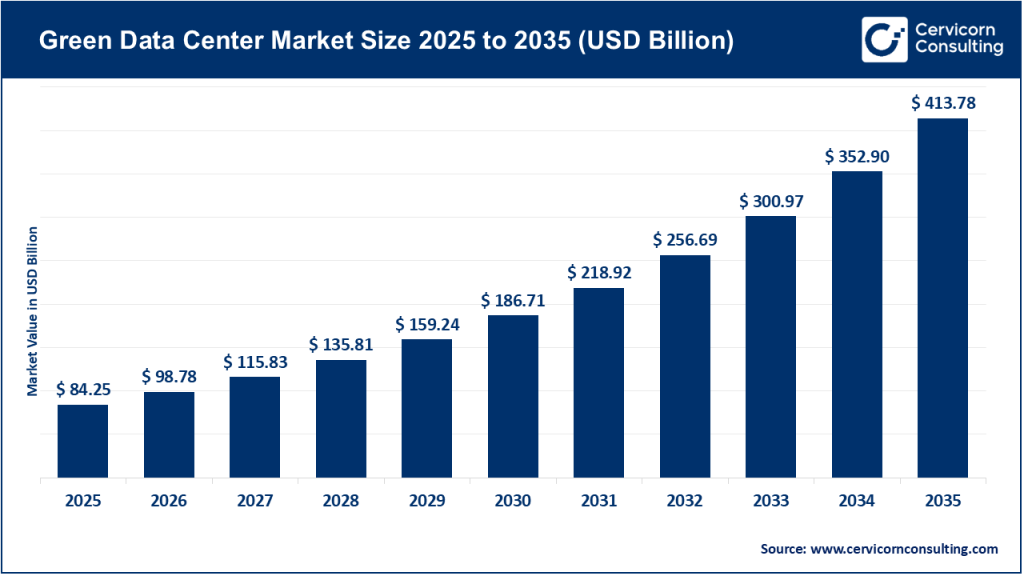
The global green data center market size was worth USD 84.25 billion in 2025 and is anticipated to expand to around USD 413.78 billion by 2035, registering a compound annual growth rate (CAGR) of 17.25% from 2026 to 2035.
What Is the Green Data Center Market?
A green data center—also called an eco-friendly or sustainable data center—is a specially designed facility that optimizes energy, water, and material efficiency across every operational level. It integrates:
- Renewable or low-carbon energy sources
- Advanced cooling technologies (liquid cooling, free-air cooling, seawater cooling, recycled-water systems)
- Energy-efficient IT hardware
- Waste-heat reuse across districts or industries
- Sustainable building materials
- Carbon-aware workload management
- Water-efficient or waterless cooling techniques
- Real-time energy and resource monitoring
The overarching purpose is to drastically reduce Power Usage Effectiveness (PUE), Water Usage Effectiveness (WUE), greenhouse gas emissions, and operational waste.
The green data center market refers to the global ecosystem that includes hyperscalers, colocation providers, renewable energy suppliers, hardware manufacturers, cooling technology providers, and policy frameworks that push data centers toward environmentally responsible design and operation.
Get a Free Sample: https://www.cervicornconsulting.com/sample/2823
Why Is the Green Data Center Market Important?
1. Rising Environmental Impact of Data Centers
Data centers consume a significant share of global electricity and are rapidly expanding due to cloud adoption, IoT, and AI growth. Without sustainability measures, their energy demand could rise unsustainably.
2. Corporate Sustainability Targets
Top cloud providers and enterprises have committed to net-zero, carbon-neutral, or water-positive goals, which require transformation of data center infrastructure.
3. Energy & Water Scarcity
Many countries are facing increasing pressure on energy grids and freshwater supply. Green data centers reduce dependence on scarce resources.
4. Economic Efficiency
Efficient data centers reduce electricity costs, cooling expenditure, and long-term operational risks.
5. Regulatory Pressure
Governments worldwide are introducing tougher regulations on efficiency, renewables adoption, and water usage, accelerating adoption of green infrastructure.
6. Competitive Advantage
Businesses prefer cloud and colocation providers that operate sustainably. Green certification enhances trust, customer acquisition, and brand reputation.
Green Data Center Market Growth Factors
The green data center market is expanding rapidly due to surging global demand for cloud computing, AI processing, and edge computing—which are driving massive increases in energy consumption—alongside rising electricity prices and water scarcity, which make efficient cooling and renewable-powered operations financially attractive; increasingly strict government regulations on carbon reduction, energy efficiency, and water use; corporate commitments to renewable energy and net-zero goals; technological innovations such as liquid and immersion cooling, waste-heat recovery, and AI-driven workload optimization; and growing investor and customer preference for provably sustainable IT infrastructure, all of which collectively accelerate both new green data center construction and retrofitting of existing facilities worldwide.
Top Companies in the Data Center Market
Below are the major global leaders shaping the green data center landscape.
1. Google (Alphabet)
Company Overview
Google is one of the most influential hyperscale data center operators globally, known for pioneering sustainable data center architecture and clean energy procurement.
Specialization
- Hyperscale cloud platform (Google Cloud)
- AI-driven data center optimization
- High-efficiency facility design
- Renewable energy buying at scale
Key Focus Areas
- Matching energy consumption with 100% renewable energy
- Carbon-aware computing (running workloads during low-carbon hours)
- Seawater and free-air cooling
- Heat recovery programs
- Custom energy-efficient hardware
Notable Green Features
- Use of seawater cooling at its Finland data center
- Large fleet of renewable power purchase agreements
- Ultra-low PUE metrics across regions
2024 Revenue
Alphabet’s global revenue for 2024 exceeded several hundred billion USD.
Market Share & Position
Google Cloud holds a significant share among the top 3 cloud providers globally.
Global Presence
Data centers in North America, Europe, Asia-Pacific, and Latin America with continuous expansion.
2. Amazon Web Services (AWS)
Company Overview
AWS is the world’s largest cloud provider and operates one of the most extensive global data center networks.
Specialization
- Public cloud services
- Custom-built energy-efficient hardware
- Large-scale colocation and hyperscale infrastructure
Key Focus Areas
- Water-positive goals by 2030
- Recycled water usage for cooling
- Wind and solar energy PPAs
- Modular and high-efficiency power & cooling systems
Notable Green Features
- Recycled wastewater-based cooling
- Advanced heat-recovery initiatives
- Highly efficient server and rack designs
2024 Revenue
Amazon recorded over USD 600 billion in revenue in 2024, with AWS contributing over USD 100 billion.
Market Share & Position
AWS leads the global cloud market with roughly one-third of global share.
Global Presence
A vast data center footprint across the Americas, Europe, APAC, and Middle East.
3. Microsoft
Company Overview
Microsoft is the second-largest cloud provider globally, operating an increasingly sustainable Azure data center footprint.
Specialization
- Azure cloud
- Enterprise software + cloud integration
- Innovative cooling R&D
Key Focus Areas
- Achieving carbon-negative status by 2030
- Water-positive and zero-waste commitments
- AI-ready, energy-efficient facilities
- Renewable-energy-centered operations
Notable Green Features
- Project Natick (subsea data center research)
- Aggressive renewable energy contracts
- Highly optimized thermal management systems
2024 Revenue
Microsoft generated approximately USD 245 billion in global revenue in 2024.
Market Share & Position
Azure holds the second-largest share of the global cloud market.
Global Presence
Data centers across North America, Europe, Asia-Pacific, Middle East, and Africa.
4. IBM
Company Overview
IBM specializes in hybrid cloud and consulting services focused on helping enterprises modernize IT infrastructure.
Specialization
- Hybrid cloud solutions
- Energy-efficient IT infrastructure consulting
- AI-driven resource optimization
Key Focus Areas
- Server consolidation for lower energy use
- Virtualization and workload management
- Helping enterprises migrate to greener IT architectures
Notable Green Features
- Advanced analytics to optimize energy usage
- Software-defined infrastructure for efficient resource consumption
2024 Revenue
IBM reported around USD 63 billion in revenue in 2024.
Market Share & Position
A major player in hybrid cloud and enterprise consulting supporting green modernization.
Global Presence
Strong global presence with managed services and enterprise data center operations worldwide.
5. Equinix
Company Overview
Equinix is the world’s largest colocation and interconnection provider, enabling multi-cloud ecosystems and edge deployments.
Specialization
- Colocation facilities
- Interconnection ecosystems
- Green-certified infrastructure
Key Focus Areas
- Heat-export projects across Europe
- Renewable energy purchase commitments
- Energy-efficient cooling designs
- Green building certification programs
Notable Green Features
- Heat recovery to warm swimming pools, homes, and public buildings
- Significant renewable energy procurement
- Sustainable building design across hundreds of IBX facilities
2024 Revenue
Equinix recorded approximately USD 8.7 billion in 2024 revenue.
Market Share & Position
A global leader in colocation and interconnection services.
Global Presence
Extensive network across Americas, Europe, the Middle East, Africa, and APAC.
Leading Trends in the Green Data Center Market & Their Impact
1. Liquid Cooling and Immersion Cooling
With AI workloads requiring dense racks, liquid cooling and immersion cooling enable more efficient heat removal while reducing energy costs.
Impact: Lower PUE, higher compute density, reduced environmental footprint.
2. Waste-Heat Reuse and District Heating Integration
Data centers are increasingly connected to local heating networks to export unused heat for public or industrial use.
Impact: Converts waste into a valuable resource, improves community sustainability, and boosts public acceptance.
3. Recycled and Treated Water Cooling
In water-stressed regions, data centers are shifting to non-potable water sources for cooling.
Impact: Reduces freshwater dependence and operational risk.
4. Integration of Renewable Energy at Multi-GW Scale
Hyperscalers are signing massive renewable PPAs to offset or directly power operations.
Impact: Accelerates renewable energy deployment and reduces carbon emissions.
5. AI and Software-Based Energy Optimization
AI is now used to time workloads, balance cooling requirements, and shift tasks to times of lower-carbon grid supply.
Impact: Increases efficiency, lowers carbon footprint, reduces operational cost.
6. Regulatory Pressure & Efficiency Standards
Governments are introducing stricter guidelines governing energy usage, cooling systems, and environmental metrics.
Impact: Forces retrofits of older data centers and increases green investments for new facilities.
Successful Examples of Green Data Centers Around the World
Google Hamina Data Center (Finland)
- Uses seawater cooling for sustainable temperature management.
- Achieves industry-leading energy efficiency.
- Supports local heat-recovery initiatives.
Microsoft Project Natick (Subsea Data Center Research)
- Demonstrated the potential for natural seawater cooling.
- Showcased innovative, low-maintenance environmental operations.
Equinix PA10 (Paris, France)
- Exports waste heat to warm nearby Olympic facilities and local communities.
- Serves as a global model for heat-recovery integration.
AWS Water Stewardship Initiatives
- Uses recycled wastewater for cooling in several regions.
- Actively pursuing water-positive goals through efficient evaporative cooling and water reuse.
Global Regional Analysis — Government Policies Influencing the Market
1. Europe
Europe is one of the most environmentally conscious regions, implementing:
- Energy efficiency codes for data centers
- Mandatory reporting requirements
- Incentives for renewable energy sourcing
- District heating integration policies
- Minimum efficiency standards for large facilities
Countries like Denmark, Finland, Netherlands, and Germany actively push heat-reuse projects and green building regulations.
2. United States
U.S. agencies are actively shaping sustainable data center development through:
- DOE research on grid-resilient, energy-efficient data centers
- Incentives for renewable energy integration
- Standards for cooling efficiency and building design
- State-level green data center regulations (e.g., California, Oregon, Virginia)
The U.S. is also investing in AI-related energy efficiency frameworks.
3. India & South Asia
India has emerged as an attractive destination for data center growth, supported by:
- National and state-level data center policies
- Incentives such as subsidies, tax breaks, and energy credits
- Programs encouraging renewable energy usage
- Focus on water-efficient cooling technology due to high water stress
States like Maharashtra, Tamil Nadu, and Karnataka lead in green data center-friendly governance.
4. Asia-Pacific (Broad Region)
Countries such as Singapore, Japan, and South Korea are adopting:
- Caps or moratoriums on inefficient data center builds
- Requirements for green certifications
- Incentives for energy-efficient cooling and clean energy integration
Singapore, for example, now allows only highly efficient, green-certified data center proposals.
5. Middle East & Africa
The region is investing heavily in solar-powered green data centers and desert-optimized heat-resistant cooling designs. Governments are providing:
- Land subsidies
- Green energy incentives
- Free-trade zone benefits for hyperscale deployments
Countries like UAE, Saudi Arabia, and Israel are leading APAC-MEA green data center adoption.
To Get Detailed Overview, Contact Us: https://www.cervicornconsulting.com/contact-us
Read Report: Composites Market Revenue, Global Presence, and Strategic Insights by 2035