


Table of Contents
ToggleGreen Cement Market Size
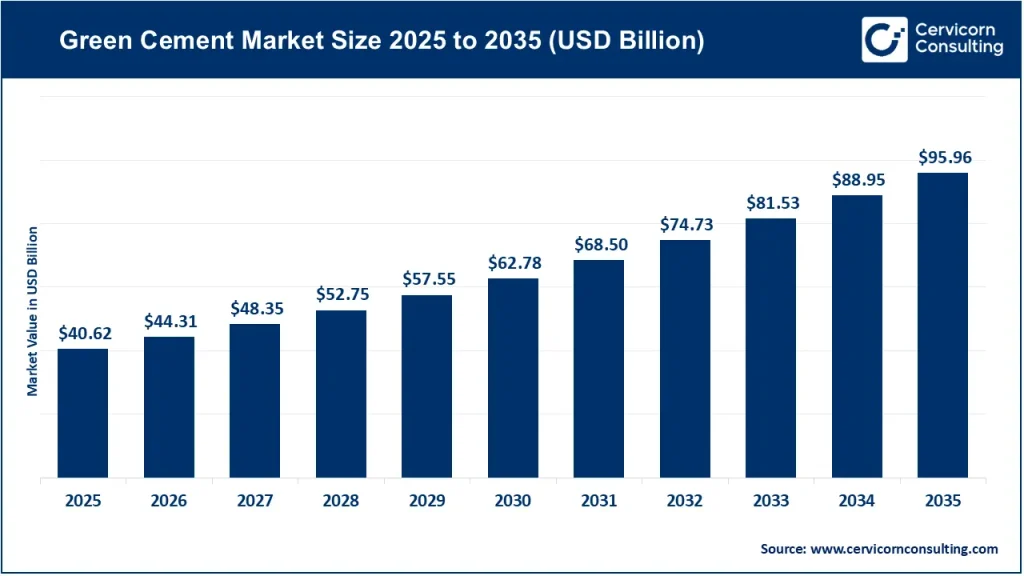
The global green cement market was valued at approximately USD 40.62 billion in 2025 and is projected to reach nearly USD 95.96 billion by 2035, growing at a CAGR of 8.98%.
Green Cement Market Growth Factors
The growth of the green cement market is primarily driven by increasing global efforts to reduce carbon emissions from the construction industry, rising investments in green buildings and sustainable infrastructure projects, stringent environmental regulations targeting traditional cement production, growing adoption of circular economy practices through the utilization of industrial by-products such as fly ash and slag, technological advancements in carbon capture and alternative binder technologies, expanding government incentives for low-carbon construction materials, increasing corporate sustainability commitments, rapid urbanization in emerging economies, and heightened awareness among developers and consumers regarding environmentally friendly construction solutions.
Additionally, net-zero emission targets established by various countries and the growing demand for LEED-certified and energy-efficient buildings continue to accelerate the adoption of green cement across residential, commercial, and industrial construction sectors.
What is the Green Cement Market?
The green cement market refers to the global industry involved in the production, distribution, and application of environmentally sustainable cement products designed to significantly reduce carbon emissions compared to conventional cement manufacturing.
Traditional cement production contributes approximately 7-8% of global carbon dioxide emissions due to the energy-intensive clinker production process. Green cement addresses this challenge by incorporating alternative raw materials, industrial waste products, supplementary cementitious materials (SCMs), carbon capture technologies, and innovative manufacturing methods.
Common forms of green cement include:
- Fly ash-based cement
- Slag cement
- Geopolymer cement
- Limestone calcined clay cement (LC3)
- Carbon-cured cement
- Recycled aggregate cement
- Magnesium-based cement
These alternatives help reduce greenhouse gas emissions, energy consumption, and natural resource depletion while maintaining or improving structural performance.
Get a Free Sample: https://www.cervicornconsulting.com/sample/2684
Why is Green Cement Important?
Reducing Carbon Emissions
The cement industry is one of the largest industrial emitters of carbon dioxide globally. Green cement significantly lowers emissions by reducing clinker content and utilizing alternative materials.
Supporting Net-Zero Goals
Many countries have established ambitious carbon neutrality targets. Green cement plays a vital role in helping governments and industries meet these commitments.
Promoting Circular Economy
Green cement often incorporates industrial waste materials such as fly ash, blast furnace slag, and silica fume, reducing landfill waste while maximizing resource efficiency.
Enhancing Sustainable Construction
Green cement enables builders to achieve sustainability certifications such as LEED, BREEAM, and Green Star, increasing property value and environmental performance.
Conserving Natural Resources
The use of recycled materials and alternative binders reduces dependence on limestone extraction and other natural resources.
Improving Durability
Many green cement formulations offer enhanced resistance to chemical attacks, corrosion, and environmental degradation, extending infrastructure lifespan.
Major Companies Operating in the Green Cement Market
Company Profile Comparison
| Company | Specialization | Key Focus Areas | Notable Features | 2025 Revenue | Estimated Market Share | Global Presence |
|---|---|---|---|---|---|---|
| Holcim Ltd. | Sustainable building materials | Low-carbon cement, circular construction, recycling | ECOPlanet green cement portfolio | USD 31+ Billion | 8-10% | 70+ countries |
| ACC Limited | Green cement and infrastructure solutions | Blended cement, waste utilization, sustainable manufacturing | Leading Indian sustainable cement producer | USD 2.5+ Billion | 2-3% | India and export markets |
| JSW Cement | Eco-friendly cement products | Slag-based cement, green building solutions | One of India’s lowest carbon footprint cement producers | USD 1.5+ Billion | 1-2% | India, Middle East, Africa |
| Green Cement Inc. | Specialized low-carbon cement technologies | Alternative binders, sustainable construction materials | Focus on innovative green cement solutions | Private Company | Emerging Player | North America |
| UltraTech Cement Limited | Sustainable cement manufacturing | Low-carbon cement, renewable energy integration | India’s largest cement producer | USD 9+ Billion | 4-6% | India, UAE, Bahrain, Sri Lanka, Nepal |
Holcim Ltd.
Holcim Ltd. is among the world’s leading producers of sustainable construction materials. The company has heavily invested in low-carbon cement technologies through its ECOPlanet product line.
Key Sustainability Initiatives
- Carbon-neutral cement products
- Circular construction solutions
- Waste recycling technologies
- Alternative fuel utilization
- Carbon capture projects
Holcim aims to accelerate decarbonization across the construction value chain while maintaining strong profitability and global competitiveness.
ACC Limited
ACC Limited has emerged as a major contributor to sustainable cement production in India.
Core Focus Areas
- Blended cement production
- Alternative fuels
- Waste heat recovery
- Green manufacturing processes
- Energy-efficient operations
The company actively supports India’s sustainable infrastructure development initiatives.
JSW Cement
JSW Cement is recognized for producing environmentally friendly cement products with one of the industry’s lowest carbon footprints.
Competitive Advantages
- High-volume slag cement production
- Reduced clinker factor
- Energy-efficient manufacturing
- Sustainable construction partnerships
- Green product innovation
JSW Cement continues expanding its green cement portfolio to meet growing demand across emerging markets.
Green Cement Inc.
Green Cement Inc. focuses on developing next-generation sustainable cement technologies.
Key Areas
- Alternative cement formulations
- Carbon reduction technologies
- Sustainable infrastructure materials
- Research and development
- Green construction partnerships
The company represents a growing segment of specialized innovators reshaping the cement industry.
UltraTech Cement Limited
UltraTech Cement Limited has become a global leader in sustainable cement manufacturing.
Sustainability Highlights
- Large-scale renewable energy adoption
- Green product portfolio
- Water-positive operations
- Circular economy initiatives
- Alternative fuel utilization
UltraTech continues to invest heavily in reducing carbon intensity across its production facilities.
Leading Trends in the Green Cement Market and Their Impact
Rise of Low-Carbon Cement Technologies
Manufacturers are increasingly reducing clinker content through supplementary cementitious materials.
Impact
- Lower CO₂ emissions
- Reduced energy consumption
- Improved sustainability ratings
- Compliance with environmental regulations
Carbon Capture, Utilization, and Storage (CCUS)
Cement manufacturers are integrating carbon capture technologies into production facilities.
Impact
- Significant emissions reduction
- Support for net-zero targets
- Enhanced regulatory compliance
- Creation of carbon-neutral cement products
Expansion of Geopolymer Cement
Geopolymer cement uses industrial waste products instead of traditional clinker.
Impact
- Up to 80% lower carbon emissions
- Improved durability
- Reduced raw material dependency
- Growing adoption in infrastructure projects
Circular Economy Integration
The use of recycled construction waste and industrial by-products is increasing.
Impact
- Reduced landfill waste
- Lower production costs
- Improved resource efficiency
- Enhanced sustainability credentials
Smart Manufacturing and Digitalization
Artificial intelligence, IoT sensors, and predictive maintenance technologies are improving production efficiency.
Impact
- Reduced operational costs
- Lower energy consumption
- Better quality control
- Enhanced sustainability performance
Green Building Certifications Driving Demand
Developers increasingly seek environmentally friendly materials for certification programs.
Impact
- Higher green cement adoption
- Premium pricing opportunities
- Increased awareness among stakeholders
- Expansion of sustainable construction practices
Successful Examples of Green Cement Market Adoption Around the World
Holcim ECOPlanet Projects – Europe
Holcim’s ECOPlanet cement products have been utilized in numerous infrastructure and commercial projects across Europe.
Achievements
- Up to 50% lower carbon emissions
- Compliance with European sustainability standards
- Large-scale adoption in public infrastructure
LC3 Cement Program – India
India has become a global leader in Limestone Calcined Clay Cement (LC3) deployment.
Benefits
- Reduced clinker usage
- Lower manufacturing emissions
- Cost-effective production
- Strong government support
The LC3 initiative has demonstrated significant potential for large-scale decarbonization.
CarbonCure Technologies – North America
CarbonCure injects captured carbon dioxide into concrete during production.
Results
- Permanent carbon sequestration
- Improved concrete strength
- Lower cement consumption
- Reduced environmental footprint
The technology has been adopted across thousands of concrete plants.
Heidelberg Materials Net-Zero Cement Projects – Europe
Major European projects are incorporating carbon-captured cement products.
Outcomes
- Near-zero carbon construction materials
- Regulatory compliance
- Increased investor confidence
- Sustainable infrastructure development
Slag Cement Adoption in Japan
Japan extensively uses blast furnace slag cement in infrastructure development.
Benefits
- High durability
- Lower carbon emissions
- Reduced industrial waste
- Improved lifecycle performance
The country’s approach demonstrates successful integration of circular economy principles.
Global Regional Analysis of the Green Cement Market
North America
North America remains a major market due to increasing investments in sustainable infrastructure and carbon reduction initiatives.
Key Growth Drivers
- Green building regulations
- Infrastructure modernization
- Carbon reduction targets
- Adoption of CCUS technologies
Government Initiatives and Policies
United States
- Inflation Reduction Act supporting clean manufacturing
- Federal infrastructure investment programs
- Buy Clean procurement initiatives
- Department of Energy carbon capture funding
Canada
- Net-Zero Emissions Accountability Act
- Green construction incentives
- Sustainable infrastructure investments
- Carbon pricing mechanisms
Market Outlook
Growing demand for low-carbon concrete and public infrastructure projects is expected to accelerate green cement adoption across the region.
Europe
Europe is the most mature green cement market due to stringent environmental regulations and aggressive climate targets.
Key Growth Drivers
- European Green Deal
- Carbon pricing policies
- Sustainable construction mandates
- Circular economy adoption
Government Initiatives and Policies
European Union
- Carbon Border Adjustment Mechanism (CBAM)
- EU Emissions Trading System (EU ETS)
- Fit for 55 climate package
- Sustainable construction regulations
Germany
- Green infrastructure investments
- Industrial decarbonization programs
- Hydrogen integration projects
France
- RE2020 building regulations
- Low-carbon construction mandates
- Circular economy legislation
Market Outlook
Europe is expected to remain a global leader in green cement innovation and adoption throughout the forecast period.
Asia-Pacific
Asia-Pacific represents the fastest-growing green cement market due to rapid urbanization and large-scale infrastructure development.
Key Growth Drivers
- Massive construction activity
- Industrial expansion
- Government sustainability programs
- Rising environmental awareness
Government Initiatives and Policies
China
- Carbon neutrality target by 2060
- Green building standards
- Industrial decarbonization programs
- Circular economy policies
India
- National Infrastructure Pipeline
- Smart Cities Mission
- Energy efficiency regulations
- Promotion of blended cement technologies
Japan
- Green Growth Strategy
- Carbon neutrality commitment
- Sustainable construction initiatives
- Advanced recycling programs
South Korea
- Korean Green New Deal
- Net-zero industrial policies
- Sustainable urban development programs
Market Outlook
The region is projected to dominate future market growth due to strong government support and rapidly expanding construction sectors.
Latin America
Latin America is witnessing growing adoption of sustainable construction practices.
Key Growth Drivers
- Urban infrastructure development
- Climate commitments
- Green building initiatives
- Foreign investments
Government Initiatives and Policies
Brazil
- National climate policies
- Sustainable infrastructure programs
- Renewable energy integration
Mexico
- Green building certification programs
- Low-carbon construction initiatives
- Infrastructure modernization efforts
Market Outlook
Increasing public and private sector investments are expected to strengthen regional demand for green cement products.
Middle East & Africa
The region is increasingly adopting green cement as governments pursue sustainable development goals.
Key Growth Drivers
- Mega infrastructure projects
- Smart city developments
- Diversification from oil economies
- Sustainability commitments
Government Initiatives and Policies
United Arab Emirates
- UAE Net Zero 2050 Strategy
- Green Building Regulations
- Sustainable urban development initiatives
Saudi Arabia
- Vision 2030 sustainability goals
- NEOM smart city project
- Green construction requirements
South Africa
- Low-carbon infrastructure programs
- Sustainable development frameworks
- Industrial decarbonization efforts
Market Outlook
Rapid urbanization and large-scale sustainable construction projects are expected to create significant opportunities for green cement manufacturers throughout the region.
Competitive Landscape of the Green Cement Market
The green cement market is characterized by increasing competition among global cement manufacturers, technology developers, construction material suppliers, and sustainability-focused startups. Companies are investing heavily in alternative raw materials, carbon capture technologies, renewable energy integration, and circular economy initiatives to reduce emissions and strengthen their market positions. Strategic partnerships, acquisitions, research collaborations, and government-supported sustainability projects are becoming key growth strategies as industry participants race to meet global decarbonization targets while addressing the growing demand for environmentally responsible construction materials.
To Get Detailed Overview, Contact Us: https://www.cervicornconsulting.com/contact-us
Read Report: Digital Twin in Agriculture Market Revenue, Trends, and Strategic Insights by 2035