


Table of Contents
ToggleGreen Ammonia Market Size
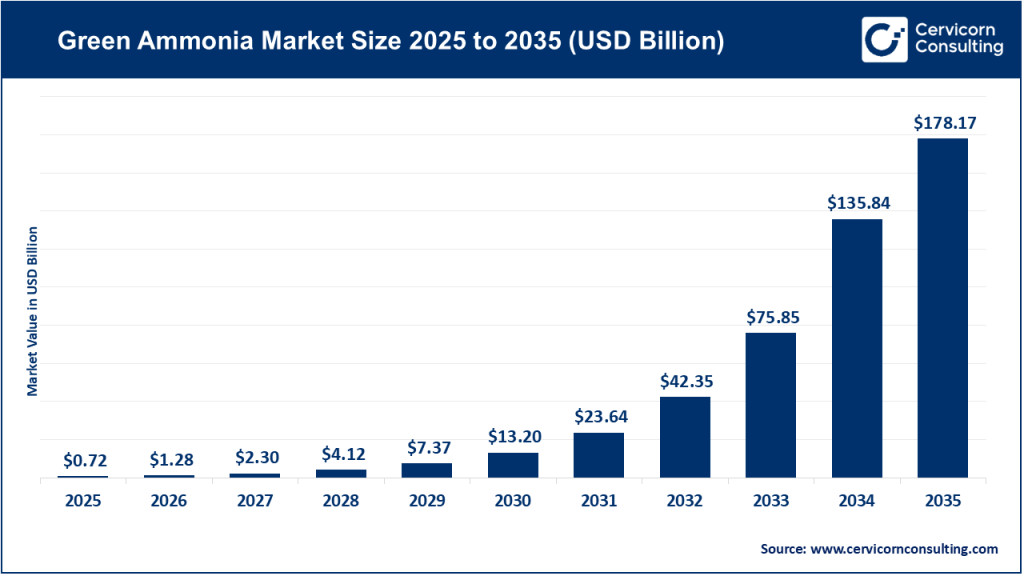
The global green ammonia market size was valued at approximately USD 0.72 billion in 2025 and is projected to reach around USD 178.17 billion by 2035, expanding at a compound annual growth rate (CAGR) of 73.52% over the forecast period from 2026 to 2035.
What is the Green Ammonia Market?
The green ammonia market refers to the global industry involved in the production, storage, transportation, and utilization of ammonia manufactured using renewable energy sources. Unlike conventional ammonia production, which relies on natural gas and emits substantial carbon dioxide through the Haber-Bosch process, green ammonia is produced using green hydrogen generated via electrolysis powered by solar, wind, hydroelectric, or other renewable energy sources.
Green ammonia serves multiple purposes beyond traditional fertilizer applications. It acts as an efficient hydrogen carrier, a clean maritime fuel, an energy storage medium, and a critical component in industrial decarbonization initiatives. The market encompasses technology providers, renewable energy developers, ammonia producers, infrastructure operators, and end-users across agriculture, transportation, power generation, and chemical industries.
Green Ammonia Market Growth Factors
The green ammonia market is witnessing remarkable growth due to the increasing global focus on decarbonization, rising investments in renewable energy projects, growing demand for sustainable fertilizers, expanding hydrogen economy initiatives, stringent environmental regulations, supportive government incentives, increasing adoption of clean fuels in maritime transportation, technological advancements in electrolysis systems, declining renewable energy costs, growing energy security concerns, rising carbon pricing mechanisms, large-scale industrial decarbonization strategies, increasing public-private partnerships, enhanced research and development activities, and the emergence of green hydrogen hubs worldwide that support green ammonia production and distribution infrastructure.
Why is the Green Ammonia Market Important?
Supporting Global Decarbonization Goals
Green ammonia significantly reduces greenhouse gas emissions compared to conventional ammonia production. Since ammonia manufacturing contributes substantially to global industrial emissions, transitioning to green ammonia can play a critical role in achieving climate targets.
Facilitating Renewable Energy Storage
One of the biggest challenges facing renewable energy adoption is intermittency. Green ammonia provides a practical solution by storing renewable energy in chemical form, enabling long-term energy storage and transportation.
Enabling Hydrogen Economy Development
Hydrogen transportation and storage remain complex and expensive. Green ammonia offers an effective carrier for hydrogen, allowing easier transportation over long distances while supporting the expansion of the hydrogen economy.
Transforming Maritime Fuel Markets
The shipping industry faces increasing pressure to reduce carbon emissions. Green ammonia is emerging as a promising zero-carbon marine fuel capable of supporting sustainable maritime transportation.
Enhancing Food Security Sustainably
Ammonia remains essential for fertilizer production. Green ammonia enables sustainable agricultural practices by reducing the carbon footprint associated with fertilizer manufacturing.
Get a Free Sample: https://www.cervicornconsulting.com/sample/2676
Major Companies Operating in the Green Ammonia Market
Siemens Energy
| Category | Details |
|---|---|
| Company | Siemens Energy |
| Specialization | Energy technologies, hydrogen systems, renewable integration |
| Key Focus Areas | Green hydrogen production, electrolysis technology, ammonia plant electrification |
| Notable Features | Comprehensive energy solutions and industrial-scale hydrogen infrastructure |
| 2025 Revenue | Approximately USD 39 billion |
| Market Share | Significant participant in green hydrogen and ammonia infrastructure projects |
| Global Presence | Operations in more than 90 countries |
Siemens Energy plays a vital role in enabling green ammonia production through advanced electrolysis systems, grid integration solutions, and renewable energy infrastructure. The company is actively involved in several large-scale green hydrogen and ammonia projects worldwide.
Yara International ASA
| Category | Details |
|---|---|
| Company | Yara International ASA |
| Specialization | Fertilizers and sustainable ammonia production |
| Key Focus Areas | Green fertilizers, renewable ammonia manufacturing |
| Notable Features | One of the world’s largest ammonia producers |
| 2025 Revenue | Approximately USD 15 billion |
| Market Share | Leading global fertilizer and ammonia producer |
| Global Presence | More than 60 countries |
Yara International is among the pioneers in commercializing green ammonia for fertilizer production. The company is investing heavily in renewable ammonia facilities and sustainable agriculture initiatives.
ENGIE
| Category | Details |
|---|---|
| Company | ENGIE |
| Specialization | Renewable energy and low-carbon solutions |
| Key Focus Areas | Green hydrogen, renewable power, ammonia export projects |
| Notable Features | Strong renewable energy portfolio |
| 2025 Revenue | Approximately USD 80 billion |
| Market Share | Major renewable energy developer supporting green ammonia projects |
| Global Presence | More than 70 countries |
ENGIE collaborates with governments and industrial partners to develop large-scale renewable energy projects that support green ammonia production and export markets.
Air Products
| Category | Details |
|---|---|
| Company | Air Products |
| Specialization | Industrial gases and hydrogen technologies |
| Key Focus Areas | Hydrogen infrastructure, ammonia production facilities |
| Notable Features | Large-scale clean energy investments |
| 2025 Revenue | Approximately USD 13 billion |
| Market Share | Leading provider of hydrogen-related technologies |
| Global Presence | Operations across 50+ countries |
Air Products is actively developing some of the world’s largest green hydrogen and green ammonia projects, contributing significantly to the industry’s growth.
ITM Power PLC
| Category | Details |
|---|---|
| Company | ITM Power PLC |
| Specialization | Proton Exchange Membrane (PEM) electrolysis |
| Key Focus Areas | Green hydrogen production technology |
| Notable Features | Advanced electrolyzer manufacturing |
| 2025 Revenue | Estimated USD 50-100 million range |
| Market Share | Emerging leader in electrolyzer technology |
| Global Presence | Europe-focused with expanding international footprint |
ITM Power provides the electrolyzer systems required for green hydrogen production, making it a critical technology supplier for green ammonia projects globally.
Leading Trends in the Green Ammonia Market and Their Impact
Expansion of Green Hydrogen Capacity
The rapid development of green hydrogen projects is directly supporting green ammonia production. Countries are investing billions in electrolyzer installations and renewable energy facilities.
Impact
- Reduced production costs
- Increased commercial viability
- Enhanced project scalability
- Improved investor confidence
Maritime Fuel Adoption
Shipping companies are exploring green ammonia as an alternative fuel to comply with decarbonization regulations.
Impact
- New demand streams
- Expansion of fueling infrastructure
- Increased ammonia exports
- Accelerated commercialization
Development of Ammonia Export Hubs
Countries with abundant renewable resources are positioning themselves as future green ammonia exporters.
Impact
- Strengthened international trade
- Enhanced energy security
- Creation of global supply chains
- Increased investment opportunities
Technological Improvements in Electrolysis
Advancements in electrolyzer efficiency continue to lower production costs.
Impact
- Improved economics
- Higher operational efficiency
- Greater project feasibility
- Accelerated market growth
Corporate Net-Zero Commitments
Industries worldwide are adopting green ammonia to reduce emissions and meet sustainability targets.
Impact
- Increased industrial demand
- Long-term supply contracts
- Stable revenue generation
- Market expansion
Successful Examples of Green Ammonia Projects Around the World
NEOM Green Hydrogen Project – Saudi Arabia
The NEOM project is among the largest green hydrogen and ammonia initiatives globally. Developed through partnerships involving Air Products, the project aims to produce significant volumes of green ammonia for export.
Key Achievements
- Gigawatt-scale renewable energy integration
- Large-scale ammonia export capability
- Global benchmark for green hydrogen projects
Yara Green Ammonia Facility – Norway
Yara is converting existing ammonia production facilities to utilize renewable hydrogen, reducing carbon emissions and supporting sustainable fertilizer production.
Key Achievements
- Reduced emissions footprint
- Commercial-scale green fertilizer production
- Demonstration of industrial decarbonization
Asian Renewable Energy Hub – Australia
Australia is developing large renewable energy projects dedicated to green hydrogen and ammonia exports to Asian markets.
Key Achievements
- Massive renewable generation capacity
- Export-oriented infrastructure
- Strong regional energy partnerships
Fukushima Hydrogen Energy Research Field – Japan
Japan is actively investing in hydrogen and ammonia technologies as part of its clean energy transition.
Key Achievements
- Renewable hydrogen production
- Clean fuel demonstration programs
- Energy security enhancement
Port of Rotterdam Green Ammonia Initiatives – Netherlands
The Port of Rotterdam is developing ammonia import and distribution infrastructure to support Europe’s energy transition.
Key Achievements
- Strategic import hub development
- Industrial decarbonization support
- Strengthened European energy supply chains
Global Regional Analysis of the Green Ammonia Market
North America
North America is experiencing substantial growth due to government funding programs, clean hydrogen initiatives, and increasing industrial decarbonization efforts.
Key Market Drivers
- Hydrogen hub investments
- Renewable energy expansion
- Industrial sustainability commitments
- Clean fuel adoption
Government Initiatives and Policies
United States
- Inflation Reduction Act (IRA)
- Clean Hydrogen Production Tax Credits
- Department of Energy Hydrogen Shot Program
- Regional Clean Hydrogen Hubs Program
These initiatives provide significant financial support for green hydrogen and ammonia projects.
Canada
- Hydrogen Strategy for Canada
- Clean Fuel Regulations
- Net-Zero Emissions Accountability Framework
These policies encourage investment in clean hydrogen and ammonia infrastructure.
Europe
Europe represents one of the most advanced markets for green ammonia due to aggressive climate goals and strong policy support.
Key Market Drivers
- Decarbonization targets
- Renewable energy leadership
- Carbon pricing mechanisms
- Industrial transformation programs
Government Initiatives and Policies
European Union
- European Green Deal
- REPowerEU Plan
- Hydrogen Strategy for a Climate-Neutral Europe
- Fit for 55 Package
These programs promote renewable hydrogen production and facilitate green ammonia adoption.
Germany
- National Hydrogen Strategy
- Renewable Energy Expansion Programs
- Industrial Decarbonization Funding
Netherlands
- Hydrogen Valley Projects
- Port Infrastructure Investments
- Clean Energy Transition Programs
Asia-Pacific
Asia-Pacific is expected to witness the fastest growth due to increasing energy demand, industrial development, and hydrogen economy strategies.
Key Market Drivers
- Rapid industrialization
- Energy security concerns
- Strong renewable energy investments
- Expanding export opportunities
Government Initiatives and Policies
Japan
Japan has established comprehensive hydrogen and ammonia roadmaps focused on power generation and transportation applications.
Key initiatives include:
- Green Growth Strategy
- Hydrogen Society Vision
- Ammonia Co-Firing Programs
South Korea
Government support includes:
- Hydrogen Economy Roadmap
- Carbon Neutrality Framework
- Clean Energy Transition Policies
Australia
Australia aims to become a major exporter through:
- National Hydrogen Strategy
- Renewable Energy Zones
- Hydrogen Headstart Program
India
India is emerging as a significant market through:
- National Green Hydrogen Mission
- Renewable Energy Expansion Policies
- Production-Linked Incentive Programs
- Industrial Decarbonization Initiatives
The country is positioning itself as a future exporter of green hydrogen and green ammonia.
Latin America
Latin America possesses substantial renewable energy resources that support green ammonia development.
Key Market Drivers
- Abundant solar and wind resources
- Export opportunities
- Increasing foreign investments
- Industrial diversification
Government Initiatives and Policies
Chile
- National Green Hydrogen Strategy
- Renewable Energy Promotion Programs
- Export Infrastructure Development
Brazil
- Hydrogen Regulatory Framework
- Renewable Energy Expansion Policies
- Sustainable Industrial Development Programs
These initiatives are attracting international investments in green ammonia production facilities.
Middle East & Africa
The Middle East is rapidly becoming a major green ammonia production hub due to exceptional solar resources and strategic export locations.
Key Market Drivers
- Low-cost renewable energy
- Export-focused strategies
- Large-scale infrastructure investments
- Energy diversification goals
Government Initiatives and Policies
Saudi Arabia
- Vision 2030
- NEOM Development Program
- Renewable Energy Expansion Initiatives
United Arab Emirates
- UAE Hydrogen Leadership Roadmap
- Net Zero by 2050 Strategy
- Green Industrial Development Programs
Egypt
- National Green Hydrogen Strategy
- Suez Canal Economic Zone Projects
- Renewable Energy Investment Incentives
These programs are positioning the region as a leading supplier of green ammonia to Europe and Asia.
Future Outlook
The green ammonia market is expected to become a cornerstone of the global energy transition. Continuous technological advancements, declining renewable energy costs, expanding hydrogen infrastructure, and strong government support will accelerate commercialization. As industries seek sustainable alternatives to fossil fuels and conventional ammonia production, green ammonia is poised to play an increasingly important role in agriculture, transportation, energy storage, and industrial decarbonization throughout the coming decade.
To Get Detailed Overview, Contact Us: https://www.cervicornconsulting.com/contact-us
Read Report: AI in Life Science Market Revenue, Trends, and Strategic Insights by 2035