


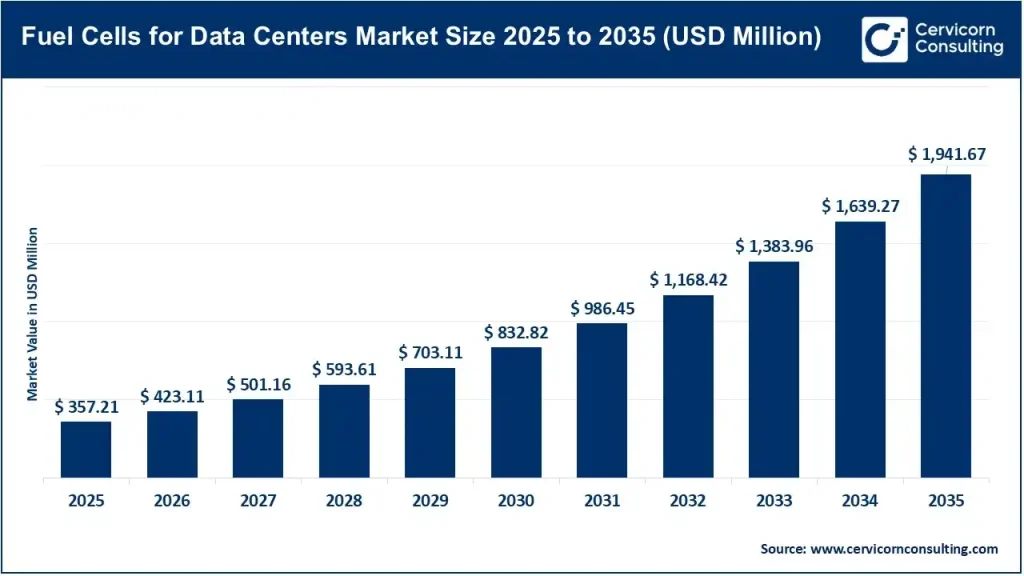
Fuel Cells for Data Centers Market Size
The global fuel cells for data centers market was valued at approximately USD 357.21 million in 2025 and is projected to reach nearly USD 1,941.67 million by 2035, growing at a CAGR of 18.4%.
What is the Fuel Cells for Data Centers Market?
The fuel cells for data centers market refers to the global industry involved in manufacturing, deploying, integrating, and maintaining fuel cell systems that provide primary or backup power for data centers.
Unlike conventional diesel generators, fuel cells generate electricity through an electrochemical reaction rather than combustion. Depending on the fuel source—natural gas, hydrogen, biogas, or renewable hydrogen—they can produce significantly lower greenhouse gas emissions while maintaining high efficiency.
Fuel cell systems are increasingly being installed in:
- Hyperscale cloud data centers
- Enterprise data centers
- Edge data centers
- Colocation facilities
- Government data centers
- Telecommunications facilities
The market includes hardware manufacturers, fuel suppliers, hydrogen infrastructure providers, power management companies, and system integrators.
Get a Free Sample: https://www.cervicornconsulting.com/sample/2994
Fuel Cells for Data Centers Market Growth Factors
The fuel cells for data centers market is experiencing strong growth due to the rapid expansion of hyperscale cloud infrastructure, increasing AI workloads requiring uninterrupted power, rising electricity demand, growing concerns over grid instability, stricter carbon emission regulations, corporate sustainability goals, investments in hydrogen production infrastructure, technological improvements in SOFC and PEM fuel cells, reduced operational costs through higher energy efficiency, increasing replacement of diesel backup generators, supportive government incentives for clean energy technologies, rising edge computing deployments, growing renewable energy integration, expansion of colocation services, and continuous innovation by leading fuel cell manufacturers partnering with major cloud service providers worldwide.
Why is the Fuel Cells for Data Centers Market Important?
1. Supports Continuous Operations
Data centers require power availability approaching 100%. Fuel cells provide highly reliable electricity even during grid outages.
2. Reduces Carbon Emissions
Traditional diesel generators contribute significantly to greenhouse gas emissions. Fuel cells offer a cleaner alternative.
3. Enhances Energy Security
Fuel cells reduce dependence on unstable electrical grids and improve resilience during natural disasters.
4. Meets Sustainability Targets
Large technology companies have pledged carbon neutrality and net-zero emissions, making fuel cells an attractive solution.
5. Improves Operational Efficiency
Fuel cells can achieve electrical efficiencies exceeding many conventional backup systems while requiring less maintenance.
6. Enables AI Infrastructure
The exponential growth of AI data centers is increasing electricity demand, creating opportunities for distributed fuel-cell power systems.
Market Drivers
Several factors are driving market expansion:
- Increasing AI computing capacity
- Rising cloud service demand
- Rapid hyperscale data center construction
- Government clean energy incentives
- Hydrogen economy development
- Expansion of renewable natural gas
- Need for resilient power systems
- Carbon reduction regulations
- Declining fuel cell costs
- Growing investment from technology companies
Challenges
Despite strong growth, several obstacles remain.
High Initial Capital Investment
Fuel cell installations remain more expensive than diesel generators.
Hydrogen Infrastructure
Hydrogen transportation and storage infrastructure is still developing.
Fuel Availability
Renewable hydrogen production remains limited in several regions.
Technology Integration
Existing facilities may require infrastructure modifications.
Skilled Workforce
Operation and maintenance require specialized expertise.
Leading Trends Transforming the Fuel Cells for Data Centers Market
Hydrogen-Based Fuel Cells
Green hydrogen is becoming the preferred fuel for future data center projects, significantly reducing lifecycle emissions.
Impact
- Lower carbon footprint
- Improved ESG performance
- Increased government funding
AI-Powered Energy Optimization
Artificial intelligence is helping operators optimize fuel cell performance, predictive maintenance, and energy distribution.
Impact
- Lower operational costs
- Improved reliability
- Enhanced efficiency
On-Site Microgrids
Fuel cells are increasingly integrated with:
- Solar energy
- Battery storage
- Smart energy management systems
Impact
Greater energy independence.
Solid Oxide Fuel Cells (SOFC)
SOFC technology is gaining popularity because of:
- High electrical efficiency
- Continuous operation
- Fuel flexibility
Impact
Reduced electricity costs.
Green Data Centers
Sustainability certifications are encouraging operators to replace diesel generators.
Impact
Accelerated fuel cell deployment.
Modular Fuel Cell Systems
Manufacturers are introducing modular systems that simplify expansion.
Impact
Scalable infrastructure for growing data centers.
Digital Monitoring
IoT sensors and cloud monitoring improve maintenance planning.
Impact
Higher uptime.
Successful Examples Around the World
Bloom Energy and Equinix
Bloom Energy has deployed solid oxide fuel cell systems for Equinix facilities, helping reduce grid dependence while improving energy resilience.
Microsoft Clean Energy Projects
Microsoft has explored hydrogen fuel cell technology as an alternative to diesel generators for backup power in data centers.
Google Sustainability Initiatives
Google continues evaluating fuel cell technologies as part of broader renewable energy and carbon-free electricity strategies.
Doosan Fuel Cell Installations in South Korea
Doosan Fuel Cell has deployed stationary fuel cell systems supporting commercial facilities and critical infrastructure, demonstrating scalable distributed power.
FuelCell Energy Utility Partnerships
FuelCell Energy has implemented combined heat and power (CHP) solutions that enhance overall energy efficiency for commercial and industrial applications, offering insights applicable to data center environments.
Edge Data Centers in Japan
Several Japanese technology companies are deploying hydrogen-powered microgrids to improve disaster resilience.
Company Analysis
| Company | Specialization | Key Focus Areas | Notable Features | Estimated 2025 Revenue | Estimated Market Share | Global Presence |
|---|---|---|---|---|---|---|
| Bloom Energy Corporation | Solid Oxide Fuel Cells (SOFC) | Data centers, utilities, commercial power | High-efficiency SOFC technology, continuous power generation | Approximately USD 1.6–1.8 Billion | ~22% | North America, Europe, Asia-Pacific |
| Ballard Power Systems Inc. | Proton Exchange Membrane (PEM) Fuel Cells | Heavy-duty mobility, stationary power, backup systems | Advanced PEM technology with global partnerships | Approximately USD 110–140 Million | ~8% | North America, Europe, China, Australia |
| FuelCell Energy, Inc. | Molten Carbonate Fuel Cells | Distributed generation, CHP, carbon capture | Large-scale stationary fuel cell platforms | Approximately USD 140–180 Million | ~14% | North America, Europe, Asia |
| Plug Power Inc. | Hydrogen Fuel Cell Systems | Hydrogen production, electrolyzers, stationary power | Integrated hydrogen ecosystem and fuel supply solutions | Approximately USD 900 Million–1.1 Billion | ~12% | North America, Europe, Asia-Pacific |
| Doosan Fuel Cell Co., Ltd. | Phosphoric Acid Fuel Cells (PAFC) | Commercial buildings, utilities, distributed power | Strong deployment in South Korea with expanding international footprint | Approximately USD 300–400 Million | ~10% | South Korea, Middle East, Asia-Pacific |
Global Regional Analysis
North America
North America represents the largest market due to the concentration of hyperscale data centers and leading cloud providers.
Key Growth Drivers
- AI infrastructure investments
- Cloud computing expansion
- Advanced hydrogen ecosystem
- High electricity demand
- Carbon reduction commitments
Government Initiatives
- U.S. Inflation Reduction Act (IRA) incentives supporting hydrogen production and fuel cell technologies.
- U.S. Department of Energy funding for hydrogen hubs and clean hydrogen research.
- State-level clean energy incentives in California, New York, and other regions encouraging distributed generation and low-emission power systems.
Europe
Europe is witnessing significant adoption driven by aggressive decarbonization policies.
Key Growth Drivers
- Green data center investments
- Hydrogen economy expansion
- Renewable energy integration
- Carbon neutrality goals
Government Policies
- European Green Deal promoting climate neutrality.
- REPowerEU strategy accelerating renewable hydrogen deployment.
- National hydrogen strategies in Germany, France, the Netherlands, and Spain supporting fuel cell innovation.
- Financial incentives for clean energy projects and emissions reduction.
Asia-Pacific
Asia-Pacific is expected to register the fastest growth throughout the forecast period.
Key Growth Drivers
- Massive cloud infrastructure investments
- Semiconductor manufacturing growth
- AI expansion
- Government hydrogen initiatives
Government Policies
Japan
- Basic Hydrogen Strategy encouraging hydrogen production and fuel cell adoption.
- Support for hydrogen-powered critical infrastructure.
South Korea
- Hydrogen Economy Roadmap promoting large-scale commercialization of fuel cells.
- Incentives for stationary fuel cell installations.
China
- Hydrogen industry development plans.
- Investments in distributed energy systems and smart infrastructure.
- Expansion of domestic fuel cell manufacturing.
Australia
- National Hydrogen Strategy supporting green hydrogen exports and domestic adoption.
Latin America
Although at an early stage, Latin America presents considerable opportunities.
Growth Drivers
- Renewable energy expansion
- Data center construction
- Growing cloud adoption
- Grid reliability improvements
Government Support
Countries including Brazil and Chile are introducing hydrogen roadmaps, renewable energy incentives, and pilot projects aimed at accelerating clean energy deployment.
Middle East & Africa
The region is emerging as a strategic market due to investments in smart cities and clean energy diversification.
Growth Drivers
- Mega data center projects
- Renewable hydrogen production
- Smart city developments
- Energy diversification initiatives
Government Initiatives
- Saudi Arabia’s Vision 2030 includes significant investments in hydrogen production and clean energy infrastructure.
- The UAE’s National Hydrogen Strategy supports hydrogen adoption across multiple sectors.
- Regional investment in large-scale renewable energy projects creates opportunities for integrating fuel cell systems into critical infrastructure.
Future Opportunities
Several opportunities are expected to shape the market over the next decade:
- Green hydrogen-powered hyperscale campuses
- Fuel-cell-powered edge computing facilities
- AI-driven power management platforms
- Integration of carbon capture with fuel cell systems
- Renewable microgrids for critical infrastructure
- Expansion of hydrogen refueling and distribution networks
- Hybrid systems combining fuel cells, batteries, and solar energy
- Development of modular, high-capacity fuel cell solutions tailored for large-scale data centers
As digital infrastructure continues to expand globally, fuel cells are positioned to play a growing role in delivering reliable, resilient, and lower-emission power for next-generation data centers.
To Get Detailed Overview, Contact Us: https://www.cervicornconsulting.com/contact-us
Read Report: Autonomous Vehicle Market Revenue, Trends, and Strategic Insights by 2035