


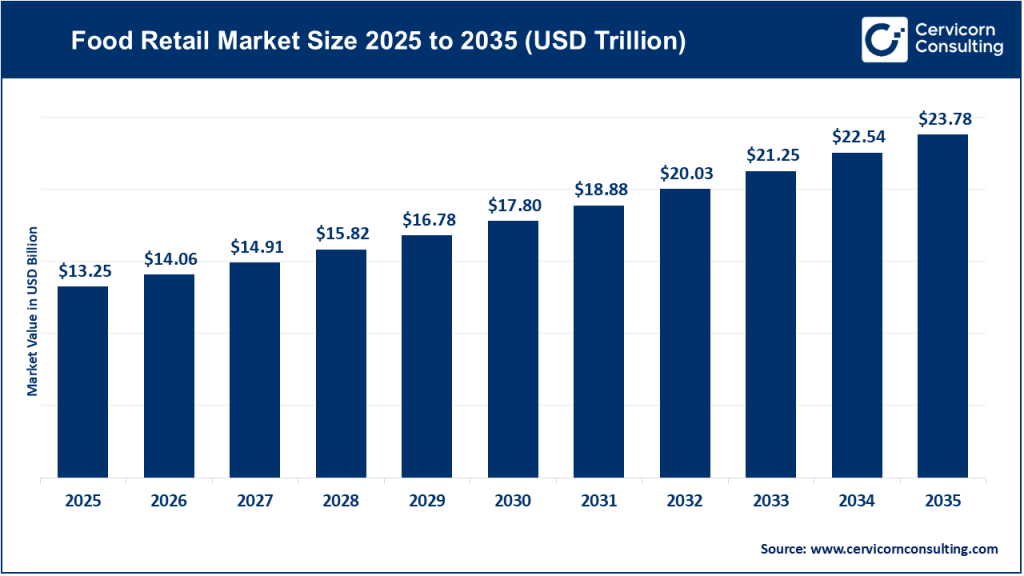
Food Retail Market Size
The global food retail market was valued at USD 13.25 trillion in 2025 and is projected to reach approximately USD 23.78 trillion by 2035, growing at a robust CAGR of 6.02% during the forecast period from 2026 to 2035.
What is the Food Retail Market?
The food retail market refers to the organized and unorganized distribution channels through which food products are sold directly to consumers for personal consumption. It includes supermarkets, hypermarkets, grocery stores, convenience stores, online grocery platforms, and hybrid retail formats that combine offline and digital experiences. The market covers a wide range of products such as fresh produce, packaged foods, dairy, meat, beverages, frozen foods, organic products, and ready-to-eat meals.
Food retail acts as the final link in the food supply chain, connecting producers, processors, and manufacturers with end consumers. It plays a critical role in ensuring food availability, affordability, accessibility, and quality across urban and rural markets globally.
Why is the Food Retail Market Important?
The food retail market is essential because it directly influences global food security, consumer lifestyle patterns, and economic stability. It ensures that essential food items are consistently available to growing populations while adapting to changing dietary preferences and sustainability concerns.
It also supports millions of jobs worldwide, ranging from supply chain logistics and store operations to digital retail technology and food distribution systems. Additionally, food retail is a major contributor to GDP in both developed and developing economies, acting as a backbone for agricultural demand and food processing industries.
Food Retail Market Growth Factors
The food retail market is experiencing strong growth driven by rapid urbanization, rising disposable incomes, changing dietary habits, increasing demand for convenience foods, and expansion of organized retail infrastructure across emerging economies; additionally, the surge in e-commerce grocery platforms, advancements in cold chain logistics, growing penetration of smartphones and digital payment systems, increasing preference for healthy, organic, and premium food products, and aggressive expansion strategies by global retail giants are collectively accelerating market growth, while government support for modern retail infrastructure and foreign direct investment liberalization further strengthens long-term market expansion.
Get a Free Sample: https://www.cervicornconsulting.com/sample/2604
Key Companies in the Food Retail Market
1. Walmart Inc.
Specialization: Hypermarkets, supermarkets, and wholesale retail (via Sam’s Club)
Key Focus Areas: Everyday low pricing strategy, supply chain efficiency, omnichannel retail, grocery delivery, private label expansion
Notable Features:
- One of the largest global retailers by revenue
- Strong presence in grocery and household essentials
- Advanced logistics and distribution network
- Expanding e-commerce grocery delivery and pickup services
2025 Revenue: Estimated over USD 650+ billion (retail segment dominated by grocery sales)
Market Share: Leading global food retail market share in the organized retail segment
Global Presence: United States, Canada, Mexico, Central America, China (select operations), and other international markets
2. The Kroger Co.
Specialization: Supermarkets and grocery retail chains
Key Focus Areas: Fresh food retailing, private labels, digital grocery platforms, loyalty programs
Notable Features:
- One of the largest supermarket chains in the United States
- Strong focus on fresh produce and in-house brands
- Advanced customer data analytics for personalized shopping
- Growing online grocery delivery ecosystem
2025 Revenue: Estimated around USD 150+ billion
Market Share: Major player in U.S. grocery retail segment
Global Presence: Primarily United States with limited international sourcing and partnerships
3. Amazon.com, Inc. (Amazon Fresh, Whole Foods Market)
Specialization: E-commerce grocery retail and premium organic supermarket chains
Key Focus Areas: Online grocery delivery, AI-driven supply chain, subscription-based delivery (Amazon Prime), smart retail stores
Notable Features:
- Operates Amazon Fresh and Whole Foods Market
- Strong dominance in online grocery delivery infrastructure
- Advanced AI and automation in warehousing and logistics
- Integration of physical and digital grocery ecosystems
2025 Revenue: Grocery and physical store segment estimated at USD 100+ billion contribution
Market Share: Rapidly growing share in online grocery retail globally
Global Presence: North America, Europe, and expanding digital grocery services in Asia-Pacific
4. Tesco PLC
Specialization: Supermarket retail and online grocery services
Key Focus Areas: Private-label expansion, Clubcard loyalty ecosystem, online grocery delivery, sustainability initiatives
Notable Features:
- Leading grocery retailer in the UK
- Strong digital transformation in grocery shopping
- Extensive private-label product portfolio
- Focus on affordable and value-driven food retail
2025 Revenue: Estimated USD 80–90+ billion
Market Share: Dominant grocery retailer in the UK market
Global Presence: United Kingdom, Ireland, Central Europe (select operations)
5. Carrefour S.A.
Specialization: Hypermarkets, supermarkets, and convenience store formats
Key Focus Areas: Multi-format retail strategy, food sustainability, private labels, digital commerce expansion
Notable Features:
- One of the largest retail chains in Europe
- Strong presence in both developed and emerging markets
- Focus on sustainable sourcing and eco-friendly packaging
- Expansion of e-commerce grocery platforms
2025 Revenue: Estimated USD 90–100+ billion
Market Share: Leading food retailer in France and significant global presence
Global Presence: Europe, Latin America, Middle East, and Asia
Leading Trends in the Food Retail Market and Their Impact
1. Online Grocery Retail Expansion
The rapid adoption of e-commerce grocery platforms is transforming the food retail landscape. Consumers increasingly prefer home delivery and click-and-collect models, especially in urban areas. This trend has pushed retailers to invest heavily in digital infrastructure and last-mile delivery systems.
2. Private Label Growth
Retailers are expanding private-label brands to improve profit margins and customer loyalty. These products often offer competitive pricing and quality comparable to branded goods, reshaping consumer purchasing behavior.
3. Health and Wellness-Oriented Consumption
Rising awareness of health and nutrition is driving demand for organic, gluten-free, plant-based, and functional food products. Food retailers are adapting by diversifying product assortments.
4. Automation and AI Integration
AI-driven demand forecasting, automated warehouses, and smart checkout systems are enhancing operational efficiency and reducing costs in food retail operations.
5. Sustainable Retailing Practices
Retailers are increasingly focusing on reducing food waste, adopting eco-friendly packaging, and sourcing sustainably produced goods to meet regulatory and consumer expectations.
6. Quick Commerce (Q-Commerce)
The rise of ultra-fast delivery platforms is reshaping convenience expectations, with delivery times shrinking to under 30 minutes in some markets.
Successful Examples of Food Retail Market Around the World
Walmart (USA)
Walmart has successfully built a global grocery empire by combining low pricing with massive supply chain efficiency. Its omnichannel grocery model, including pickup and delivery services, has set benchmarks for retail scalability.
Tesco (UK)
Tesco has become a leader in customer loyalty through its Clubcard system, which uses data analytics to personalize promotions and improve customer retention.
Carrefour (France)
Carrefour has successfully expanded into emerging markets such as Brazil and the Middle East, adapting its product mix to local consumer preferences.
Amazon Fresh & Whole Foods (Global)
Amazon has disrupted traditional grocery retail by integrating AI, logistics automation, and subscription-based delivery models into food retailing.
DMart (India – notable example outside required list)
DMart has achieved strong growth through a low-cost, high-efficiency retail model focusing on essential goods and minimal operating expenses.
Global Regional Analysis of the Food Retail Market
North America
North America remains one of the most advanced food retail markets globally. The United States dominates due to the presence of large retail chains such as Walmart and Kroger, as well as strong e-commerce penetration.
Government Initiatives and Policies:
- Support for food safety regulations through the FDA
- Subsidies for agricultural supply chains
- Incentives for digital commerce infrastructure
- SNAP (Supplemental Nutrition Assistance Program) influencing retail demand patterns
The region is characterized by high consumer spending, strong logistics infrastructure, and rapid adoption of online grocery services.
Europe
Europe has a highly structured and mature food retail ecosystem dominated by supermarket chains and hypermarkets.
Government Initiatives and Policies:
- EU Common Agricultural Policy (CAP) supporting food supply stability
- Strict food safety and labeling regulations
- Sustainability mandates for packaging and carbon reduction
- Incentives for organic farming and local sourcing
Countries like the UK, France, and Germany lead in retail innovation, with strong emphasis on sustainability and private-label growth.
Asia-Pacific
Asia-Pacific is the fastest-growing food retail market, driven by population growth, urbanization, and rising incomes.
Government Initiatives and Policies:
- India’s FDI liberalization in retail allowing global participation
- China’s digital economy policies supporting e-grocery platforms
- Southeast Asian infrastructure investments in cold chain logistics
- Subsidies for agricultural modernization
The region shows strong growth in both traditional retail and modern e-commerce grocery platforms.
Latin America
Latin America is experiencing steady growth in organized food retail, led by Brazil, Mexico, and Argentina.
Government Initiatives and Policies:
- Trade liberalization policies improving food imports and exports
- Investments in retail modernization and logistics
- Food security programs targeting low-income populations
Retailers like Carrefour have expanded significantly in this region, adapting to local consumption habits.
Middle East & Africa
This region is emerging as a high-potential market due to population growth, tourism, and urban development.
Government Initiatives and Policies:
- National food security strategies in Gulf countries
- Investments in hypermarket infrastructure
- Import dependency reduction programs
- Growth of retail free zones and trade hubs
The market is highly dependent on imports, making supply chain efficiency a key competitive factor.
To Get Detailed Overview, Contact Us: https://www.cervicornconsulting.com/contact-us
Read Report: Lithium-Ion Battery Market Revenue, Trends, and Strategic Insights by 2035