


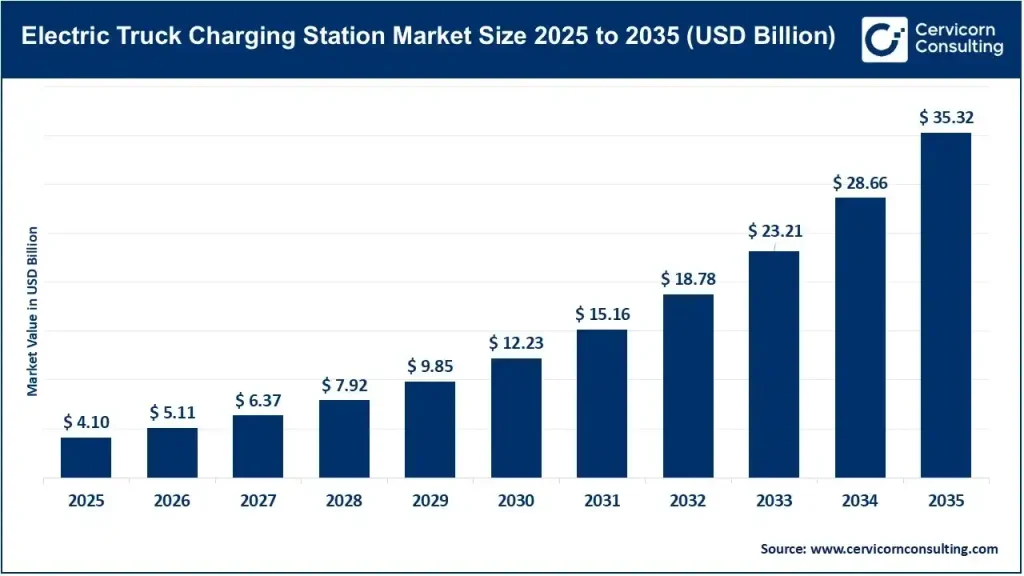
Electric Truck Charging Station Market Size and Growth Outlook
The global electric truck charging station market was valued at USD 4.10 billion in 2025 and is projected to reach USD 35.32 billion by 2035, expanding at a 24.0% CAGR from 2026 to 2035. Asia Pacific accounted for the largest regional share, at 55% in 2025, while heavy-duty electric trucks represented approximately 30% of the market and are expected to be among the fastest-growing vehicle categories. DC fast charging led charger technologies with a 40% share, while fleet-depot charging accounted for 55% of deployment revenue.
Electric Truck Charging Station Market Growth Factors
The electric truck charging station market is growing because of the rapid electrification of commercial fleets, increasingly stringent vehicle-emission regulations, falling battery costs, improvements in charging technology, expansion of zero-emission freight corridors, corporate decarbonization commitments, and increasing demand for efficient urban and regional logistics. Fleet operators are increasingly deploying depot chargers because trucks can recharge during overnight parking, while highway charging hubs are becoming essential for longer-distance operations.
The development of Megawatt Charging Systems (MCS) is particularly important because heavy-duty trucks require much greater charging capacity than passenger EVs. Governments are supporting the market through subsidies, infrastructure grants, emissions regulations, and charging-network mandates, while utilities and charging companies are investing in grid upgrades, energy-management software, battery storage, and renewable-energy integration.
E-commerce growth is also increasing demand for electric delivery fleets, and advances in battery range are expanding the economic viability of electric trucks beyond short-distance routes. The International Energy Agency estimates that more than 70,000 public charging points capable of accommodating heavy-duty vehicles were available globally in 2025, although only about 1,200 were verified as exclusively truck-dedicated; this infrastructure gap creates significant room for further investment.
Get a Free Sample: https://www.cervicornconsulting.com/sample/3012
What Is the Electric Truck Charging Station Market?
The electric truck charging station market encompasses the equipment, infrastructure, software, services, and energy-management systems used to charge battery-electric trucks. Unlike conventional passenger-EV charging infrastructure, truck charging must accommodate larger batteries, higher power requirements, larger vehicle dimensions, longer operating hours, and the commercial importance of minimizing vehicle downtime.
The market includes AC chargers, DC fast chargers, high-power DC chargers, and Megawatt Charging Systems. Charging infrastructure can be deployed at fleet depots, distribution centers, warehouses, ports, logistics parks, highway rest areas, public truck charging hubs, and industrial facilities.
The market is also developing around different operating models. Fleet-owned charging infrastructure provides predictable energy costs and greater operational control, while public charging networks allow smaller operators to access high-power infrastructure without making large capital investments. Charging-as-a-service and software-based energy-management models are also gaining importance.
In 2025, the fleet-depot segment held the largest deployment share at 55%, reflecting the operational advantages of charging trucks when they are parked overnight or during scheduled loading and unloading periods.
Why Is the Electric Truck Charging Station Market Important?
Electric truck charging infrastructure is critical because freight transportation represents a major source of road-transport emissions, while commercial trucks generally consume considerably more energy than passenger vehicles. Electrifying trucks without developing suitable charging infrastructure would create operational bottlenecks and limit fleet adoption.
Charging stations allow logistics companies to maintain vehicle utilization while reducing dependence on diesel. Depot charging can be scheduled around fleet operations, while high-power highway charging enables electric trucks to undertake longer routes.
Infrastructure development also contributes to the broader electricity transition. Large charging hubs can incorporate solar generation, stationary battery storage, smart charging, and demand-management systems. This creates opportunities for utilities and energy companies to manage electricity demand more efficiently.
The IEA estimates that the average battery-electric truck range is currently around 300 km, making public heavy-duty charging infrastructure increasingly important for longer-distance applications.
Leading Companies in the Electric Truck Charging Station Market
| Company | Specialization | Key Focus Areas | Notable Features | 2025 Revenue | Market Share | Global Presence |
|---|---|---|---|---|---|---|
| ABB E-mobility | EV charging hardware and infrastructure | High-power DC charging, fleet charging, heavy-duty charging, grid integration | Terra chargers, high-power solutions, MCS development | ABB Group: USD 33.22B | Company-specific truck-charging share not separately disclosed | Global |
| Siemens | Smart infrastructure and EV charging | Depot charging, high-power charging, energy management, electrification | Integrated charging and grid infrastructure | Siemens: EUR 78.9B group revenue | Not separately disclosed | Global |
| Kempower | DC fast and heavy-duty EV charging | Electric trucks, fleet depots, MCS, charging software | MCS up to 1.2 MW, modular architecture | EUR 251.3M | Not separately disclosed | Solutions delivered to about 60 countries |
| Tesla | EV charging networks and high-power charging | Supercharging, Tesla Semi, Megacharging | High-power Megacharger ecosystem | USD 94.83B | Not separately disclosed for truck charging | Global |
| ChargePoint | Networked charging and charging software | Fleet charging, commercial charging, charging management | Large networked platform and subscription model | USD 417.1M FY2025 | Approximately 61% of publicly available networked AC ports in North America according to company estimate | North America and Europe |
Note: Company revenues are total corporate/group revenues unless a company separately reports e-mobility revenue. Electric-truck charging market share is generally not disclosed separately by these companies, so a directly comparable truck-charging share should not be inferred from total corporate revenue. ChargePoint’s 61% figure is its own estimate for North American publicly available networked AC charging ports, not a global electric-truck charging market share.
ABB E-mobility
ABB E-mobility is one of the prominent suppliers of high-power EV charging technology, with particular relevance to commercial fleets and heavy-duty vehicles. Its portfolio includes DC fast-charging systems, fleet charging infrastructure, charging management, and high-power solutions. ABB’s broader 2025 revenue reached USD 33.22 billion, although ABB does not separately report revenue for its E-mobility business in a way that allows direct calculation of electric truck charging revenue.
ABB has participated in European heavy-duty charging demonstrations, including projects designed to validate megawatt charging technology for electric trucks. Its strength lies in combining charging equipment with electrical infrastructure, automation, and grid expertise.
Siemens
Siemens participates in electric commercial-vehicle charging through its Smart Infrastructure business, combining charging technology with electrical distribution, building infrastructure, energy management, and digital systems. Siemens reported EUR 78.9 billion in group revenue in fiscal 2025, while Smart Infrastructure generated EUR 22.989 billion in revenue.
The company’s key competitive advantage is its ability to integrate charging stations with broader energy infrastructure. This is particularly valuable for large truck depots that may require transformers, switchgear, load management, renewable energy, and battery storage alongside chargers.
Kempower
Kempower is strongly positioned in commercial and heavy-duty charging. Its portfolio includes DC charging systems, depot solutions, charging management software, and MCS technology. Its Megawatt Charging System has a peak power of 1.2 MW and can support both CCS and MCS outputs, providing flexibility as MCS adoption expands.
Kempower generated EUR 251.3 million in revenue in 2025, up 12% from 2024, and its charging solutions had been delivered to approximately 60 countries. North America represented 12% of its 2025 revenue, while Europe outside the Nordic region accounted for 49%.
Tesla
Tesla’s charging ecosystem is particularly relevant to electric trucking because the company is developing high-power charging around its Tesla Semi program. Tesla’s broader 2025 revenue was USD 94.83 billion, including USD 12.53 billion from services and other activities.
Tesla’s truck charging strategy centers on very high-power charging designed to minimize downtime for heavy-duty vehicles. A 2026 project in Texas involving a Tesla Megacharger has been reported with a capacity of up to 1.2 MW, illustrating the direction of commercial truck charging toward megawatt-scale infrastructure.
ChargePoint
ChargePoint is primarily known for its networked charging ecosystem, cloud-based management software, hardware, subscriptions, and commercial charging solutions. The company reported USD 417.1 million in fiscal 2025 revenue, with subscription revenue increasing 20% to USD 144.3 million.
ChargePoint estimated that it held approximately 61% of publicly available networked AC charging ports in North America as of January 31, 2025. It has also expanded into more than 20 European countries.
Its importance in truck charging extends beyond individual charging hardware because fleet operators increasingly require software for charger monitoring, payment, energy management, maintenance, and fleet scheduling.
Leading Trends and Their Impact
1. Megawatt Charging Systems
The development of MCS is one of the most important trends in the market. Heavy-duty long-haul trucks require substantially more energy than passenger vehicles, making conventional charging rates less suitable for high-utilization freight operations.
MCS technology is designed to provide charging power above 1 MW, reducing charging times and enabling trucks to return to operation more quickly. Kempower, for example, offers an MCS solution with peak power of 1.2 MW.
The impact will be particularly significant for long-haul logistics, where charging duration directly affects fleet economics.
2. Depot Charging
Depot charging remains the foundation of electric truck infrastructure. Fleets with predictable routes can return to centralized facilities and recharge overnight or during scheduled downtime.
The dominance of depot charging reduces reliance on expensive public charging and allows fleet operators to optimize electricity purchases. However, large depots require significant grid capacity, transformers, power-management systems, and potentially battery storage.
3. Highway Charging Corridors
As electric trucks travel longer distances, highway charging networks are becoming essential. Public charging enables trucks to travel beyond the range supported by depot-only operations.
The IEA reports that Europe already has more than 4,000 public charging points suitable for heavy-duty vehicles, with more than two-thirds capable of charging at 350 kW to 1 MW.
4. Renewable Energy and Battery Storage
Charging hubs are increasingly being combined with solar power, stationary batteries, and microgrids. This approach can reduce grid dependence and help manage peak electricity demand.
China provides a notable example: a Huawei megawatt charging hub that began operation in 2025 combined 18 megawatt chargers, 1 MW of solar PV, and a microgrid.
5. Smart Charging and Digitalization
Software is becoming as important as charging hardware. Fleet operators need real-time information about charger availability, energy prices, vehicle schedules, battery status, and charging demand.
Smart charging can shift charging activity to lower-cost periods, prevent grid overload, and improve charger utilization. Cloud-based systems also enable remote diagnostics and predictive maintenance.
6. Interoperability and Standardization
The market is moving toward standardized charging interfaces and greater interoperability. MCS is particularly important because it is intended to establish a common high-power charging approach for long-haul electric trucks.
Standardization can reduce infrastructure fragmentation and allow fleets to use chargers across different networks and vehicle brands.
Successful Examples of Electric Truck Charging Stations Around the World
Europe: German HoLa Project
Germany’s HoLa project has been an important demonstration of megawatt charging for long-haul electric trucks. The project has tested charging technology and operational requirements on the A2 autobahn, helping industry participants understand the practical requirements for high-power freight charging.
Germany is also pursuing a much larger deployment program. The IEA reports that its “Power to Road” plan included 350 heavy-duty charging stations, with 2,400 ultra-fast and 1,800 MW charging points planned or tendered.
China: High-Power Truck Charging Hubs
China is the world’s leading market for electric trucks and has developed charging infrastructure at a much larger scale than most other countries. By the end of 2025, China had nearly one million electric trucks, equivalent to around 3% of its truck fleet.
China is also experimenting with integrated charging hubs that combine megawatt charging, solar power, and energy storage. Freight corridors connecting ports, industrial facilities, mines, and logistics centers are increasingly becoming targets for charging deployment.
United States: California Heavy-Duty Charging
California has been the leading U.S. state for electric-truck adoption and heavy-duty charging infrastructure. In 2025, public and semi-public chargers accessible to medium- and heavy-duty vehicles in the United States increased to around 400 charging points, while nearly 1,000 additional HDV chargers were under development or pre-construction.
The U.S. market is also benefiting from federal and state infrastructure programs that encourage commercial fleet electrification and charging deployment.
India: Emerging Freight-Charging Network
India’s electric truck charging ecosystem remains comparatively early-stage but is expanding. The IEA reports that three electric truck charging stations became operational in India during 2025, including two at ports and one on a highway. Ten high-speed chargers were also installed along two highways, with charging speeds ranging from 120 kW to 400 kW.
This is particularly important because ports, industrial corridors, mines, warehouses, and fixed logistics routes are likely to become early opportunities for electric truck deployment in India.
Global Regional Analysis Including Government Initiatives and Policies
Asia Pacific
Asia Pacific dominated the global electric truck charging station market with approximately 55% of market revenue in 2025. China is the primary force behind this leadership, supported by large-scale electric truck adoption, extensive battery manufacturing, government-backed electrification, and rapid development of commercial charging networks.
China had nearly one million electric trucks by the end of 2025, while public HDV charging infrastructure is concentrated around industrial clusters, ports, freight corridors, mining areas, and logistics centers.
India represents an emerging growth market. Under PM E-DRIVE, government guidelines provide support for 1,800 CCS-II chargers for e-buses and e-trucks, alongside charging infrastructure for other EV categories. The scheme can provide substantial support toward upstream infrastructure costs.
Japan and South Korea are also investing in commercial-vehicle electrification, although their market structures differ from China’s high-volume electric truck ecosystem.
Europe
Europe is one of the most strategically important markets because of stringent emissions targets and the development of coordinated cross-border charging infrastructure.
The EU’s Alternative Fuels Infrastructure Regulation (AFIR) is encouraging the deployment of charging infrastructure along major transport corridors. Funding through the Alternative Fuels Infrastructure Facility (AFIF) is supporting heavy-duty charging deployment. In its second phase, approximately EUR 600 million was allocated to transport decarbonization projects, including projects involving about 2,000 new HDV charging points rated at at least 350 kW and nearly 600 charging points at 1 MW or higher.
The European Commission is also supporting research projects such as MACBETH, which is developing and demonstrating multipoint megawatt charging hubs for battery-electric trucks along TEN-T corridors and at logistics terminals. The project has an EU contribution of approximately EUR 8.39 million.
Germany, the Netherlands, Sweden, Norway, and other European markets are developing truck-charging hubs around highways, logistics centers, ports, and industrial zones.
North America
North America is expected to experience strong growth as fleet operators electrify delivery vehicles, regional-haul trucks, refuse vehicles, buses, and eventually long-haul freight.
The United States is focusing on a combination of federal funding, state programs, utility investment, and private charging networks. California remains the leading market for heavy-duty electrification because of its zero-emission vehicle policies and large commercial transportation sector.
Infrastructure deployment is also being supported by federal charging programs and state-level initiatives. The challenge remains balancing high upfront infrastructure costs with utilization rates, grid availability, permitting, and uncertainty surrounding fleet adoption schedules.
Canada is also developing commercial charging infrastructure as provinces and federal authorities pursue transportation decarbonization.
Latin America
Latin America is an emerging market for electric truck charging infrastructure. Adoption is initially concentrated in urban logistics, mining, ports, buses, delivery fleets, and fixed-route commercial transportation.
Chile and Brazil are particularly relevant because of their mining, logistics, and urban freight sectors. Charging infrastructure is expected to develop first around predictable commercial routes and fleet depots before expanding into extensive highway networks.
Renewable electricity availability in several Latin American countries could also support low-carbon truck charging, particularly when charging hubs are integrated with solar or other renewable generation.
Middle East and Africa
The Middle East and Africa remain smaller markets but offer long-term opportunities. Fleet electrification is likely to begin with municipal vehicles, logistics fleets, ports, distribution centers, and controlled industrial environments.
The Middle East’s investment capacity, expanding renewable-energy projects, logistics hubs, and strategic trade corridors could support large-scale charging infrastructure. Countries developing electric mobility strategies are increasingly examining charging infrastructure as part of broader smart-city and clean-transport programs.
In Africa, the most promising applications are likely to involve urban delivery, buses, mining, ports, and commercial fleets operating on predictable routes. Limited grid capacity and high infrastructure costs remain important constraints.
To Get Detailed Overview, Contact Us: https://www.cervicornconsulting.com/contact-us
Read Report: Food Containers Market Revenue, Trends, and Strategic Insights by 2035