


Document AI Market: 6 Decisions Companies Should Make to Improve Automation, Data Accuracy, and Business Value
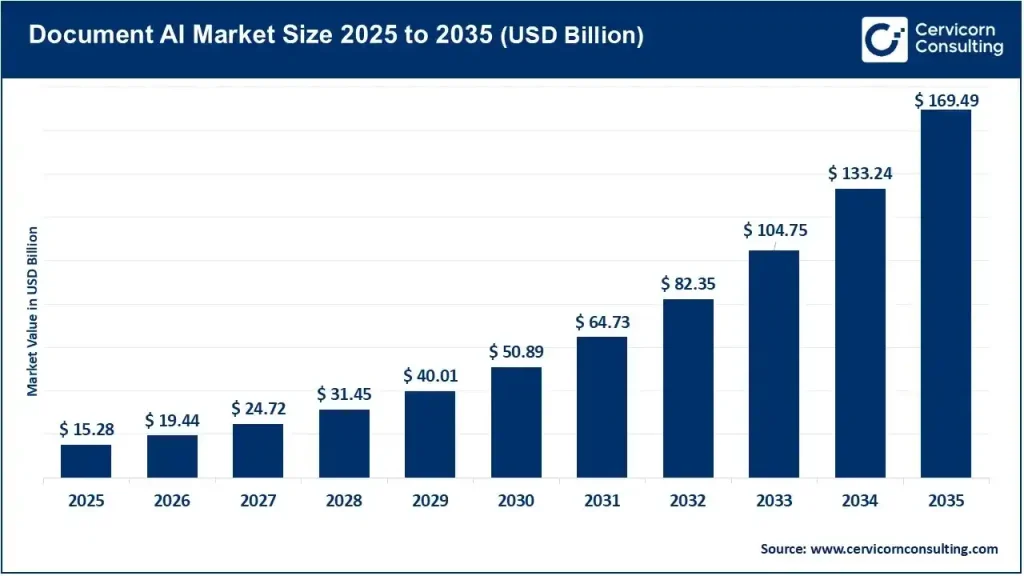
The global document AI market was valued at USD 15.28 billion in 2025 and is projected to reach USD 169.49 billion by 2035, growing at a CAGR of 27.2% from 2026 to 2035. Increasing enterprise adoption of generative AI, machine learning, and intelligent document processing is creating new opportunities to automate document-intensive operations across banking, healthcare, insurance, manufacturing, and government.
However, the business value of Document AI depends on more than the ability to read documents automatically. Companies must determine which processes to automate, how to validate extracted information, which deployment architecture fits their data requirements, and how to integrate AI into existing workflows. Poorly defined use cases, unreliable outputs, and underestimated implementation costs can limit returns even when the underlying technology performs well.
For business leaders, the priority is to treat Document AI as an operational investment rather than a standalone technology upgrade. Six decisions can help organizations improve implementation outcomes and build a more scalable automation strategy.
1. Which Document Workflows Should Companies Automate First?
Not every document-intensive process offers the same automation potential. Some workflows involve standardized invoices or purchase orders, while others require interpreting complex contracts, handwritten forms, insurance claims, or regulatory submissions.
Companies should prioritize processes according to transaction volume, processing time, error frequency, business impact, and the cost of manual intervention.
Key decision factors:
- Processing volume: Identify document categories handled in large quantities, particularly those requiring repetitive data entry.
- Operational bottlenecks: Examine where document reviews delay payments, customer onboarding, claims settlement, or approvals.
- Error consequences: Distinguish between low-risk administrative errors and mistakes that could affect financial reporting, regulatory compliance, or customer eligibility.
- Workflow standardization: Begin with processes that have clearly defined inputs, outputs, and validation rules.
For example, automating invoice extraction may deliver measurable benefits more quickly than automating complex legal interpretation. A company processing thousands of invoices each month can assess improvements in processing time, exception rates, and cost per transaction against an established baseline.
Business implication: The best starting point is not necessarily the most technologically advanced use case. It is the workflow where automation can produce measurable benefits without introducing disproportionate operational risk.
Get a Free Sample: https://www.cervicornconsulting.com/sample/3067
2. How Much Accuracy Is Required Before Automation Can Scale?
Document AI platforms can extract information from scanned documents, tables, forms, and unstructured text. However, performance can vary across document formats, languages, image quality, handwriting styles, and data complexity.
A system that performs well on standard invoices may struggle with poor-quality scans or unusual document layouts. Similarly, extracting a number correctly does not guarantee that the number has been assigned to the right field or interpreted in the correct business context.
Companies should establish accuracy requirements at the field and workflow levels rather than relying on a single platform-wide accuracy score.
Key decision factors:
- Field-level accuracy: Measure performance for critical fields such as invoice totals, tax identifiers, dates, account numbers, and contractual obligations.
- Exception handling: Define how incomplete, inconsistent, or low-confidence outputs are identified and escalated.
- Human review: Determine which transactions require approval before information enters downstream systems.
- Continuous validation: Test performance against new document templates, changing formats, and real-world operating conditions.
Financial institutions, for instance, may require stricter validation for customer identity and lending documentation than for routine internal correspondence. Healthcare organizations must similarly consider the consequences of incorrect information entering clinical or administrative workflows.
Business implication: Automation targets should reflect the cost of errors, not just the percentage of documents processed without human intervention. A slightly slower process with reliable validation may create more value than faster automation that produces expensive downstream corrections.
3. Should Companies Build In-House, Buy a Platform, or Combine Both?
The Document AI market includes specialist document-processing vendors, enterprise automation platforms, cloud-based AI services, and solutions integrated into existing content management systems. Each option offers different trade-offs in implementation effort, flexibility, integration, and long-term ownership.
The decision should be based on the company’s technical capabilities and document-processing requirements rather than the number of features a vendor offers.
Key decision factors:
- Buy: Consider established platforms when standard document-processing capabilities, deployment speed, and vendor support are priorities.
- Build: Consider custom development when workflows involve proprietary document structures, specialized decision rules, or differentiated intellectual property.
- Hybrid approach: Combine existing platforms with custom models, validation logic, or workflow components when neither a fully packaged solution nor a complete in-house build meets requirements.
- Long-term flexibility: Assess model portability, API availability, data export options, integration dependencies, and the ability to change providers.
Forrester’s 2026 analysis of document mining and analytics platforms highlights the importance of matching providers to specific use cases and architectures. It also emphasizes that different platforms have different strengths, making a generic vendor comparison insufficient for complex enterprise requirements.
Business implication: A platform should be evaluated on how effectively it solves the company’s actual document-processing problem, not simply on its AI capabilities. The right approach balances speed to deployment with control over costs, data, and future technology choices.
4. Which Deployment Model Best Fits Data Security and Compliance Requirements?
Document AI systems often process confidential financial records, healthcare information, contracts, employee records, and customer identities. As a result, deployment architecture is both a technical and a governance decision.
Cloud-based solutions can support rapid deployment and scalable processing, while on-premises environments may offer greater control over infrastructure and sensitive data. Hybrid architectures can help organizations separate routine workloads from documents that require additional security or jurisdictional controls.
Key decision factors:
- Data residency: Establish where documents, extracted text, logs, and derived data may be stored and processed.
- Access control: Ensure the AI system respects existing permissions and prevents unauthorized retrieval of sensitive information.
- Retention and deletion: Define how long original files, model inputs, outputs, and audit records are retained.
- Model data usage: Verify whether submitted documents may be used to train or improve third-party models.
- Auditability: Preserve source references and processing records so important outputs can be reviewed and verified.
These requirements are particularly important in banking, healthcare, insurance, and government, where mistakes in document handling can have legal, financial, or reputational consequences.
Business implication: Security and compliance requirements should be established before vendor selection. Retrofitting governance controls after deployment can increase implementation costs and delay broader adoption.
5. How Should Companies Measure the Return on Document AI Investments?
A Document AI business case should measure the full cost of processing a document, not just the software subscription or model inference expense.
Implementation costs may include integration, document preparation, model configuration, testing, employee training, human review, infrastructure, ongoing monitoring, and exception management. These costs can materially change the expected return on investment.
Companies should compare the current process with the proposed automated workflow using consistent operating assumptions.
Key performance indicators to track:
- Cost per document processed.
- Average processing and approval time.
- Percentage of documents processed without manual intervention.
- Extraction accuracy for critical fields.
- Exception and rework rates.
- Compliance-related errors and audit findings.
- Employee capacity released for higher-value work.
A useful evaluation is to calculate the net benefit after accounting for implementation and recurring costs. For example, reduced data-entry time does not automatically translate into cash savings; the organization must determine whether the released capacity reduces overtime, supports higher transaction volumes, or enables employees to perform more valuable tasks.
Companies should also distinguish between benefits that can be measured immediately and those that emerge over time, such as improved customer experience, faster decision-making, and better access to organizational knowledge.
Business implication: Investment decisions should be based on realized operational improvements rather than vendor demonstrations or theoretical productivity gains. Pilot results should establish a credible baseline before large-scale deployment.
6. How Can Companies Scale Document AI Without Creating New Operational Risks?
A successful pilot does not guarantee that a solution will perform consistently across business units, regions, document types, and transaction volumes. Scaling introduces additional challenges involving system integration, changing document formats, model performance, and employee adoption.
Organizations should establish a repeatable deployment framework before expanding automation across multiple functions.
Key decision factors:
- Integration readiness: Connect Document AI with enterprise resource planning, customer relationship management, document management, and workflow systems where appropriate.
- Standardized governance: Define ownership, approval responsibilities, escalation procedures, and performance thresholds.
- Model monitoring: Track changes in accuracy, exception rates, processing costs, and document characteristics.
- Workforce readiness: Train employees to review exceptions, correct outputs, and manage cases that cannot be fully automated.
- Phased expansion: Extend deployment to additional document types only after the initial workflow meets its operational and financial targets.
Companies should also assess whether document AI outputs will merely support employees or trigger downstream actions automatically. Extracting invoice information for review presents a different risk profile from automatically approving payments or modifying customer records.
Business implication: Sustainable scaling requires clear controls over what the AI system can do independently and when human authorization is necessary. Automation should expand in line with demonstrated performance and the organization’s ability to manage exceptions.
What These Decisions Mean for the Document AI Market
The next phase of Document AI adoption will depend on the industry’s ability to move beyond basic text recognition toward contextual understanding, workflow integration, and reliable execution.
Three developments are particularly important for business leaders:
- Multimodal document understanding: Systems that interpret text, tables, images, and complex layouts can address document types that are difficult to process using conventional extraction methods.
- Generative and agentic AI: Organizations are exploring systems that combine document interpretation with tasks such as validation, information retrieval, case routing, and workflow coordination. Greater autonomy also increases the need for controls and oversight.
- Industry-specific solutions: Banking, healthcare, insurance, and other regulated industries require capabilities aligned with their document structures, data policies, and operational risks.
These developments create opportunities for technology vendors, system integrators, and enterprise users. They also make careful evaluation more important: a platform with strong general-purpose AI capabilities may not necessarily be the best choice for a specialized, high-risk workflow.
Conclusion
Document AI can help companies reduce repetitive work, accelerate information processing, and make business data more accessible. However, successful implementation depends on a series of interconnected decisions involving use-case selection, accuracy, architecture, governance, financial returns, and scalability.
Organizations that establish measurable targets, validate performance using representative documents, and integrate appropriate human oversight are better positioned to translate AI capabilities into operational improvements.
For decision-makers evaluating the Document AI market, the central question is no longer simply whether a process can be automated. It is which processes should be automated, under what controls, and at what cost to deliver sustainable business value.
To Get Detailed Overview, Contact Us: https://www.cervicornconsulting.com/contact-us