


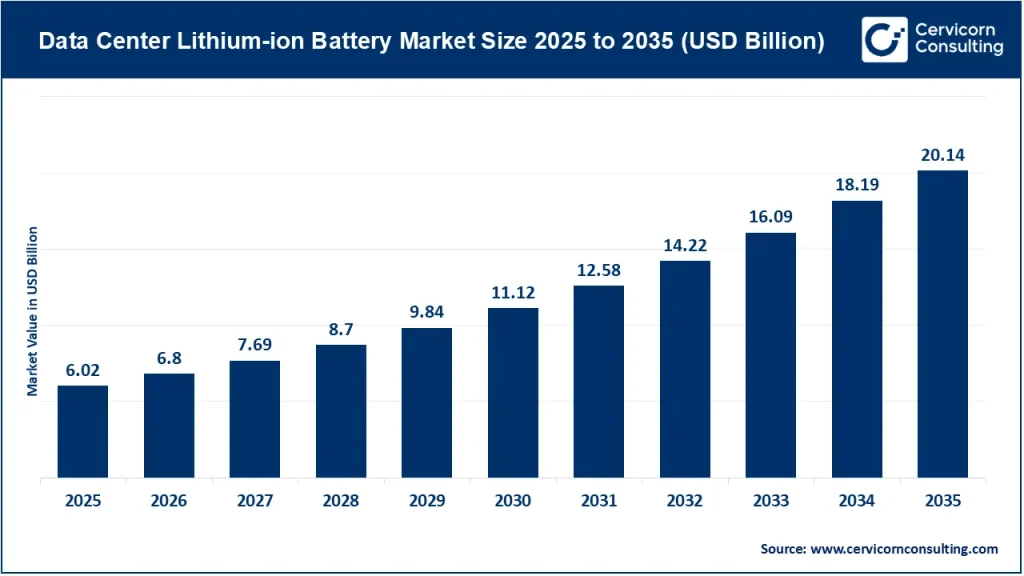
Data Center Lithium-ion Battery Market Size
The global data center lithium-ion battery market size was valued at approximately USD 6.02 billion in 2025 and is projected to reach USD 20.14 billion by 2035, representing a 12.84% CAGR from 2026 to 2035.
Data center lithium-ion battery market growth factors
Growth is being supported by rising data-center power consumption, AI and high-performance computing workloads, increasing deployment of UPS systems, replacement of conventional lead-acid batteries, demand for higher energy density, and the need to reduce maintenance and battery replacement requirements. Lithium-ion batteries can provide longer service life, smaller footprints, lower weight, faster charging, and improved monitoring capabilities compared with conventional VRLA batteries, making them increasingly relevant for modern high-density facilities. Vertiv states that lithium-ion UPS batteries can last two to three times longer than lead-acid alternatives, while Eaton highlights 10- to 15-year lithium-ion battery lifespans compared with substantially shorter replacement cycles for lead-acid systems.
At the same time, the integration of renewable energy, battery energy storage systems, microgrids, and grid-interactive UPS technologies is expanding the role of batteries beyond emergency backup.
Get a Free Sample: https://www.cervicornconsulting.com/sample/2762
What is the data center lithium-ion battery market?
The data center lithium-ion battery market comprises batteries, battery modules, battery cabinets, battery management systems, monitoring technologies, and integrated energy-storage solutions designed to support critical data-center infrastructure.
The batteries are primarily integrated with uninterruptible power supply (UPS) systems to provide immediate backup power when the utility supply is interrupted or experiences voltage instability. They can bridge the period between a grid failure and the start or stabilization of standby generators, protecting servers, storage systems, networking equipment, cooling infrastructure, and other critical loads.
Lithium-ion systems differ from conventional lead-acid batteries primarily through their higher energy density, smaller physical footprint, longer operating life, lower maintenance requirements, and sophisticated battery-management capabilities. Common chemistries used or considered for data-center applications include lithium iron phosphate (LFP), nickel manganese cobalt (NMC), and lithium titanate (LTO).
The market also increasingly includes battery energy storage systems (BESS) that can perform functions beyond conventional UPS backup. These systems may support peak shaving, renewable-energy integration, load shifting, microgrid operation, and grid-support services.
The broader data-center battery market was estimated at approximately USD 3.6 billion in 2025 by several industry studies, although market estimates vary considerably according to scope and methodology. Lithium-ion represents a growing portion of this broader market as operators transition toward higher-density and digitally monitored power infrastructure.
Why is the data center lithium-ion battery market important?
Ensuring business continuity
Data centers support cloud applications, financial transactions, healthcare systems, telecommunications, government services, e-commerce, and AI workloads. Even short power interruptions can disrupt critical operations. Lithium-ion batteries provide rapid-response stored energy for UPS systems, helping maintain continuity during power disturbances.
Saving valuable data-center space
Space is an increasingly important consideration as data centers move toward higher rack densities and AI infrastructure. Lithium-ion batteries provide greater energy density than traditional lead-acid systems, allowing operators to obtain comparable backup capability from a smaller footprint. Vertiv notes that lithium-ion systems can substantially reduce footprint and weight compared with traditional battery configurations.
Reducing maintenance and replacement requirements
Traditional lead-acid batteries often require more frequent replacement. Eaton states that lithium-ion UPS batteries can offer a 10- to 15-year lifespan, compared with typical lead-acid replacement intervals of approximately three to five years. Longer operating life can reduce battery replacement activities, labor requirements, and associated disruptions.
Supporting AI data-center expansion
AI servers and high-performance computing systems are increasing power density and placing additional demands on electrical infrastructure. Battery systems must increasingly operate alongside high-capacity UPS systems, advanced power distribution, and intelligent energy-management platforms.
Schneider Electric, for example, has developed Galaxy UPS platforms with lithium-ion compatibility for medium, large, and hyperscale data centers, while its newer Galaxy VXL platform is designed around high-density and AI-oriented infrastructure requirements.
Enabling energy flexibility
Modern lithium-ion battery systems can potentially support functions beyond emergency backup. Grid-interactive UPS systems can use stored energy for frequency regulation, peak shaving, demand management, and renewable-energy integration. This creates an opportunity for data-center batteries to become active energy assets rather than remaining idle until an outage occurs.
Major companies in the data center lithium-ion battery market
| Company | Specialization | Key Focus Areas | Notable Features | 2025 Revenue | Market Share | Global Presence |
|---|---|---|---|---|---|---|
| Vertiv Group Corp. | Critical digital infrastructure, UPS, thermal management and power systems | Data centers, hyperscale facilities, edge infrastructure, AI infrastructure | LiiON and HPL lithium-ion solutions, integrated UPS and battery monitoring | USD 10.23 billion | Not separately disclosed | 130+ countries |
| Eaton Corporation | Power management, UPS and electrical infrastructure | Data centers, distributed energy, power quality, grid interaction | Lithium-ion UPS systems, EnergyAware technology, intelligent power management | USD 27.45 billion | Not separately disclosed | Global |
| Schneider Electric SE | Energy management and automation | Data centers, critical power, digital infrastructure, AI facilities | Galaxy UPS family, lithium-ion battery options, EcoStruxure monitoring | €40+ billion | Not separately disclosed | Global |
| Legrand SA | Electrical and digital infrastructure | Data centers, power distribution, connectivity and digital infrastructure | Strong data-center portfolio and energy-transition solutions | ~€9.5 billion | Not separately disclosed | Global, 180+ countries |
| Delta Electronics Inc. | Power electronics, UPS, thermal and ICT infrastructure | AI data centers, UPS, batteries, power distribution and cooling | LFP/NMC lithium-ion systems, BMS, high-density power solutions | NT$554.89 billion | Not separately disclosed | Global |
Vertiv reported 2025 net sales of approximately USD 10.23 billion and operates in more than 130 countries. Eaton reported 2025 net sales of USD 27.448 billion. Schneider Electric reported 2025 revenue exceeding €40 billion, while Legrand generated approximately €9.5 billion in 2025. Delta Electronics reported 2025 revenue of approximately NT$554.885 billion. These are company-wide figures rather than lithium-ion data-center battery revenues.
Vertiv Group Corp.
Specialization: Critical digital infrastructure, UPS systems, thermal management, racks, power distribution, and services.
Key focus areas: Hyperscale data centers, AI infrastructure, edge computing, critical power, and integrated digital infrastructure.
Notable features: Vertiv offers lithium-ion UPS solutions and dedicated LiiON and HPL lithium-ion battery systems. Its LiiON systems use LFP chemistry and integrated battery-management capabilities, while its HPL platform uses NMC modules and redundant BMS architecture.
2025 revenue: USD 10.23 billion.
Market share: Lithium-ion data-center battery-specific share is not separately disclosed.
Global presence: More than 130 countries.
Eaton Corporation
Specialization: Electrical power management, UPS, power distribution, energy infrastructure, and industrial power systems.
Key focus areas: Data centers, power quality, distributed energy, grid services, and intelligent energy management.
Notable features: Eaton provides lithium-ion battery systems compatible with UPS platforms such as its 9395 and 93PM families. The company also developed EnergyAware UPS technology that allows lithium-ion UPS batteries to participate in grid-support applications.
2025 revenue: USD 27.448 billion.
Market share: Lithium-ion data-center battery-specific share is not separately disclosed.
Global presence: International operations across multiple regions and major data-center markets.
Schneider Electric SE
Specialization: Energy management, industrial automation, electrical infrastructure, and digital data-center solutions.
Key focus areas: Critical power, UPS, data-center infrastructure management, AI data centers, energy efficiency, and sustainability.
Notable features: Schneider Electric’s Galaxy range includes lithium-ion battery options across multiple UPS capacities. Galaxy VXL is positioned for high-density and AI-oriented environments and supports lithium-ion battery configurations.
2025 revenue: More than €40 billion.
Market share: Lithium-ion data-center battery-specific share is not separately disclosed.
Global presence: Global operations serving customers across North America, Europe, Asia-Pacific, Latin America, the Middle East, and Africa.
Legrand SA
Specialization: Electrical and digital building infrastructure.
Key focus areas: Data centers, power distribution, connectivity, digital infrastructure, energy transition, and critical infrastructure.
Notable features: Legrand has expanded its data-center portfolio through organic development and acquisitions. Data-center activities accounted for 26% of group revenue in 2025, while 53% of sales were associated with energy and digital transition solutions.
2025 revenue: Approximately €9.5 billion.
Market share: Lithium-ion data-center battery-specific share is not separately disclosed.
Global presence: More than 39,600 employees worldwide and operations across a broad international market footprint.
Delta Electronics Inc.
Specialization: Power electronics, UPS, thermal management, ICT infrastructure, and energy infrastructure.
Key focus areas: AI data centers, high-density computing, UPS, lithium-ion batteries, liquid cooling, and advanced power architectures.
Notable features: Delta offers both LFP and NMC lithium-ion battery systems for mission-critical applications. Its UBH Gen3 series provides up to 250 kW of power and 35.5 kWh per cabinet, with stated reductions in space and weight compared with conventional batteries.
2025 revenue: Approximately NT$554.885 billion.
Market share: Lithium-ion data-center battery-specific share is not separately disclosed.
Global presence: International operations spanning Asia, North America, Europe, and other major technology markets.
Leading trends and their impact
Shift from lead-acid to lithium-ion
One of the most important structural trends is the gradual transition from VRLA lead-acid batteries toward lithium-ion systems. Higher energy density, longer operating life, lower weight, faster charging, and reduced maintenance are encouraging operators to consider lithium-ion for new UPS deployments.
This transition is particularly relevant for hyperscale and colocation facilities where space, deployment speed, lifecycle cost, and reliability are major considerations.
AI and high-density computing
AI infrastructure is increasing rack power densities and changing the design requirements for data-center power systems. High-performance GPUs require stable and scalable electrical infrastructure, making UPS systems and battery energy storage increasingly important.
Schneider Electric has specifically positioned its Galaxy VXL architecture for AI environments, while Delta has been expanding integrated power and cooling solutions for high-density AI data centers.
Battery energy storage systems
BESS is emerging as an important complement to conventional UPS systems. Data-center operators can use battery storage to manage peak loads, integrate renewable energy, reduce exposure to electricity-price fluctuations, and potentially provide grid services.
Schneider Electric identifies BESS as a mechanism for addressing rising energy costs and grid instability while supporting renewable-energy integration.
Intelligent battery monitoring
Modern lithium-ion systems increasingly incorporate BMS technologies capable of monitoring temperature, state of charge, battery health, and abnormal operating conditions. This enables predictive maintenance and provides operators with greater visibility into battery performance.
Grid-interactive UPS
The role of batteries is evolving from simple emergency backup toward active energy management. Eaton and Microsoft demonstrated a lithium-ion UPS-based system capable of interacting with the electrical grid for services such as frequency regulation and energy optimization.
Sustainability and circularity
Data-center operators are under increasing pressure to reduce carbon emissions, energy consumption, and resource use. Lithium-ion batteries can contribute to infrastructure efficiency through higher energy density and longer operating life, while regulations are increasingly addressing battery sourcing, safety, recycling, and end-of-life management.
Successful examples of the data center lithium-ion battery market around the world
Microsoft data center in Ireland
Microsoft has explored the use of data-center UPS batteries as grid-support resources. At its Dublin data center, batteries traditionally used for backup power were tested and approved for interaction with the electrical grid. The initiative demonstrated how data-center battery infrastructure can support grid stability and renewable-energy integration while retaining its primary backup-power function.
Microsoft and Eaton in the United States
Microsoft and Eaton collaborated on EnergyAware UPS technology at Microsoft’s Innovation Center in Boydton, Virginia. The project used lithium-ion battery-powered UPS infrastructure as a distributed energy resource capable of interacting with the grid.
The system was designed to provide services such as frequency regulation while maintaining the UPS’s primary role of protecting data-center loads. This example demonstrates the potential for lithium-ion UPS systems to contribute to both data-center resilience and energy-management objectives.
DataVita data center in Scotland
Vertiv deployed a lithium-ion battery and UPS solution at DataVita’s DV2 data center in Glasgow. The facility required an efficient power architecture within a city environment where space was an important constraint.
The solution combined Vertiv Liebert EXL S1 UPS systems with lithium-ion batteries. Vertiv reports benefits including reduced space requirements, lower operating costs, faster recharge capability, and longer battery life.
South Africa data-center deployment
Vertiv also supplied advanced lithium-ion battery infrastructure for a Tier III prefabricated modular data-center project in Johannesburg. The project involved Internet Solutions and Dimension Data and used Vertiv power and thermal-management technologies along with lithium-ion batteries. The modular design was intended to provide reliable infrastructure while reducing operational expenses.
Delta’s high-density data-center infrastructure
Delta has developed lithium-ion UPS battery systems specifically for Internet data centers, including LFP and NMC solutions. Its systems emphasize compact footprints, long service life, integrated UPS compatibility, battery-management technology, and safety certifications. Delta is also expanding integrated power, cooling, and high-voltage DC architectures for AI-oriented data centers.
Global regional analysis including government initiatives and policies shaping the market
North America
North America remains a major market for data-center battery infrastructure because of extensive hyperscale development, cloud adoption, AI infrastructure investment, and the concentration of large technology companies.
The United States is also seeing growing attention to grid impacts from data-center expansion. In September 2026, the U.S. House advanced legislation requiring state utility regulators to consider whether large electricity consumers such as data centers should bear additional infrastructure costs associated with their electricity demand.
For lithium-ion batteries, the region’s policy environment is also influenced by broader energy-storage investment, domestic battery manufacturing, supply-chain security, and renewable-energy deployment. These factors can support demand for battery systems capable of serving both backup and energy-management functions.
Europe
Europe is an important market because data-center operators face strong requirements around energy efficiency, carbon reduction, renewable-energy use, and battery sustainability.
The EU Batteries Regulation, Regulation (EU) 2023/1542, establishes requirements covering battery sustainability, safety, labeling, producer responsibility, collection, recycling, and due diligence. The regulation applies to industrial batteries and therefore has relevance to batteries used in infrastructure and energy-storage applications.
Europe is also increasing scrutiny of data-center resource consumption. In September 2026, the European Commission proposed rules requiring data centers with at least 500 kW capacity to disclose energy and water-efficiency information. The initiative reflects growing policy attention to the environmental performance of digital infrastructure.
These developments can encourage operators to evaluate battery technologies according to lifecycle performance, energy efficiency, safety, and end-of-life management rather than initial purchase price alone.
Asia-Pacific
Asia-Pacific represents a significant growth market due to rapid digitalization, cloud adoption, 5G deployment, AI infrastructure development, and expansion of hyperscale and colocation data centers.
China has implemented dedicated programs to improve the energy efficiency and sustainability of data centers. Its 2025 national green data-center recommendation program encourages high-efficiency facilities and specifically promotes the use of energy storage and other technologies capable of improving load flexibility. The program also establishes efficiency criteria for participating facilities.
China’s broader Green Low-Carbon Data Center Action Plan targets improvements in data-center efficiency, renewable-energy utilization, and computing-resource deployment. It encourages new large and ultra-large data centers to align with national computing-power hubs and supports the integration of renewable-energy resources and storage.
India is another important market because of rapid data-center construction and increasing electricity requirements. The Indian government has established a framework for energy-storage deployment and issued guidelines covering procurement and utilization of battery energy storage systems. Government information released in 2026 cited an estimated requirement of 41.65 GW of BESS capacity by 2029-30 as part of a broader 60.63 GW energy-storage requirement.
At the state level, Karnataka’s Sustainable Data Centre Policy 2026-2031 targets 1 GW of cumulative data-center IT load by 2031 while emphasizing renewable energy, efficient cooling, water management, and robust infrastructure.
Latin America
Latin America is developing as an emerging data-center market, particularly around Brazil, Mexico, Chile, and other digitally connected economies. Growing cloud adoption, telecommunications infrastructure, and enterprise digitization are creating additional requirements for resilient power infrastructure.
Lithium-ion systems can be attractive in markets where operators must balance limited facility space, maintenance requirements, grid reliability, and increasingly demanding uptime expectations. Expansion of renewable-energy projects also creates opportunities for batteries to participate in hybrid power and energy-storage architectures.
Middle East and Africa
The Middle East is experiencing rapid investment in cloud infrastructure, AI, digital services, and large-scale data centers, while countries such as the United Arab Emirates and Saudi Arabia are developing digital infrastructure as part of broader economic-diversification strategies.
Africa’s data-center market is also expanding, particularly in major connectivity hubs. Power reliability remains a significant consideration in several markets, creating demand for UPS systems and battery backup technologies.
Lithium-ion systems can support these facilities by providing compact backup power, longer service life, remote monitoring, and reduced maintenance requirements. The South African deployment of Vertiv lithium-ion technology demonstrates the applicability of advanced battery infrastructure in the region.
Market outlook: technology and investment priorities
The data center lithium-ion battery market is increasingly moving toward integrated power ecosystems rather than standalone backup batteries. Future deployments are likely to combine lithium-ion battery cabinets, UPS systems, BMS platforms, DCIM software, renewable-energy systems, BESS, microgrids, and grid-interactive controls.
The growing concentration of AI workloads is particularly significant because AI data centers require high-density electrical infrastructure and rapid scalability. Battery systems must therefore deliver not only reliable emergency backup but also intelligent monitoring, predictable lifecycle performance, rapid deployment, and compatibility with increasingly sophisticated power architectures.
At the same time, safety, thermal management, battery chemistry, recycling, supply-chain resilience, and regulatory compliance will remain important purchasing considerations. LFP and NMC technologies are already being deployed in different data-center applications, while alternative chemistries and next-generation storage technologies may gradually expand the competitive landscape.
For data-center operators, the investment decision is increasingly shifting from evaluating the initial battery purchase price to assessing total cost of ownership, footprint, lifecycle, maintenance, safety, energy efficiency, scalability, and potential grid-services value. This broader evaluation is likely to remain a key factor shaping the development of the global data center lithium-ion battery market.
To Get Detailed Overview, Contact Us: https://www.cervicornconsulting.com/contact-us
Read Report: AI Inference Market Revenue, Trends, and Strategic Insights by 2035