


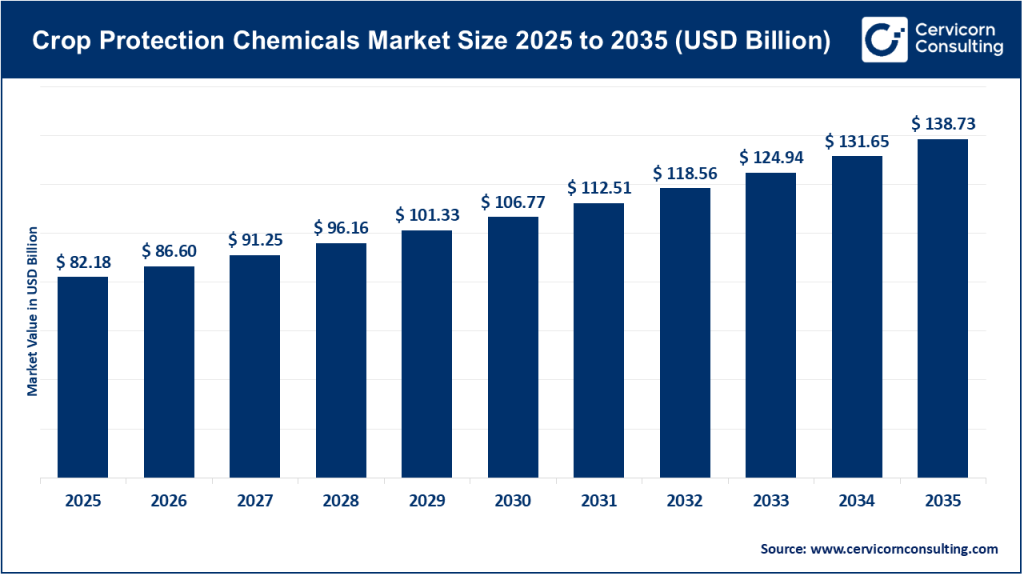
Crop Protection Chemicals Market Size
The global crop protection chemicals market size was worth USD 82.18 billion in 2025 and is anticipated to expand to around USD 138.73 billion by 2035, registering a compound annual growth rate (CAGR) of 5.4% from 2026 to 2035.
Growth Factors Driving the Crop Protection Chemicals Market
The crop protection chemicals market is expanding due to a combination of structural, environmental, technological, and economic drivers. Population growth remains one of the most influential factors, as rising global food demand compels farmers to increase yields while minimizing losses. Climate change introduces additional complexity, altering pest lifecycles, expanding disease zones, and intensifying weed resistance challenges, thereby increasing the necessity for advanced protection strategies. Technological innovation also plays a central role, with new active ingredients, improved formulations, and precision application technologies enhancing product efficiency and safety.
Additionally, evolving agricultural practices—including commercial farming expansion in emerging economies—have widened the market’s customer base. Regulatory developments encouraging safer, more targeted solutions are simultaneously reshaping product portfolios, stimulating investment in biological alternatives and environmentally sustainable chemistries. Rising consumer expectations regarding food quality, combined with government initiatives supporting agricultural modernization, further reinforce market growth. Together, these factors sustain long-term demand for effective crop protection solutions across diverse agricultural systems.
What Is the Crop Protection Chemicals Market?
The crop protection chemicals market refers to the global industry engaged in research, production, distribution, and application of chemical and biological agents that protect crops from harmful organisms. These products are designed to prevent or mitigate damage caused by insects, weeds, fungi, bacteria, nematodes, and other agricultural threats.
The market includes multiple product categories:
- Herbicides – Used to control unwanted weeds that compete with crops for nutrients, water, and sunlight
- Insecticides – Designed to manage insect populations that damage crops
- Fungicides – Protect plants from fungal infections and diseases
- Nematicides – Target soil-borne nematodes
- Biopesticides – Derived from natural materials such as plants, microorganisms, or minerals
This market also integrates complementary technologies such as seed treatments, precision spraying systems, and integrated pest management solutions.
Get a Free Sample: https://www.cervicornconsulting.com/sample/2893
Why the Crop Protection Chemicals Market Is Important
Crop protection chemicals are fundamental to global agricultural productivity. Crop losses caused by pests, weeds, and diseases can be substantial, often exceeding 20–40% of potential yields without proper management. These losses translate directly into reduced food supply, lower farmer income, and increased commodity price volatility.
Beyond yield protection, crop protection chemicals contribute to:
- Food Security – Supporting consistent crop production for growing populations
- Economic Stability – Protecting farm profitability and rural livelihoods
- Land Efficiency – Enabling higher productivity on limited arable land
- Quality Assurance – Maintaining crop quality standards for global trade
- Sustainability Goals – Reducing pressure for land conversion
Modern agriculture would struggle to meet global demand without effective crop protection strategies.
Major Companies Shaping the Crop Protection Chemicals Market
BASF SE
Company Specialization:
BASF SE is one of the world’s largest chemical companies with a strong agricultural solutions division. The company specializes in herbicides, fungicides, insecticides, seed treatments, and digital farming technologies.
Key Focus Areas:
BASF emphasizes innovation-driven crop protection, sustainable solutions, and precision agriculture integration. Significant investment is directed toward developing safer chemistries and resistance-management products.
Notable Features:
- Extensive global R&D network
- Strong pipeline of new active ingredients
- Focus on environmentally optimized formulations
2024 Revenue (Estimated):
BASF maintains multi-billion-dollar agricultural revenues as part of its broader chemical business.
Market Share:
BASF holds a substantial share of the global crop protection industry.
Global Presence:
Operations span Europe, North America, Asia-Pacific, and Latin America.
Bayer CropScience
Company Specialization:
Bayer CropScience is a leading global provider of crop protection chemicals, seeds, and digital agriculture technologies.
Key Focus Areas:
The company integrates chemistry with digital farming, artificial intelligence, and precision application technologies. Sustainability and productivity optimization remain central priorities.
Notable Features:
- Advanced research capabilities
- Digital agriculture platforms
- Strong herbicide and insecticide portfolio
2024 Revenue (Estimated):
Bayer’s agricultural division generates significant global revenues.
Market Share:
Bayer consistently ranks among the largest crop protection players worldwide.
Global Presence:
Strong footprint across North America, Europe, Latin America, and Asia.
Syngenta Group
Company Specialization:
Syngenta Group is a major global agribusiness specializing in crop protection chemicals and seeds.
Key Focus Areas:
The company focuses on integrated crop solutions, including herbicides, fungicides, insecticides, and biological products.
Notable Features:
- Broad product portfolio
- Strong presence in emerging markets
- Continued R&D investments
2024 Revenue (Estimated):
Syngenta remains a high-revenue participant in global agriculture.
Market Share:
Syngenta commands a significant share of crop protection sales.
Global Presence:
Extensive reach across Latin America, Asia-Pacific, Europe, and North America.
Corteva Agriscience
Company Specialization:
Corteva Agriscience combines seed technologies with crop protection chemistry.
Key Focus Areas:
Innovation, biological solutions, and integrated pest management technologies.
Notable Features:
- Balanced seed and chemical portfolio
- Focus on sustainable farming solutions
- Strong innovation pipeline
2024 Revenue (Estimated):
Corteva generates multi-billion-dollar revenues globally.
Market Share:
Maintains a strong position among top industry participants.
Global Presence:
Active across the Americas, Europe, and Asia.
FMC Corporation
Company Specialization:
FMC Corporation specializes in innovative insecticides, fungicides, and biological crop protection products.
Key Focus Areas:
Next-generation active ingredients, precision compatibility, and sustainability.
Notable Features:
- Strong insecticide leadership
- Focus on biological expansion
- Global innovation programs
2024 Revenue (Estimated):
FMC sustains significant revenues from agricultural sciences.
Market Share:
Holds a meaningful global market position.
Global Presence:
Broad operational network across major agricultural regions.
Leading Trends and Their Impact
1. Rise of Biological Crop Protection
Biopesticides and biological agents are gaining traction as regulators and consumers push for environmentally safer solutions. This shift is reshaping product portfolios and R&D strategies.
Impact:
- Increased innovation investments
- Expansion of sustainable product lines
- New market entrants and partnerships
2. Precision Agriculture Integration
Farmers increasingly adopt drones, sensors, GPS sprayers, and AI-driven analytics for optimized chemical application.
Impact:
- Reduced input waste
- Improved cost efficiency
- Enhanced environmental performance
3. Resistance Management
Pest resistance challenges drive demand for novel chemistries and multi-mode-of-action products.
Impact:
- Accelerated R&D cycles
- Development of advanced formulations
- Greater emphasis on integrated solutions
4. Sustainability-Driven Innovation
Regulatory frameworks worldwide encourage reduced toxicity and safer chemical use.
Impact:
- Growth of bio-based solutions
- Reformulation of existing products
- Industry transformation toward greener technologies
5. Emerging Market Expansion
Developing economies increasingly invest in agricultural productivity.
Impact:
- Rising chemical adoption
- Growth opportunities for manufacturers
- Diversification of demand centers
Successful Examples Across the World
Latin America’s High-Efficiency Agriculture
Brazil and Argentina utilize advanced herbicide and fungicide systems to support large-scale soybean and corn production.
Europe’s Biological Transition
European agriculture increasingly integrates biological crop protection with conventional solutions.
North America’s Precision Farming
Digital agriculture tools enable targeted crop protection strategies.
Asia’s Productivity Modernization
Countries like India and China adopt crop protection technologies to enhance yields and food security.
Global Regional Analysis
North America
Highly mechanized farming, precision agriculture adoption, and advanced regulatory oversight characterize this market.
Policy Influence:
Strict safety regulations and innovation-friendly frameworks shape product approvals.
Europe
Europe leads sustainability-driven regulation with strong emphasis on reduced chemical usage.
Policy Influence:
Encouragement of biological alternatives and integrated pest management.
Asia-Pacific
Largest and fastest-growing regional market driven by agricultural dependence.
Policy Influence:
Government initiatives supporting productivity and modernization.
Latin America
A major growth engine supported by export-oriented agriculture.
Policy Influence:
Policies balancing productivity, biotechnology adoption, and chemical use.
Middle East & Africa
Gradual growth supported by food security initiatives and agricultural investment.
Policy Influence:
Programs focused on yield improvement and resource efficiency.
To Get Detailed Overview, Contact Us: https://www.cervicornconsulting.com/contact-us
Read Report: Switchgear Market Growth Drivers, Trends, Key Players and Regional Insights by 2035