


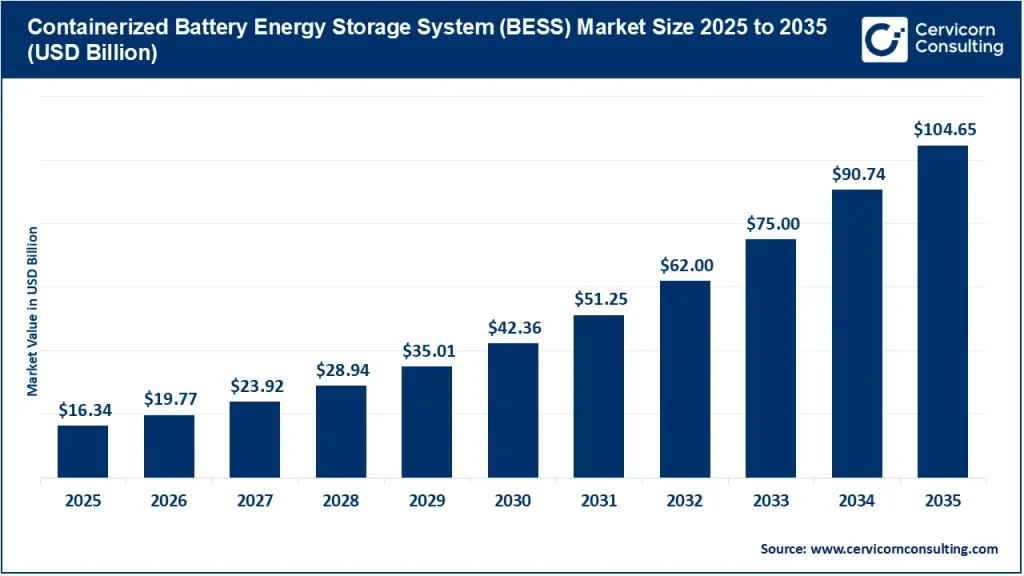
Containerized Battery Energy Storage System (BESS) Market Size
The global containerized battery energy storage system (BESS) market is projected to reach USD 16.34 billion in 2025 and approximately USD 104.65 billion by 2035, representing a CAGR of 20.41%.
Containerized Battery Energy Storage System (BESS) Market Growth Factors
The containerized BESS market is expanding because of the rapid deployment of renewable energy, growing electricity demand, grid modernization, declining battery costs, increasing requirements for peak-load management, and the need for reliable backup power. Solar and wind generation are inherently variable, creating a need for flexible storage systems that can absorb excess electricity and release it when generation falls or demand increases. Containerized architectures are particularly attractive because they can be manufactured, tested, transported, installed, and expanded in modular blocks, reducing project deployment complexity.
Utilities are increasingly using BESS for frequency regulation, voltage support, peak shaving, energy arbitrage, congestion management, and ancillary services, while commercial and industrial users deploy batteries to reduce demand charges and improve power resilience. Data centers are another emerging demand center because AI workloads are increasing electricity requirements and making power reliability increasingly important. Government incentives are also accelerating adoption: India, for example, has expanded its BESS viability-gap-funding support to approximately 43,850 MWh, while Australia is using its Capacity Investment Scheme to support renewable generation and dispatchable battery capacity.
Get a Free Sample: https://www.cervicornconsulting.com/sample/2753
What Is the Containerized Battery Energy Storage System (BESS) Market?
The containerized BESS market covers the development, manufacturing, integration, deployment, and servicing of battery-based energy storage systems packaged within containerized enclosures. Instead of constructing a battery storage facility entirely from individually installed components, containerized systems consolidate major equipment into an integrated unit.
A typical containerized BESS contains:
- Lithium-ion battery cells and modules
- Battery management system (BMS)
- Power conversion system (PCS)
- Energy management system (EMS)
- HVAC and thermal-management equipment
- Fire detection and suppression systems
- Protection and electrical switchgear
- Monitoring and communications systems
- Safety and cybersecurity controls
Lithium iron phosphate (LFP) chemistry has become particularly important because of its balance of safety, cycle life, cost, and suitability for stationary applications. The containerized architecture allows developers to install multiple units in parallel, making the technology appropriate for projects ranging from several megawatt-hours to multi-gigawatt-hour installations.
Why Is Containerized BESS Important?
Containerized BESS is important because renewable-energy expansion alone does not guarantee reliable electricity. Solar generation peaks during daylight hours, while electricity demand can remain high during evening periods. Wind output can also fluctuate considerably. Battery storage provides a mechanism for shifting electricity across time.
For grid operators, BESS can provide rapid-response services that conventional generation cannot always deliver economically. Batteries can respond in milliseconds to changes in grid frequency, helping stabilize power systems. They can also store electricity when wholesale prices are low and discharge during high-price periods.
For businesses, containerized systems provide backup power, demand management, renewable-energy integration, and potentially lower electricity costs. Their modular architecture is also valuable in remote areas, mining operations, islands, military facilities, and microgrids where conventional grid infrastructure can be expensive or difficult to expand.
The importance of the technology is increasing alongside electrification, data-center expansion, electric-vehicle charging infrastructure, and industrial decarbonization.
Competitive Landscape and Leading Companies
The competitive landscape includes battery manufacturers, electrical-equipment suppliers, energy-storage integrators, software companies, and renewable-energy developers. Among the prominent companies relevant to the containerized BESS ecosystem are CATL, Samsung SDI, ABB, Eaton, and Fluence.
| Company | Specialization | Key Focus Areas | Notable Features | 2025 Revenue | Market Share* | Global Presence |
|---|---|---|---|---|---|---|
| CATL | Battery cells, ESS batteries and integrated storage | Utility-scale storage, renewable integration, grid storage | Large-scale manufacturing, LFP technology, containerized ESS platforms | RMB 423.7B | ~13.5% of global BESS container/enclosure market | China, Europe, North America, Asia and other global markets |
| Samsung SDI | Lithium-ion batteries and ESS | Utility, commercial and industrial storage | LFP/NCA ESS batteries, next-generation battery technologies | KRW 13.27T | Not separately disclosed | South Korea, U.S., Europe and Asia |
| ABB | Electrification, PCS, automation and grid solutions | Grid integration, microgrids, power conversion and controls | Electrical infrastructure, automation and energy-management capabilities | USD 33.22B | Not separately disclosed | Europe, Americas, Asia, Middle East and Africa |
| Eaton | Power management and electrical systems | Microgrids, distributed energy, data centers and grid-edge applications | Electrical distribution, power quality and energy-management solutions | USD 27.45B | Not separately disclosed | North America, Europe, Asia-Pacific and other markets |
| Fluence | Grid-scale energy storage and software | Utility storage, optimization, digital energy management | Integrated storage, asset optimization software and services | USD 2.26B | Among leading global integrators; exact containerized share not separately disclosed | Americas, Europe, Asia-Pacific and Middle East/Africa |
CATL
CATL has emerged as one of the most influential companies in the stationary energy-storage market. The company reported RMB 423.7 billion in revenue in 2025, while energy-storage battery shipments accounted for 30.4% of global energy-storage battery shipments, according to SNE Research data cited by CATL. CATL also reported approximately 2,300 energy-storage projects globally and more than 160% year-over-year growth in shipments from its energy-storage system integration business.
Its focus includes high-energy-density batteries, LFP technology, long-duration storage, grid-scale systems, battery safety, and integrated energy-storage solutions. CATL’s large manufacturing footprint gives it an important advantage in supplying containerized systems at scale.
Samsung SDI
Samsung SDI is strengthening its position in stationary storage through lithium-ion battery technologies. The company reported KRW 13.27 trillion in annual revenue in 2025 and highlighted strong ESS battery sales during the year. Its strategy includes expanding NCA and LFP battery applications for ESS and developing next-generation battery technologies.
The company is particularly relevant to premium energy-storage applications requiring high reliability, safety, and advanced battery performance.
ABB
ABB operates across electrification, automation and power technologies rather than focusing exclusively on battery manufacturing. In 2025, ABB generated USD 33.22 billion in revenue, with its Electrification business accounting for USD 17.36 billion.
Its importance in containerized BESS comes from the electrical infrastructure surrounding batteries: power conversion, switchgear, grid connection, automation, protection, microgrid controls and energy management. This allows ABB to participate in BESS projects even when it is not supplying the battery cells themselves.
Eaton
Eaton generated USD 27.45 billion in net sales in 2025, up from USD 24.88 billion in 2024. Its BESS-related capabilities are centered on power management, electrical distribution, microgrids, data-center infrastructure, protection, controls and energy optimization.
The company’s positioning is particularly attractive as BESS moves closer to commercial buildings, industrial facilities and data centers where batteries must interact with broader electrical infrastructure.
Fluence
Fluence is one of the major global energy-storage integrators. Its fiscal 2025 revenue was approximately USD 2.26 billion, including USD 2.17 billion from energy-storage products and solutions.
The company ended fiscal 2025 with approximately USD 5.3 billion in backlog, while annual order intake exceeded USD 1.4 billion during the fourth quarter. Fluence focuses on grid-scale storage, asset optimization, digital software, services and integrated energy-storage projects.
Leading Trends and Their Impact
1. Shift Toward LFP Battery Chemistry
LFP is increasingly preferred for stationary storage because energy density is generally less important in stationary applications than cost, thermal stability, cycle life and safety. The shift toward LFP can reduce system costs and improve the economic case for large-scale storage.
Impact: Lower system costs are making four-hour and longer-duration BESS projects increasingly commercially viable.
2. Growth of Renewable-Plus-Storage Projects
Solar-plus-storage and wind-plus-storage projects are becoming standard components of new power infrastructure. Batteries allow renewable developers to shift generation into higher-value periods.
Impact: Containerized BESS becomes an enabling technology for turning variable renewable generation into more dispatchable electricity.
3. Larger Container Capacities
Manufacturers are continuously increasing the energy capacity of individual containers. Higher-capacity systems can reduce the number of containers, foundations, cables and balance-of-system components required per project.
Impact: Higher energy density can reduce land requirements, installation complexity and balance-of-system costs.
4. AI and Data-Center Power Demand
The rapid construction of AI data centers is creating new requirements for reliable and flexible electricity infrastructure. Battery storage can support peak management, backup power, renewable-energy integration and grid services.
CATL, for example, reports that its storage technology supporting an AI data center in Shanghai helps save more than 10 million kWh annually and reduces electricity costs by approximately 7%.
Impact: Data centers could become a major high-value application for advanced BESS and hybrid power systems.
5. Battery Safety and Thermal Management
As BESS projects become larger, developers and regulators are placing greater emphasis on thermal runaway prevention, fire detection, fire suppression, ventilation, monitoring and emergency response.
Impact: Safety technology is becoming a competitive differentiator rather than simply a compliance requirement.
6. Digitalization and AI-Based Energy Management
Modern BESS increasingly incorporates cloud platforms, predictive analytics, machine learning and automated energy-management software.
Impact: Software can improve battery utilization, optimize charging and discharging, forecast electricity prices and increase project revenues from multiple grid services.
7. Longer-Duration Storage
Although lithium-ion batteries remain dominant, the industry is increasingly exploring systems capable of four, six, eight or more hours of storage.
Impact: Longer-duration BESS can expand the addressable market beyond frequency regulation and short-duration peak shaving into renewable firming and broader energy shifting.
Successful Examples of Containerized BESS Around the World
China
China has become a global center for large-scale battery manufacturing and deployment. CATL reported approximately 2,300 energy-storage projects worldwide and continued to expand its energy-storage system integration business.
China’s enormous renewable-energy base creates strong demand for grid-scale storage. Its manufacturing ecosystem also enables rapid commercialization of high-capacity containerized systems.
United States
The U.S. has become one of the world’s largest markets for grid-scale BESS. Projects increasingly combine lithium-ion battery containers with solar farms, transmission infrastructure and standalone storage assets.
Federal clean-electricity incentives have supported investment in energy-storage technology. The U.S. Treasury and IRS finalized rules for the technology-neutral Clean Electricity Investment Credit under Section 48E, which applies to qualifying energy-storage technology placed in service after 2024.
Fluence’s fiscal 2025 results illustrate the scale of the U.S.-centered market, with revenue of approximately USD 2.3 billion and a record USD 5.3 billion backlog.
Australia
Australia is becoming an important demonstration market for large-scale batteries because of high renewable penetration and the need to replace retiring thermal generation.
The Australian government’s Capacity Investment Scheme is designed to accelerate investment in renewable generation and clean dispatchable capacity such as battery storage. In 2025, the government increased the scheme’s capacity target from 32 GW to 40 GW, with the uplift expected to support approximately 5 GW of additional storage.
CIS Tender 3 selected 16 large-scale battery projects representing 4.13 GW and approximately 15.37 GWh of storage capacity.
India
India is developing a rapidly expanding BESS ecosystem to support solar and wind integration. The government has expanded VGF support substantially, with the Central Electricity Authority reporting support for around 43,850 MWh of BESS capacity.
The country’s 2029–30 planning requirement is estimated at 41.65 GW of BESS, alongside pumped-storage capacity, highlighting the scale of the future opportunity.
Global Regional Analysis and Government Initiatives
North America
North America is expected to remain one of the most attractive BESS markets because of renewable deployment, aging grid infrastructure, rising electricity demand and data-center expansion.
In the U.S., Section 48E and related clean-energy policies provide an important investment framework for energy-storage projects. The policy environment has encouraged developers to combine batteries with solar and standalone grid-scale storage.
The region is also witnessing increasing interest in domestic battery manufacturing and supply-chain localization. For containerized BESS manufacturers, North America represents a major market for large utility projects as well as commercial and industrial applications.
Europe
Europe’s BESS market is being driven by renewable integration, energy security, electricity-price volatility and the need for greater grid flexibility. The region’s transition away from fossil-fuel dependence has increased the value of fast-response storage.
The market is moving toward utility-scale systems, balancing services, solar-plus-storage projects and behind-the-meter applications. European buyers are also placing increasing emphasis on battery traceability, lifecycle management, safety and sustainability.
For suppliers, Europe represents a market where compliance, cybersecurity, recycling and lifecycle carbon considerations can influence purchasing decisions alongside price and technical specifications.
Asia-Pacific
Asia-Pacific is the manufacturing and deployment center of the global battery-storage industry. China has extensive battery-cell manufacturing capacity and is also one of the world’s largest renewable-energy markets. Japan and South Korea continue to contribute advanced battery technologies, while India is developing substantial grid-scale storage capacity.
China’s manufacturing dominance creates cost advantages for containerized BESS suppliers, while India’s policy support is creating a rapidly developing market for utility-scale projects.
India’s VGF programs, ISTS-charge exemptions and energy-storage procurement frameworks are intended to improve project economics. The government has also promoted co-location of ESS with solar projects and expanded the range of ownership and operating models available for storage assets.
Latin America
Latin America represents an emerging opportunity because of substantial solar and wind resources, increasing electricity demand and grid constraints. Chile, Brazil and other countries are exploring storage to manage renewable intermittency and improve system reliability.
Chile is particularly attractive for storage because its large solar resources can create significant midday generation surpluses that batteries can shift toward evening demand.
The region’s market development will depend on electricity-market reforms, storage remuneration mechanisms, grid investment and project-financing availability.
Middle East & Africa
The Middle East is increasingly investing in solar power and large-scale storage as countries diversify their energy systems. Large renewable projects paired with batteries can provide dispatchable clean electricity and reduce dependence on conventional peaking generation.
The United Arab Emirates and Saudi Arabia are among the markets attracting major interest in large-scale energy storage. In Africa, containerized BESS has additional potential for mini-grids, remote industrial operations, telecommunications infrastructure and locations with unreliable grid connections.
For African markets, modular containerized systems can be particularly valuable because they can be deployed incrementally without requiring the construction of extensive centralized generation infrastructure.
Government Policies Shaping the Containerized BESS Market
Government policy is increasingly influencing the economics and deployment speed of containerized BESS.
United States: Clean Electricity Investment Credits and related federal clean-energy incentives support qualifying storage investments.
India: VGF support, ISTS-charge waivers, storage procurement guidelines and national energy-storage frameworks are directly reducing barriers to BESS deployment. India’s government has expanded VGF programs to support tens of gigawatt-hours of storage.
Australia: The Capacity Investment Scheme provides a revenue-underwriting mechanism for renewable generation and dispatchable storage, reducing investment risk for large battery projects.
China: Government-backed investment in renewable energy, grid modernization and battery manufacturing has supported the development of a large domestic storage ecosystem. At the same time, China’s battery industry is entering a more mature phase; notably, Reuters reported on September 7, 2026 that China had temporarily halted approvals for new battery-storage manufacturing projects, potentially affecting future supply-chain expansion.
Europe: European energy policy increasingly emphasizes renewable integration, grid flexibility, energy security, decarbonization and battery sustainability. These factors favor storage systems that can deliver multiple grid services while meeting increasingly stringent environmental and safety requirements.
The policy environment therefore remains one of the most important determinants of containerized BESS deployment. Incentives that reduce upfront capital costs, guarantee revenue, provide market access or lower transmission costs can substantially improve project economics and accelerate commercial adoption.
To Get Detailed Overview, Contact Us: https://www.cervicornconsulting.com/contact-us
Read Report: Software-Defined Hardware Market Revenue, Trends, and Strategic Insights by 2035