


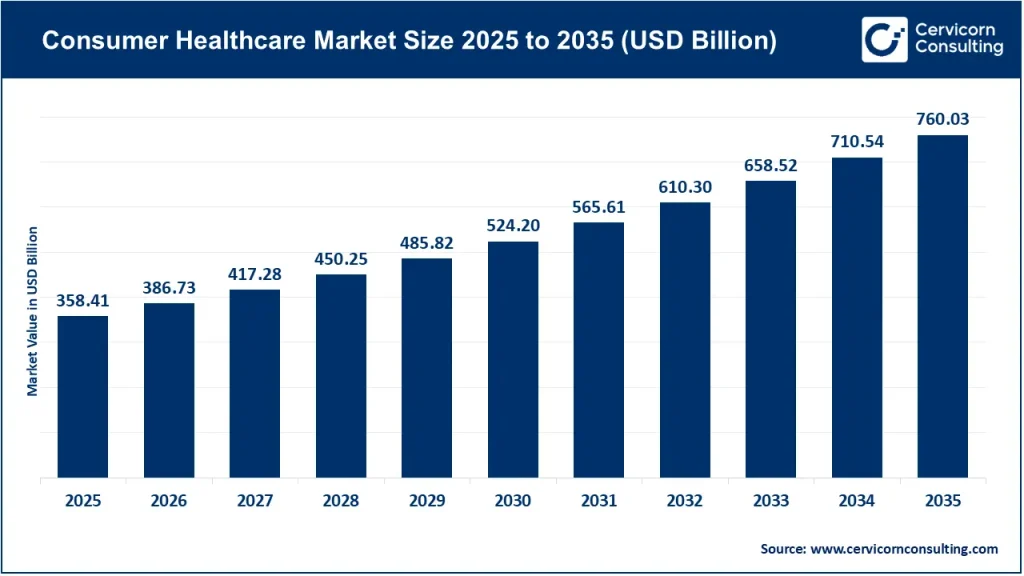
Consumer Healthcare Market Size
The global construction technology market was valued at approximately USD 358.41 billion in 2025and is projected to reach USD 760.03 billion by 2035, expanding at a CAGR of 7.81% during the forecast period.
Consumer Healthcare Market Growth Factors
The consumer healthcare market is being driven by several interconnected factors, including rising consumer awareness of preventive healthcare, increasing healthcare expenditure, growing incidence of lifestyle-related conditions, aging populations, demand for convenient self-treatment, expanding OTC product availability, increasing adoption of vitamins and dietary supplements, digitalization of pharmacies and healthcare retail, rapid growth of e-commerce, product innovation, urbanization, and rising disposable incomes in emerging economies. Consumers are increasingly seeking products that support immunity, digestive health, sleep, mental wellness, healthy aging, weight management, and active lifestyles rather than focusing only on treatment after illness occurs.
At the same time, healthcare systems in many countries are encouraging appropriate self-care for minor conditions to reduce pressure on physicians and hospitals. Regulatory developments are also supporting broader access to selected nonprescription medicines. For example, the U.S. FDA’s 2024 final rule created a framework for nonprescription drugs that can use additional conditions, such as questionnaires, to support appropriate consumer self-selection and use.
Get a Free Sample: https://www.cervicornconsulting.com/sample/2717
What Is the Consumer Healthcare Market?
The consumer healthcare market refers to the ecosystem of products and services that allow individuals to manage health and wellness needs directly or with limited professional supervision. Unlike traditional prescription-focused healthcare, consumer healthcare emphasizes accessibility, convenience, prevention, self-care, and everyday health management.
Major product categories include:
- OTC medicines for pain, fever, cough, cold, allergy, gastrointestinal problems, and minor skin conditions.
- Vitamins, minerals, herbal products, probiotics, protein supplements, and other dietary supplements.
- Oral healthcare products such as toothpaste, mouthwash, dental gels, and specialized oral-care products.
- Dermatology and skincare products designed for acne, dry skin, sun protection, and other common conditions.
- Digestive-health products, including antacids, laxatives, probiotics, and digestive supplements.
- Nutrition and wellness products supporting immunity, energy, healthy aging, sports performance, and weight management.
- Consumer health devices and digital tools that support monitoring, prevention, and personal wellness.
The market therefore sits at the intersection of pharmaceuticals, nutrition, wellness, personal care, medical technology, retail, and digital healthcare.
Why Is Consumer Healthcare Important?
Consumer healthcare plays an important role in improving accessibility and encouraging individuals to become more involved in managing their health. OTC medicines can provide convenient treatment for many minor conditions without requiring a physician appointment, while supplements and wellness products support preventive health strategies.
The sector can also reduce pressure on healthcare systems by enabling appropriate self-care for minor ailments. In the United Kingdom, for example, government policy has increasingly explored medicine reclassification to allow suitable treatments to become available through pharmacies or OTC channels, helping patients access care without always needing a general-practitioner appointment.
Consumer healthcare is also important because it supports health literacy. As consumers increasingly search online for information about symptoms, nutrition, medicines, and wellness, companies are investing in educational content, digital platforms, personalized recommendations, and connected health solutions.
Major Companies in the Consumer Healthcare Market
The competitive landscape includes multinational pharmaceutical companies, nutrition companies, chemical and ingredient manufacturers, wellness companies, and specialized OTC brands. Five notable participants include Abbott Laboratories, Amway Corporation, BASF SE, Bayer AG, and Boehringer Ingelheim International GmbH.
| Company | Specialization | Key Focus Areas | Notable Features | 2025 Revenue | Consumer Healthcare Market Share | Global Presence |
|---|---|---|---|---|---|---|
| Abbott Laboratories | Healthcare, nutrition, diagnostics, medical devices, pharmaceuticals | Nutrition, established pharmaceuticals, diagnostics, medical devices | Strong science and diversified healthcare portfolio | USD 44.3 billion | Not separately disclosed | Global operations across major markets |
| Amway Corporation | Nutrition, wellness, beauty and personal care | Vitamins, supplements, gut health, nutrition and wellness | Direct-selling model; Nutrilite is a major global nutrition brand | USD 7.3 billion | Not separately disclosed | 100+ countries and territories |
| BASF SE | Chemicals, nutrition and care ingredients | Nutrition, personal care ingredients, specialty chemicals | Major global ingredient and formulation capabilities | EUR 59.7 billion | Not separately disclosed | Nearly every major global market |
| Bayer AG | Pharmaceuticals, consumer health and agriculture | OTC medicines, dermatology, digestive health, pain and cardiovascular health | Strong consumer-health brand portfolio | EUR 45.6 billion group sales; EUR 5.8 billion Consumer Health sales | Not separately disclosed | Global |
| Boehringer Ingelheim International GmbH | Pharmaceuticals and animal health | Human pharmaceuticals, respiratory health, metabolic health | Research-intensive privately held pharmaceutical company | EUR 27.8 billion | Not separately disclosed | Global |
Abbott Laboratories
Abbott has a diversified position across nutrition, established pharmaceuticals, diagnostics, and medical devices. Its consumer-health exposure is particularly associated with nutrition products and wellness-oriented solutions. The company reported USD 44.3 billion in full-year 2025 sales, with growth led by medical devices and established pharmaceuticals.
Abbott’s key advantage is its ability to combine clinical research, nutrition science, diagnostics, and consumer-facing products. This creates opportunities in areas such as healthy aging, specialized nutrition, metabolic health, and preventive monitoring.
Amway Corporation
Amway is a major global direct-selling company with a strong concentration in health and wellness. Its portfolio includes Nutrilite nutrition products, Artistry beauty products, and other consumer wellness offerings.
Amway reported USD 7.3 billion in global sales for 2025, while its health and wellbeing portfolio remained a central component of its business. The company operates across more than 100 countries and territories and has more than one million Amway Business Owners worldwide.
Its Nutrilite business is particularly significant because consumers are increasingly seeking vitamins, minerals, plant-based nutrition, probiotics, and products supporting holistic wellness.
BASF SE
BASF participates in consumer healthcare primarily through its Nutrition & Care activities and its role as a supplier of ingredients and specialty solutions used in nutrition, personal care, and health-related applications.
BASF generated EUR 59.7 billion in sales in 2025, including approximately EUR 649 million in EBITDA before special items from its Nutrition & Care segment.
Rather than competing exclusively through finished consumer brands, BASF benefits from the growing consumer healthcare industry by supplying ingredients, formulation technologies, and specialty materials to manufacturers. This positions the company to benefit from trends such as functional nutrition, personal care innovation, sustainable formulations, and advanced health products.
Bayer AG
Bayer has one of the strongest direct positions among the listed companies in consumer healthcare. Its portfolio covers digestive health, dermatology, pain and cardiovascular health, allergy and cold products, and nutritional products.
Bayer reported EUR 45.6 billion in group sales in 2025, including EUR 5.8 billion from Consumer Health. Bayer said its Consumer Health business remained broadly stable on a currency- and portfolio-adjusted basis, with gains in digestive health, dermatology, and pain and cardiovascular categories offset by declines in nutritionals and allergy and cold products.
The company’s broad geographic reach and established brands provide significant advantages in the OTC and self-care market.
Boehringer Ingelheim International GmbH
Boehringer Ingelheim is primarily a pharmaceutical company rather than a traditional consumer-health company. Nevertheless, its focus on respiratory, metabolic, cardiovascular, and other healthcare areas gives it relevance to the broader consumerization of healthcare.
The company reported EUR 27.8 billion in group net sales in 2025, up 7.3%, while investing EUR 6.4 billion in R&D, equivalent to 22.9% of company-wide net sales.
Its research-intensive model can support the longer-term expansion of products and therapies into more accessible healthcare channels where regulations permit.
Leading Trends and Their Impact on the Consumer Healthcare Market
1. Preventive Healthcare and Wellness
Consumers are moving from reactive treatment toward preventive health management. Vitamins, minerals, probiotics, functional foods, immunity products, sleep-support solutions, and healthy-aging products are benefiting from this shift.
The impact is particularly strong in developed markets where consumers have greater health awareness and purchasing power. Emerging economies are also adopting preventive wellness as urbanization and middle-class expansion increase.
2. Personalized Consumer Healthcare
Personalization is becoming an important competitive differentiator. Consumers increasingly expect health products and recommendations based on age, lifestyle, dietary patterns, activity levels, health objectives, and individual preferences.
Digital questionnaires, wearable devices, health apps, AI-enabled recommendations, and personalized nutrition platforms are helping companies create more targeted consumer experiences.
3. E-Commerce and Digital Pharmacies
Online retail has transformed how consumers discover, compare, purchase, and reorder healthcare products. E-commerce provides access to a wider product assortment while enabling subscription models and personalized recommendations.
Digital channels are especially valuable for vitamins, supplements, skincare, oral care, and nonprescription medicines. However, regulation of online medicine sales and advertising remains an important consideration.
4. Functional Nutrition and Gut Health
Gut health has moved from a niche wellness category toward a mainstream consumer-health priority. Probiotics, prebiotics, fiber, fermented products, digestive supplements, and microbiome-focused products are attracting significant consumer attention.
Amway’s expansion of gut-health solutions illustrates how companies are responding to this trend through combinations of supplements, plant-based nutrition, fiber, and probiotics.
5. Healthy Aging
The global aging population is generating demand for products supporting bone health, joint health, cardiovascular wellness, cognitive function, immunity, nutrition, and mobility.
This trend is encouraging companies to develop products targeted toward older consumers while also promoting healthy-aging strategies among younger populations.
6. Digital Health and Connected Devices
Wearables and connected consumer-health devices are increasingly becoming part of everyday health management. Smartwatches, glucose-monitoring technologies, fitness trackers, connected blood-pressure devices, and other sensors can provide consumers with continuous health information.
The integration of artificial intelligence with wearable data could further shift consumer healthcare from episodic treatment toward continuous monitoring and early intervention.
7. Clean-Label and Sustainable Products
Consumers increasingly scrutinize ingredients, packaging, sourcing, and manufacturing practices. This has encouraged companies to develop products with recognizable ingredients, plant-based formulations, recyclable packaging, and more sustainable supply chains.
Sustainability is also becoming relevant to ingredient suppliers such as BASF, which is investing in solutions intended to support sustainable transformation across industries.
Successful Examples of Consumer Healthcare Around the World
United States: OTC Accessibility and Self-Care
The United States has one of the world’s most developed consumer healthcare ecosystems, supported by large retail chains, pharmacies, e-commerce platforms, established OTC brands, and strong consumer awareness.
Regulatory developments are also expanding possibilities for self-care. The FDA’s additional-condition framework allows certain medicines to potentially be marketed without prescription when safeguards such as consumer questionnaires are used to support appropriate selection and use.
United Kingdom: Pharmacy-Led Self-Care
The UK provides a strong example of integrating self-care with pharmacy services. Medicines can be classified as prescription-only, pharmacy medicines, or general-sale medicines. The MHRA’s framework allows medicines to be reclassified when evidence demonstrates that consumers can use them safely.
In 2025, the UK Department of Health and Social Care specifically encouraged additional reclassification applications for selected conditions, supporting greater access to appropriate medicines without requiring a GP appointment.
Europe: Safety, Quality, and Sustainable Healthcare
European consumer healthcare operates within a highly regulated pharmaceutical environment. EU rules emphasize quality, safety, and efficacy, with medicinal products requiring authorization before being placed on the market.
The European Pharmaceutical Strategy also emphasizes access to affordable medicines, innovation, competitiveness, sustainability, and high-quality healthcare products.
India: Expanding Self-Care and Wellness
India is becoming increasingly important for consumer healthcare because of its large population, growing middle class, expanding pharmacy networks, increasing digital commerce, and rising awareness of preventive health.
Bayer has identified India’s expanding self-care segment as an important growth opportunity and has been strengthening its consumer-health presence in the country.
India’s regulatory environment remains important because OTC and prescription classifications, advertising requirements, product claims, and safety standards influence how consumer-health products reach the market. The Central Drugs Standard Control Organization maintains the Drugs Rules framework governing medicines in India.
China: Healthy China and Preventive Health
China’s Healthy China strategy has created a broad policy environment supporting preventive healthcare, health literacy, pharmaceutical supply, and public health.
The country’s 2026–2030 health plan aims to raise average life expectancy to 80 years by 2030 and emphasizes proactive health management, primary-level disease prevention, improved healthcare access, and life-cycle health services.
These priorities create opportunities for consumer healthcare companies offering nutrition, preventive health, wellness, and self-care products.
Global Regional Analysis Including Government Initiatives and Policies Shaping the Market
North America
North America is one of the most mature consumer healthcare markets, supported by high healthcare spending, strong retail and pharmacy infrastructure, established consumer brands, high digital adoption, and widespread awareness of OTC products and dietary supplements.
The United States remains a major innovation center for OTC medicines, supplements, digital health, personalized wellness, and connected consumer healthcare. FDA regulations strongly influence product approvals, labeling, claims, safety, and OTC availability.
Canada also has a developed healthcare and pharmacy infrastructure, with regulatory oversight governing natural health products and nonprescription medicines.
The region is expected to maintain strong demand for digestive health, nutritional supplements, pain management, skincare, allergy treatments, healthy aging, and digital health solutions.
Europe
Europe represents another major consumer healthcare region, characterized by sophisticated healthcare systems, strong pharmaceutical manufacturing capabilities, established pharmacy networks, and high consumer awareness.
The European regulatory framework prioritizes medicine quality, safety, efficacy, and post-market monitoring.
Government initiatives increasingly emphasize preventive healthcare, access to medicines, sustainability, and healthcare-system resilience. The European Pharmaceutical Strategy supports access to affordable medicines while encouraging innovation and competitiveness.
Germany, the United Kingdom, France, Italy, and Spain remain important markets, while Central and Eastern Europe offer additional growth opportunities as healthcare expenditure and consumer purchasing power develop.
Asia-Pacific
Asia-Pacific is one of the most attractive growth regions for consumer healthcare because of its large population, expanding middle class, urbanization, increasing health awareness, and rapidly developing digital commerce infrastructure.
China, India, Japan, South Korea, and Australia represent major markets with different regulatory and consumer dynamics.
China’s Healthy China strategy is increasing emphasis on prevention, public health awareness, and proactive health management.
India is experiencing increasing demand for vitamins, supplements, OTC medicines, oral care, digestive health products, and personal wellness solutions. Government programs promoting health literacy and healthy lifestyles can further support the consumerization of healthcare. India’s 2024–2027 health-literacy initiative focuses on improving public knowledge and promoting healthier lifestyles.
Japan’s aging population also creates substantial opportunities for healthy-aging products, nutrition, mobility, and chronic-condition self-management.
Latin America
Latin America is developing into an increasingly attractive consumer healthcare market as consumers gain greater access to pharmacies, supermarkets, digital commerce, and health information.
Brazil and Mexico represent important markets because of their large populations and expanding consumer bases. Demand is increasing for OTC medicines, vitamins, supplements, personal care products, oral healthcare, and digestive-health products.
Economic volatility, currency fluctuations, regulatory differences, and unequal healthcare access remain challenges. However, local manufacturing, regional distribution networks, and digital retail can help companies expand access.
Middle East & Africa
The Middle East and Africa represent emerging consumer healthcare opportunities driven by population growth, urbanization, increasing healthcare investment, rising health awareness, and expansion of modern retail.
Gulf countries are investing heavily in healthcare infrastructure and preventive health programs, while African markets offer long-term opportunities as pharmacy networks, mobile commerce, and consumer access improve.
The major growth areas include OTC medicines, vitamins and supplements, personal care, oral health, maternal and child health products, and wellness solutions. However, affordability, distribution infrastructure, regulatory fragmentation, and product availability remain important barriers.
Government Initiatives and Policies Shaping Future Market Development
Government policies will remain a critical factor in determining how quickly consumer healthcare develops globally. In the United States, the FDA’s additional-condition framework could increase opportunities for carefully selected medicines to transition toward nonprescription access while maintaining safeguards for consumers.
In the UK, medicine reclassification is being used as a mechanism to expand appropriate self-care and reduce pressure on primary-care services.
In Europe, pharmaceutical policy is focused on ensuring access, safety, innovation, resilience, and sustainability.
China’s Healthy China policies emphasize prevention, health literacy, life-cycle health services, and proactive health management.
India’s national health-literacy initiatives are also strengthening consumer awareness around healthy lifestyles and preventive health.
These policy developments indicate that the future of consumer healthcare will not depend solely on product innovation. Regulatory accessibility, responsible consumer education, digital infrastructure, product safety, evidence-based claims, and collaboration between manufacturers, pharmacists, healthcare professionals, retailers, and governments will increasingly determine market success.
The competitive landscape is consequently moving toward a broader concept of consumer health in which OTC medicines, nutrition, supplements, digital health, connected devices, preventive care, personalized wellness, and health education increasingly operate as interconnected parts of the consumer healthcare ecosystem.
To Get Detailed Overview, Contact Us: https://www.cervicornconsulting.com/contact-us
Read Report: U.S. Value-Based Healthcare Service Market Revenue, Trends, and Strategic Insights by 2035