


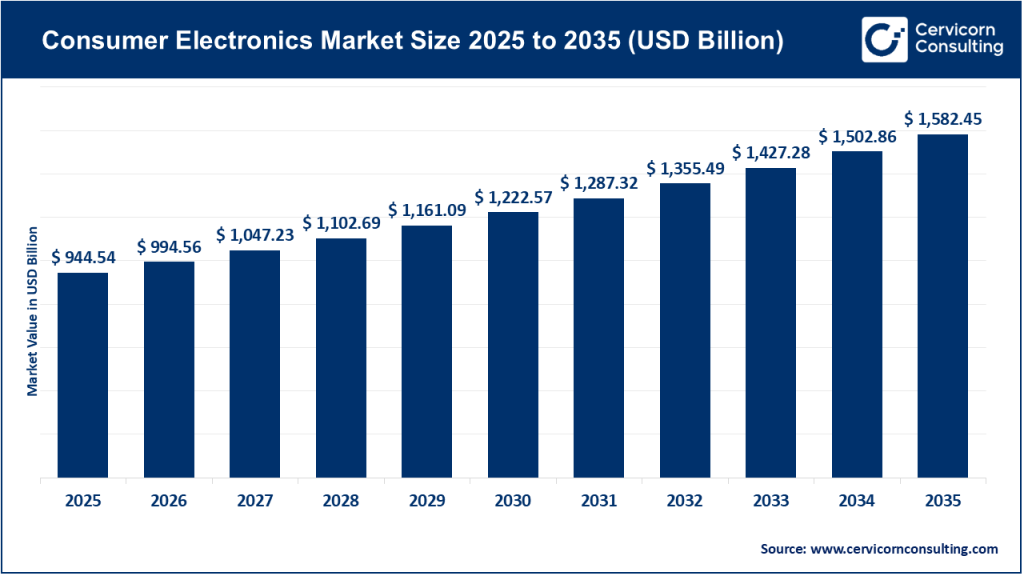
Consumer Electronics Market Size
The global consumer electronics market size was worth USD 944.54 billion in 2025 and is anticipated to expand to around USD 1,582.45 billion by 2035, registering a compound annual growth rate (CAGR) of 5.3% from 2026 to 2035.
What is the consumer electronics market?
The consumer electronics market refers to the global industry involved in the design, manufacturing, distribution, and sale of electronic devices intended for everyday personal and household use. This market includes products such as smartphones, tablets, laptops, desktops, smart TVs, audio systems, gaming consoles, wearable devices, smart home equipment, and digitally enabled appliances. It also extends to embedded software, operating systems, firmware updates, and value-added services that enhance device functionality. The market is highly dynamic, shaped by rapid innovation, short product life cycles, and strong competition among global brands.
Why is the consumer electronics market important?
The consumer electronics market plays a crucial role in economic development, digital inclusion, and technological progress. It drives large-scale manufacturing, supports millions of jobs across global supply chains, and fuels innovation in semiconductors, displays, batteries, and connectivity technologies. On a societal level, consumer electronics enable access to information, remote education, telemedicine, digital payments, and entertainment, thereby improving quality of life. The market also serves as a primary gateway for emerging technologies such as artificial intelligence, 5G, and the Internet of Things, accelerating their adoption across industries and regions.
Get a Free Sample: https://www.cervicornconsulting.com/sample/2845
Consumer Electronics Market Growth Factors
The growth of the consumer electronics market is driven by increasing smartphone and smart device penetration, rising disposable incomes in emerging economies, rapid urbanization, and continuous innovation in connectivity technologies such as 5G and high-speed broadband. Frequent device upgrade cycles, growing demand for smart home and wearable products, and the integration of artificial intelligence into consumer devices further stimulate market expansion. Additionally, declining component costs, improved manufacturing efficiencies, supportive government policies for local electronics production, and increasing consumer preference for energy-efficient and sustainable devices are collectively strengthening long-term market growth.
Leading Companies: Profiles and 2024 Overview
Sony Corporation
-
Company: Sony Corporation
-
Specialization: Consumer electronics, gaming, imaging sensors, entertainment content
-
Key Focus Areas: PlayStation gaming ecosystem, premium televisions, audio equipment, digital cameras, imaging sensors
-
Notable Features: Strong integration of hardware with content and services, leadership in imaging sensor technology, globally recognized entertainment ecosystem
-
2024 Revenue: Sony reported consolidated revenue in the range of tens of billions of US dollars in 2024
-
Market Share & Global Presence: Sony holds strong global positions in gaming consoles, image sensors, and premium consumer electronics, with operations across Asia, Europe, and North America
Samsung Electronics Co., Ltd.
-
Company: Samsung Electronics Co., Ltd.
-
Specialization: Smartphones, televisions, home appliances, semiconductors, displays
-
Key Focus Areas: Galaxy smartphones, foldable devices, OLED and QLED displays, memory and logic chips
-
Notable Features: Vertical integration from components to finished products, global manufacturing scale, innovation leadership in displays and semiconductors
-
2024 Revenue: Samsung Electronics recorded consolidated revenues amounting to several hundred billion US dollars equivalent in 2024
-
Market Share & Global Presence: Samsung consistently ranks among the world’s top smartphone and TV brands, with a strong presence in Asia, Europe, the Americas, and emerging markets
OnePlus
-
Company: OnePlus
-
Specialization: Smartphones, audio devices, smart accessories
-
Key Focus Areas: Performance-oriented smartphones, fast charging technology, premium features at competitive pricing
-
Notable Features: Strong community engagement, clean software experience, aggressive innovation cycles
-
2024 Revenue: OnePlus generated revenues estimated in the low single-digit billions of US dollars in 2024
-
Market Share & Global Presence: OnePlus has a strong foothold in India, Europe, and parts of Southeast Asia, particularly in the premium mid-range smartphone segment
Panasonic Corporation
-
Company: Panasonic Holdings Corporation
-
Specialization: Consumer electronics, home appliances, industrial electronics, energy solutions
-
Key Focus Areas: Smart home appliances, batteries, automotive electronics, industrial components
-
Notable Features: Diversified business portfolio, reputation for quality and reliability, strong B2B partnerships
-
2024 Revenue: Panasonic reported consolidated revenues in the multi-trillion Japanese yen range for fiscal year 2024
-
Market Share & Global Presence: Panasonic maintains a strong presence in Japan and international markets, especially in home appliances and industrial electronics
Koninklijke Philips N.V.
-
Company: Koninklijke Philips N.V.
-
Specialization: Consumer health electronics and health technology
-
Key Focus Areas: Personal care devices, connected health solutions, home healthcare equipment
-
Notable Features: Strategic shift from traditional consumer electronics to health-focused technologies, strong brand trust in personal health
-
2024 Revenue: Philips reported annual revenues in the tens of billions of euros for 2024
-
Market Share & Global Presence: Philips has a strong global footprint across Europe, North America, and Asia, particularly in personal health and wellness devices
Leading Trends and Their Impact
Artificial intelligence is increasingly embedded in consumer electronics, enabling smarter cameras, voice assistants, predictive maintenance, and personalized user experiences. The expansion of 5G networks enhances device performance and enables cloud-based services, immersive gaming, and high-quality streaming. The rise of smart homes and IoT ecosystems is driving demand for interoperable devices that work seamlessly together. Sustainability has emerged as a major trend, with manufacturers focusing on energy efficiency, recyclable materials, longer software support, and repairability. At the same time, premiumization and service-based revenue models are allowing brands to improve margins while offering enhanced functionality and long-term customer engagement.
Successful Examples of the Consumer Electronics Market Around the World
Globally, several companies have demonstrated successful consumer electronics strategies. In the United States, integrated ecosystems combining hardware, software, and services have enabled premium positioning and strong customer loyalty. In South Korea, advanced display and semiconductor manufacturing capabilities have supported leadership in smartphones and televisions. Japan has produced successful models combining entertainment content with consumer devices, particularly in gaming and imaging. In India, smartphone brands leveraging online sales, local manufacturing, and competitive pricing have rapidly scaled market share. In Europe, companies that pivoted toward health-focused and sustainable consumer electronics have created new growth pathways in mature markets.
Global Regional Analysis Including Government Initiatives and Policies Shaping the Market
North America
Government initiatives supporting semiconductor manufacturing, research and development, and domestic electronics production have strengthened the regional supply chain. Policies focused on data privacy, cybersecurity, and consumer protection influence product design and software integration, pushing manufacturers toward higher compliance standards and secure ecosystems.
Europe
European policies emphasize sustainability, energy efficiency, and consumer rights. Regulations related to e-waste reduction, right-to-repair, and eco-design standards encourage manufacturers to design durable, repairable, and environmentally responsible products. These policies are shaping long-term innovation and product lifecycle strategies.
Asia-Pacific
Asia-Pacific remains the manufacturing hub of the global consumer electronics market. Countries such as China, South Korea, and Japan support advanced electronics and semiconductor development through industrial policies and R&D incentives. India’s production-linked incentive programs and “Make in India” initiatives encourage local manufacturing and attract global brands, transforming the country into a major electronics production and consumption center.
Latin America and Africa
These regions are emerging growth markets driven by rising smartphone adoption and expanding digital infrastructure. Government initiatives aimed at improving connectivity, encouraging local assembly, and expanding access to digital services are gradually strengthening regional consumer electronics ecosystems, despite challenges related to affordability and logistics.
Global Policy Impact
Across regions, trade policies, import-export regulations, sustainability mandates, and data protection laws are influencing sourcing strategies, pricing structures, and product innovation. Companies that align with local regulations while maintaining global efficiency are better positioned to succeed in an increasingly regulated market.
To Get Detailed Overview, Contact Us: https://www.cervicornconsulting.com/contact-us
Read Report: eHealth Market Growth Drivers, Trends, Key Players and Regional Insights by 2034