


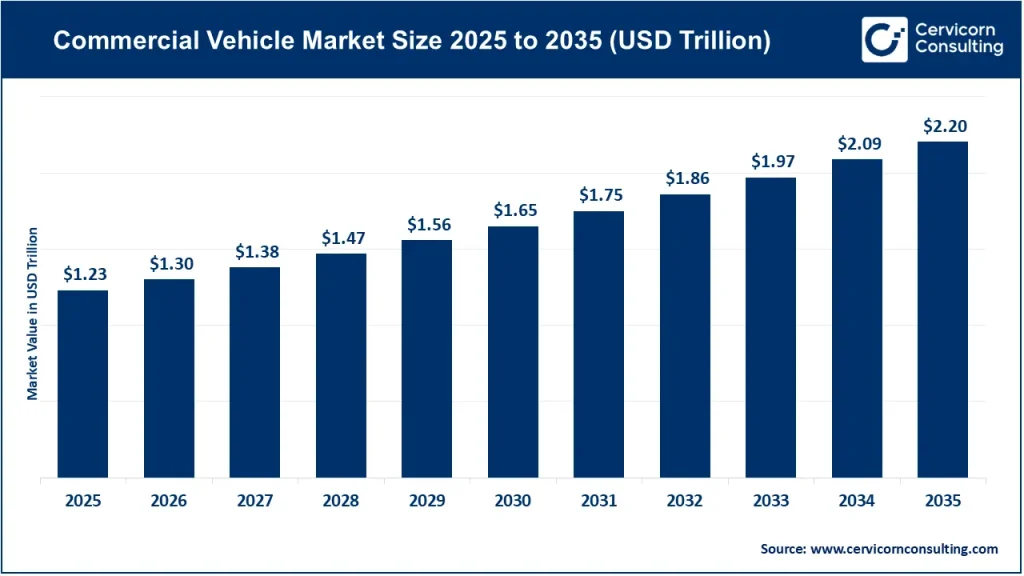
Commercial Vehicle Market Size
The global commercial vehicle market was valued at approximately USD 1.23 trillion in 2025 and is projected to reach USD 2.20 trillion by 2035, expanding at a CAGR of 5.99% during the forecast period.
Commercial Vehicle Market Growth Factors
The commercial vehicle market is experiencing robust growth due to increasing global trade, expanding logistics networks, rapid urbanization, rising construction activities, and significant government investments in transportation infrastructure. The rapid expansion of e-commerce has substantially increased demand for delivery fleets, while fleet operators are investing in connected vehicles to improve operational efficiency and reduce maintenance costs. Electrification is becoming a major growth catalyst as governments worldwide introduce stricter emission regulations and incentives for zero-emission transportation.
Furthermore, technological innovations such as Advanced Driver Assistance Systems (ADAS), telematics, predictive maintenance, fleet management software, artificial intelligence, autonomous driving technologies, and hydrogen fuel-cell vehicles are transforming commercial transportation. Rising investments in smart cities, last-mile delivery, and sustainable mobility continue to create substantial opportunities for manufacturers and fleet operators worldwide.
Get a Free Sample: https://www.cervicornconsulting.com/sample/2691
What is the Commercial Vehicle Market?
The commercial vehicle market refers to the global industry involved in the design, manufacturing, sales, leasing, maintenance, and operation of vehicles primarily used for transporting goods or passengers for commercial purposes.
Commercial vehicles generally include:
- Light Commercial Vehicles (LCVs)
- Medium Commercial Vehicles (MCVs)
- Heavy Commercial Vehicles (HCVs)
- Buses and Coaches
- Pickup Trucks
- Delivery Vans
- Tractor-Trailers
- Construction Trucks
- Mining Trucks
- Refrigerated Transport Vehicles
- Municipal Utility Vehicles
Unlike passenger cars, commercial vehicles are designed for durability, higher payload capacities, long operational hours, and business-specific transportation requirements.
Why is the Commercial Vehicle Market Important?
Commercial vehicles form the backbone of global commerce by enabling efficient transportation across industries.
Supports Global Supply Chains
Nearly every manufacturing industry relies on commercial vehicles for raw material transportation and product distribution.
Enables E-commerce Growth
The exponential rise of online shopping has significantly increased demand for delivery vans and logistics fleets.
Infrastructure Development
Construction trucks and specialized commercial vehicles support highways, airports, ports, smart cities, and industrial development.
Public Transportation
Buses and coaches provide affordable transportation for millions of commuters daily.
Agricultural Development
Commercial vehicles transport fertilizers, crops, machinery, and livestock across rural regions.
Economic Growth
The commercial vehicle sector generates employment across manufacturing, logistics, maintenance, insurance, financing, and aftermarket services.
Major Segments of the Commercial Vehicle Market
By Vehicle Type
- Light Commercial Vehicles
- Medium Commercial Vehicles
- Heavy Commercial Vehicles
- Buses
- Coaches
By Fuel Type
- Diesel
- Petrol
- Electric
- Hybrid
- Hydrogen Fuel Cell
- Natural Gas (CNG/LNG)
By End User
- Logistics
- Construction
- Mining
- Agriculture
- Public Transport
- Municipal Services
- Defense
- Industrial Manufacturing
Leading Companies in the Commercial Vehicle Market
| Company | Specialization | Key Focus Areas | Notable Features | 2025 Revenue (Approx.) | Market Share (Approx.) | Global Presence |
|---|---|---|---|---|---|---|
| Daimler Truck AG | Heavy-duty trucks and buses | Electric trucks, hydrogen mobility, fleet connectivity | Mercedes-Benz Trucks, Freightliner, FUSO, BharatBenz | USD 61 Billion | 10–12% | Europe, North America, Asia-Pacific, Latin America |
| Volvo Group | Trucks, buses, construction equipment | Sustainable transportation, autonomous solutions | Volvo Trucks, Renault Trucks, Mack Trucks | USD 56 Billion | 9–11% | Over 190 countries |
| Traton SE (MAN, Scania, Navistar) | Heavy trucks and commercial transport | Electrification, digital transport ecosystem | Scania, MAN, International Trucks | USD 52 Billion | 8–10% | Europe, North America, Latin America, Asia |
| PACCAR Inc. | Premium heavy-duty trucks | Connected vehicles, fuel efficiency | Kenworth, Peterbilt, DAF Trucks | USD 38 Billion | 6–8% | More than 100 countries |
| Tata Motors Ltd. | Commercial trucks and buses | Affordable mobility, EV commercial vehicles | India’s largest CV manufacturer with strong emerging-market presence | USD 55 Billion* | 5–7% | Asia, Africa, Middle East, Latin America |
Commercial Vehicle Market Dynamics
Increasing Freight Transportation
Global manufacturing growth has significantly increased road freight movement.
Modern logistics companies require:
- Larger fleets
- Fuel-efficient trucks
- Connected fleet management
- Real-time tracking
This is driving demand for technologically advanced commercial vehicles.
Electrification of Commercial Fleets
Electric trucks are becoming mainstream due to:
- Lower operating costs
- Government subsidies
- Carbon neutrality goals
- Reduced maintenance requirements
- Improved battery technologies
Major manufacturers are investing billions in electric commercial vehicle platforms.
Growth of Last-Mile Delivery
The rapid expansion of online retail has transformed urban logistics.
Companies increasingly deploy:
- Electric delivery vans
- Small cargo vehicles
- Smart route optimization
- AI-based logistics platforms
Last-mile delivery has become one of the fastest-growing commercial vehicle segments.
Connected Fleet Management
Fleet operators increasingly rely on:
- GPS tracking
- Predictive maintenance
- Driver monitoring
- Fuel optimization
- Remote diagnostics
- Cloud-based fleet analytics
These technologies reduce operational costs while improving fleet utilization.
Hydrogen Commercial Vehicles
Hydrogen fuel-cell trucks are emerging for long-distance transportation due to:
- Fast refueling
- Longer driving range
- Heavy payload capacity
- Zero tailpipe emissions
Hydrogen is expected to complement battery-electric trucks in heavy-duty applications.
Leading Trends and Their Impact
Artificial Intelligence in Fleet Operations
AI is improving route optimization, predictive maintenance, cargo planning, and driver behavior analysis.
Impact:
- Reduced fuel consumption
- Lower maintenance costs
- Improved fleet productivity
- Better customer service
Autonomous Commercial Vehicles
Autonomous trucking is progressing through advanced sensor technologies, AI, radar, LiDAR, and camera systems.
Impact:
- Improved road safety
- Lower labor costs
- Enhanced logistics efficiency
- Increased fleet utilization
Vehicle Electrification
Electric commercial vehicles are becoming commercially viable across delivery fleets, city buses, and municipal transportation.
Impact:
- Reduced emissions
- Lower total cost of ownership
- Compliance with environmental regulations
- Increased adoption of renewable energy
Digital Fleet Ecosystems
Cloud-based fleet management platforms integrate:
- Vehicle diagnostics
- Driver management
- Cargo monitoring
- Predictive analytics
Impact:
- Higher operational efficiency
- Improved customer visibility
- Reduced downtime
- Better regulatory compliance
Software-Defined Vehicles
Commercial vehicles increasingly receive software updates over the air.
Impact:
- Enhanced cybersecurity
- Continuous feature upgrades
- Reduced maintenance visits
- Improved fleet performance
Sustainable Transportation
Fleet operators increasingly prioritize:
- Electric trucks
- Renewable fuels
- Lightweight materials
- Circular manufacturing
Impact:
- Lower carbon emissions
- Improved ESG performance
- Greater investor confidence
- Long-term operational savings
What are Some Successful Examples of the Commercial Vehicle Market Around the World?
Amazon’s Electric Delivery Fleet
Amazon has invested heavily in electric delivery vans to reduce emissions and improve last-mile delivery efficiency. The deployment of electric fleets supports its sustainability commitments while lowering operating costs.
DHL Green Logistics
DHL has expanded its use of electric delivery vehicles, alternative fuels, and smart fleet management technologies across Europe and other regions. These initiatives help reduce emissions while improving delivery efficiency.
Volvo Electric Trucks in Europe
Volvo Trucks has introduced battery-electric heavy-duty trucks for freight transportation, construction, and waste management. These vehicles are increasingly adopted by logistics operators seeking low-emission transport solutions.
Tata Motors Electric Commercial Vehicles in India
Tata Motors has launched electric buses and commercial vehicles that support urban public transportation and cargo logistics. The company has become a leading supplier of electric commercial mobility solutions in India.
Scania Sustainable Transport Solutions
Scania has developed connected commercial vehicles integrated with telematics, predictive maintenance, and fuel-efficiency technologies, enabling fleet operators to optimize operations and reduce total ownership costs.
Global Regional Analysis Including Government Initiatives and Policies Shaping the Market
North America
North America represents one of the world’s largest commercial vehicle markets due to advanced logistics infrastructure, high freight transportation demand, and continuous technological innovation.
The United States leads regional demand through extensive interstate transportation networks and strong investments in fleet modernization.
Government Initiatives
- Tax incentives supporting electric commercial vehicle adoption
- Federal investments in EV charging infrastructure
- Clean transportation funding programs
- Stricter greenhouse gas emission regulations
- Grants supporting zero-emission buses
Market Drivers
- Strong e-commerce sector
- Fleet digitization
- Autonomous truck development
- Infrastructure modernization
- Growing demand for heavy-duty freight transportation
Europe
Europe remains a global leader in sustainable commercial transportation.
Countries including Germany, Sweden, France, the Netherlands, and Norway are rapidly expanding electric and hydrogen commercial vehicle deployment.
Government Policies
- European Green Deal
- Carbon neutrality targets
- Euro VII emission regulations
- Subsidies for electric commercial vehicles
- Hydrogen infrastructure investments
Market Drivers
- Fleet electrification
- Smart logistics
- Sustainable freight transport
- Advanced manufacturing
- Connected mobility technologies
Asia-Pacific
Asia-Pacific is expected to witness the fastest commercial vehicle market growth.
China, India, Japan, South Korea, and Southeast Asian countries continue expanding manufacturing capacity while investing heavily in transportation infrastructure.
Government Initiatives
China
- New Energy Vehicle (NEV) policies
- EV purchase subsidies
- Battery manufacturing support
India
- FAME incentives
- Production Linked Incentive (PLI) schemes
- National Logistics Policy
- PM Gati Shakti infrastructure initiative
Japan
- Hydrogen mobility roadmap
- Carbon-neutral transportation programs
South Korea
- Hydrogen commercial vehicle development
- Smart mobility investments
Market Drivers
- Rapid industrialization
- Expanding manufacturing sector
- Urbanization
- Growing logistics demand
- Increasing infrastructure projects
- Rising exports
Latin America
Latin America continues expanding commercial transportation through infrastructure investments and regional trade.
Brazil and Mexico remain the largest regional markets.
Government Policies
- Fleet modernization incentives
- Infrastructure development projects
- Public transportation investments
- Alternative fuel adoption programs
Market Drivers
- Mining
- Agriculture
- Cross-border logistics
- Construction activities
- Urban freight transportation
Middle East & Africa
The Middle East and Africa commercial vehicle market is benefiting from diversification initiatives, smart city development, and large-scale infrastructure projects.
Saudi Arabia, the UAE, and South Africa remain key growth markets.
Government Initiatives
- Saudi Vision 2030
- UAE Net Zero Strategy 2050
- Public transport modernization programs
- Investments in logistics hubs and industrial corridors
Market Drivers
- Oil and gas transportation
- Construction megaprojects
- Tourism infrastructure
- Cross-border trade
- Mining operations
Emerging Opportunities in the Commercial Vehicle Market
Several high-growth opportunities are expected to reshape the commercial vehicle industry over the coming decade:
- Expansion of electric trucks and buses across urban and regional fleets.
- Development of hydrogen fuel-cell commercial vehicles for long-haul freight applications.
- Wider adoption of autonomous driving technologies to improve safety and logistics efficiency.
- Growth in connected fleet management platforms powered by artificial intelligence and IoT.
- Increasing demand for lightweight materials and aerodynamic vehicle designs to improve fuel economy.
- Expansion of charging infrastructure and hydrogen refueling networks supporting zero-emission fleets.
- Rising investment in software-defined vehicles with over-the-air updates and advanced cybersecurity features.
- Continued growth of e-commerce and last-mile delivery services driving demand for light commercial vehicles.
- Greater public and private sector collaboration to modernize transportation infrastructure and accelerate sustainable mobility.
These developments are expected to strengthen the commercial vehicle market by improving operational efficiency, reducing environmental impact, and enabling more resilient global supply chains over the forecast period.
To Get Detailed Overview, Contact Us: https://www.cervicornconsulting.com/contact-us
Read Report: Quantum Sensor Market Revenue, Trends, and Strategic Insights by 2035