


CO2 Separation Membrane Market: 6 Decisions Companies Should Make to Improve Carbon Capture Economics
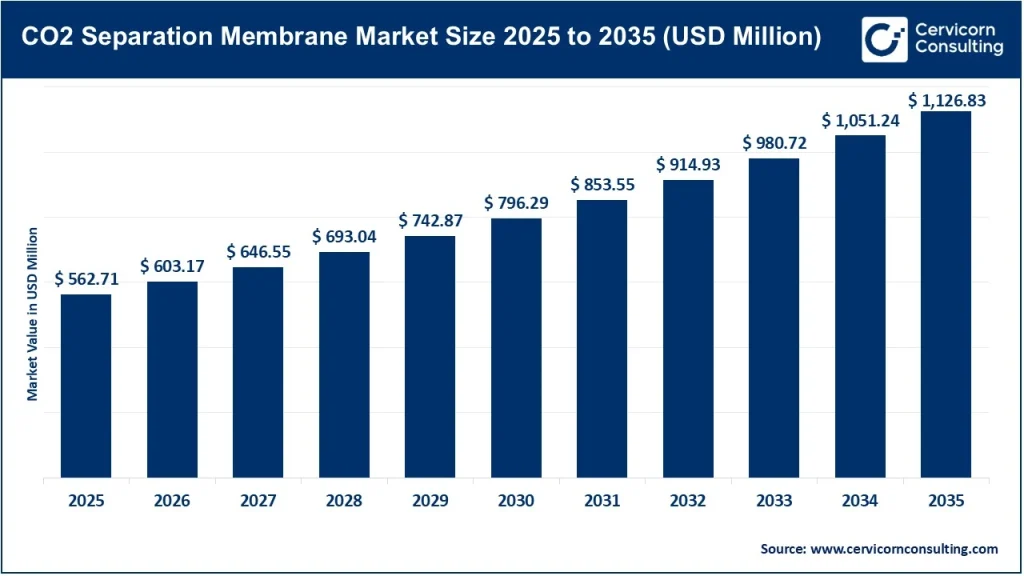
The global CO2 separation membrane market was valued at USD 562.71 million in 2025 and is projected to reach USD 1.13 billion by 2035, growing at a compound annual growth rate (CAGR) of 7.2% from 2026 to 2035. Growth is being supported by industrial decarbonization, demand for efficient gas separation, and expanding carbon capture, utilization, and storage (CCUS) initiatives.
However, market growth alone does not guarantee a viable investment. For industrial operators, membrane manufacturers, engineering companies, and carbon capture developers, the central challenge is determining where membrane separation can deliver measurable economic and operational benefits. Performance depends on gas composition, operating pressure, CO2 concentration, purity requirements, energy consumption, and the cost of handling the separated carbon dioxide.
Membrane technology is already established in applications such as natural gas sweetening and biogas upgrading, while post-combustion carbon capture presents additional opportunities alongside technical and economic challenges. A 2026 review in the Journal of Membrane Science highlights the importance of membrane permeance, process configuration, and application-specific performance in making carbon capture commercially competitive.
Companies evaluating this market should focus on six decisions that connect technology selection with project economics, operational reliability, and long-term investment priorities.
1. Which Industrial Applications Offer the Strongest Business Case?
Not every CO2 separation application presents the same commercial opportunity. Companies must evaluate the gas stream, the value of recovered products, the cost of emissions reduction, and the availability of supporting infrastructure before selecting a target market.
According to the 2025 market segmentation, industrial separation accounted for 50.9% of market revenue, while post-combustion capture represented 28.4% and pre-combustion capture accounted for 20.7%. The oil and gas sector represented 42.8% of end-use demand, reflecting the established role of membranes in natural gas processing.
These segments present different investment considerations:
- Natural gas processing: Evaluate CO2 removal requirements, pipeline specifications, hydrocarbon recovery, feed pressure, and the cost of alternative separation methods.
- Biogas upgrading: Assess the economics of producing biomethane, local gas-grid requirements, plant throughput, and the potential value of recovered CO2.
- Hydrogen production: Examine CO2 removal from process gas, hydrogen recovery, integration with existing purification equipment, and the requirements of low-carbon hydrogen projects.
- Post-combustion capture: Focus on flue-gas composition, relatively low CO2 partial pressure, pretreatment requirements, and the energy needed to achieve the required capture rate.
- Chemical and industrial processing: Identify opportunities where CO2 separation improves product quality, process efficiency, or compliance with emissions requirements.
For technology suppliers, the priority should be to identify applications where membrane performance is sufficiently established and customers have a clear operational or financial reason to invest. For industrial buyers, the appropriate starting point is a defined separation problem rather than the general ambition to reduce emissions.
Get a Free Sample: https://www.cervicornconsulting.com/sample/2964
2. Should Companies Prioritize Polymeric Membranes or Advanced Materials?
Material selection directly affects separation performance, equipment costs, durability, and maintenance requirements.
Polymeric membranes accounted for 67.6% of the market in 2025, supported by their commercial maturity, manufacturing scalability, and established use in industrial gas separation. Zeolite, ceramic, and other advanced membrane materials provide alternative options for applications that demand specific selectivity, thermal stability, or resistance to challenging operating conditions.
Companies should compare materials against actual process conditions rather than relying exclusively on laboratory performance or published selectivity figures.
Key evaluation criteria include:
- CO2 permeability and selectivity: Determine how effectively the membrane separates CO2 from nitrogen, methane, hydrogen, or other gases in the target stream.
- Operating pressure and temperature: Verify that the material can sustain the required conditions without unacceptable performance degradation.
- Moisture and contaminant tolerance: Assess exposure to water vapor, hydrocarbons, particulates, and other compounds that may affect membrane performance.
- Mechanical and chemical stability: Estimate membrane life, replacement frequency, and the risk of performance loss under continuous operation.
- Manufacturing and replacement costs: Consider the cost of membrane production, module fabrication, installation, and future replacement.
A high-performance material is not automatically the most economical choice. A more expensive membrane may be justified if it reduces the number of modules, improves recovery, or lowers operating expenditure. Conversely, a mature polymeric solution may offer better overall economics where operating conditions are well understood and performance requirements are achievable with existing technology.
The decision should be based on lifecycle cost per tonne of CO2 separated or captured, not material price or selectivity in isolation.
3. How Should Companies Select the Right Membrane Module and Process Configuration?
Module architecture determines how membrane area is packaged, how much space the system occupies, and how effectively it can be integrated into an industrial process.
Hollow fiber modules accounted for 61.8% of market demand in 2025, while spiral-wound modules represented 24.7%. Hollow fiber systems benefit from high membrane surface area within a compact footprint, making them attractive for several established industrial gas separation applications.
Spiral-wound modules may be suitable where packing density, equipment layout, and process-specific performance favor that configuration. Other designs may be relevant for specialized applications.
Before selecting a module, companies should answer three questions:
- What gas flow rate and separation capacity must the system handle under normal and peak operating conditions?
- What combination of membrane area, pressure differential, and process stages will achieve the required recovery and product purity?
- How much space is available for the equipment, pretreatment systems, compression, and downstream CO2 conditioning?
A single-stage membrane system may be simpler, but it may not deliver the required purity or recovery. Multistage configurations, recycle streams, or hybrid systems can improve overall performance, although they may introduce additional compression, piping, and control requirements.
The decision must therefore consider the complete separation process rather than the membrane module alone. Equipment suppliers and project developers should assess alternative configurations through process simulation and, where necessary, pilot-scale testing before committing to a commercial installation.
4. Can Membrane Separation Reduce Total Carbon Capture Costs?
The commercial value of membrane technology depends on the total cost of operating the system, not simply the energy consumption of the membrane itself.
Membrane separation can offer modularity, a compact footprint, and opportunities for lower-energy operation. However, actual economics vary considerably with feed composition, operating pressure, capture rate, product specifications, and the need for compression or downstream purification.
A practical evaluation should include:
- Capital expenditure: Membrane modules, vessels, compressors, pretreatment equipment, piping, controls, and installation.
- Energy consumption: Feed compression, vacuum requirements where applicable, recycle compression, and downstream CO2 conditioning.
- Pretreatment costs: Removal of moisture, particulates, aerosols, and contaminants that may reduce membrane life or compromise separation performance.
- Operating expenditure: Maintenance, membrane replacement, labor, utilities, and equipment downtime.
- Carbon management costs: CO2 dehydration, transport, storage, utilization, and any additional infrastructure required to deliver the separated product.
Companies should calculate the levelized cost per tonne of CO2 captured using consistent assumptions about capture rate, operating hours, membrane life, and energy prices.
A 2026 study published in the Journal of Membrane Science examined membrane-based carbon capture and reported that membrane systems could offer cost advantages over amine-based capture for cement flue gas under the study’s assessed conditions. Such findings support further evaluation, but they should not be interpreted as a universal cost advantage across all industries or gas streams.
For decision-makers, the relevant question is whether the complete membrane-based process delivers a lower cost or a stronger operational advantage than the available alternatives at the specific facility.
5. How Should Companies Manage Technical Risk Before Scaling Up?
Performance under real operating conditions can differ from laboratory results. This is particularly important for post-combustion capture, where dilute CO2 streams, moisture, contaminants, and fluctuating operating conditions can complicate separation.
A pilot or demonstration project can help companies validate performance before committing to a full-scale installation. The objective should be to reduce uncertainty around the factors that have the greatest impact on project economics.
A structured validation program should examine:
- Feed-gas variability: Test representative changes in CO2 concentration, pressure, temperature, and contaminant levels.
- Separation performance: Measure CO2 recovery, product purity, permeance, and selectivity under realistic operating conditions.
- Energy requirements: Record compressor, vacuum, and auxiliary equipment consumption rather than evaluating the membrane in isolation.
- Durability: Monitor performance degradation, fouling, plasticization, and the effects of prolonged exposure to process gases.
- System integration: Verify compatibility with existing plant operations, safety systems, maintenance procedures, and downstream CO2 handling equipment.
Companies should establish measurable acceptance criteria before beginning a pilot. These may include minimum recovery, required product purity, maximum energy consumption, uptime, and expected membrane replacement intervals.
Scaling decisions should follow evidence from the demonstration stage. If a pilot identifies a major performance gap, it is generally more economical to resolve it before expanding capacity than to incorporate unverified assumptions into a larger capital project.
For membrane manufacturers, demonstrating consistent performance under customer-specific conditions can also strengthen commercial credibility and differentiate a product from alternatives supported primarily by laboratory data.
6. Which Markets and Partnerships Should Companies Prioritize for Long-Term Growth?
The CO2 separation membrane market is expanding across established industrial gas processing and emerging carbon capture applications. However, market entry decisions should account for differences in technology maturity, project financing, customer requirements, and the availability of CO2 transport and storage infrastructure.
North America accounted for 46.4% of global market revenue in 2025, followed by Europe at 25.8% and Asia-Pacific at 20.6%. These regional shares indicate the current distribution of market activity, but they do not independently determine which region offers the best opportunity for an individual company.
Companies should evaluate regional opportunities using a combination of market demand and project readiness.
- North America: Assess established gas processing demand, industrial carbon management projects, and the availability of supporting carbon capture infrastructure.
- Europe: Examine industrial decarbonization requirements, carbon management policies, and the development of carbon transport and storage networks.
- Asia-Pacific: Evaluate demand from chemicals, refining, power generation, steel, cement, hydrogen, and biomethane production, while accounting for differences in project maturity across countries.
Partnerships can help reduce the technical and commercial barriers to entering these markets. Membrane manufacturers may collaborate with engineering, procurement and construction (EPC) contractors, process licensors, gas-processing companies, and carbon capture developers. Industrial buyers may benefit from working with suppliers that can integrate membranes with pretreatment, compression, process controls, and downstream CO2 conditioning.
Before committing resources, companies should compare the size of the addressable opportunity with realistic customer conversion timelines, local service capabilities, competitive alternatives, and the cost of establishing a commercial presence.
The most attractive opportunity is not necessarily the region with the largest market share. It is the application and geography where a company can deliver a technically reliable solution, establish a defensible economic advantage, and convert demand into repeatable projects.
Conclusion: Turn Market Growth Into Better Investment Decisions
The CO2 separation membrane market is projected to grow from USD 562.71 million in 2025 to USD 1.13 billion by 2035, creating opportunities for membrane manufacturers, industrial gas-processing companies, engineering firms, and carbon capture developers.
Realizing this potential requires more than selecting a membrane with strong separation performance. Companies must identify commercially attractive applications, choose suitable materials and modules, evaluate lifecycle economics, validate performance under real operating conditions, and prioritize markets where customers have both a clear need and a viable route to implementation.
The six decisions provide a practical framework for evaluating investment opportunities and reducing uncertainty before deployment. For industrial buyers, the priority is to establish whether membrane separation improves the economics and reliability of a specific process. For technology suppliers, the challenge is to demonstrate repeatable performance, competitive lifecycle costs, and compatibility with customer operating requirements.
As carbon management projects advance, companies that connect membrane performance with measurable industrial outcomes will be better positioned to identify sustainable commercial opportunities.
To Get Detailed Overview, Contact Us: https://www.cervicornconsulting.com/contact-us