


Table of Contents
ToggleCell Culture Media Market Size
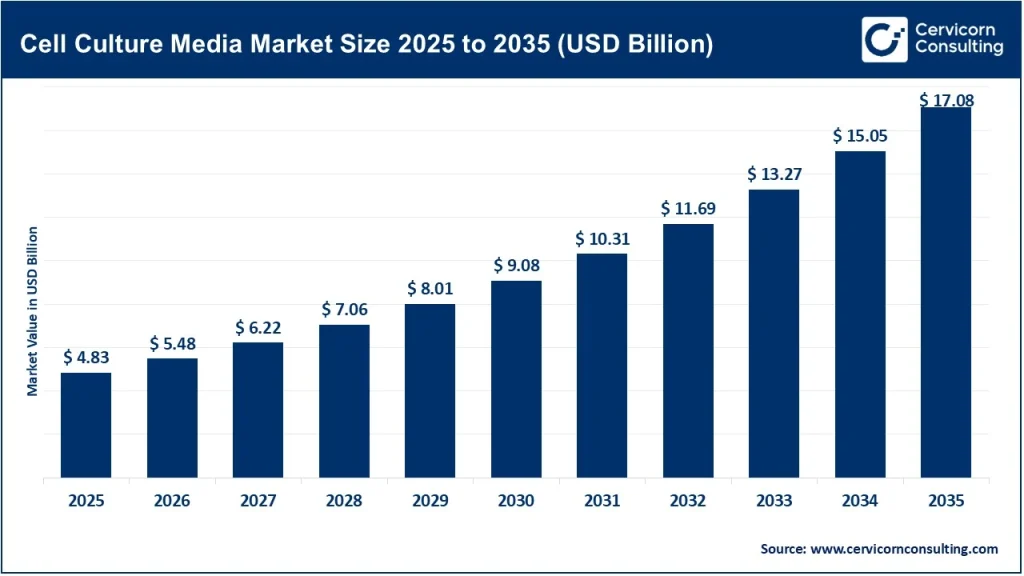
The global cell culture media market reached an estimated valuation of USD 4.83 billion in 2025 and is projected to grow substantially, attaining approximately USD 17.08 billion by 2035. This growth reflects a strong compound annual growth rate (CAGR) of around 13.5% throughout the forecast period.
What is the Cell Culture Media Market?
The cell culture media market refers to the global industry focused on the development, production, and commercialization of nutrient-rich solutions used to support the growth, proliferation, and maintenance of cells in controlled laboratory environments outside their natural biological systems. These media formulations contain essential nutrients such as amino acids, vitamins, salts, glucose, buffering agents, and growth supplements that enable cells to survive and function in vitro conditions across research and industrial applications.
The cell culture media market plays a foundational role in life sciences because it supports drug discovery pipelines, vaccine production programs, monoclonal antibody development, stem-cell research, regenerative medicine platforms, and gene therapy manufacturing. Media formulations vary widely depending on the intended application and include classical media, serum-free media, protein-free media, and chemically defined media designed for high reproducibility and regulatory compliance.
As the biotechnology and pharmaceutical sectors increasingly transition toward biologics-based therapies, the cell culture media market continues to gain importance as a critical upstream component of therapeutic manufacturing workflows. Demand for specialized culture environments is expanding across academic research institutes, contract manufacturing organizations, pharmaceutical companies, and biotechnology startups worldwide.
Why the Cell Culture Media Market is Important?
The cell culture media market is essential because it enables modern biomedical innovation across nearly every stage of therapeutic development and production. Without optimized culture media environments, cells cannot replicate effectively or produce therapeutic proteins at industrial scale.
One of the primary reasons the cell culture media market is important is its central role in biologics manufacturing. Monoclonal antibodies, recombinant proteins, vaccines, and cell-based therapies all rely heavily on precisely engineered media environments to ensure product quality and consistency. As biologics increasingly dominate pharmaceutical pipelines globally, the importance of reliable culture media solutions continues to grow.
The market is also critical for regenerative medicine research. Stem-cell expansion, tissue engineering, and gene-editing workflows require specialized media formulations that support controlled differentiation and long-term viability. Similarly, cancer research depends extensively on cell culture platforms to evaluate drug responses and disease mechanisms before clinical trials begin.
Additionally, the increasing adoption of personalized medicine is creating new demand for application-specific cell culture solutions tailored to individual patient-derived cells. As therapy development becomes more targeted and precise, the role of the cell culture media market is expanding beyond traditional laboratory research into advanced therapeutic production environments.
Get a Free Sample: https://www.cervicornconsulting.com/sample/2928
Cell Culture Media Market Growth Factors
The growth of the cell culture media market is being driven by the rapid expansion of biologics manufacturing, increasing demand for monoclonal antibodies and vaccines, rising investments in stem-cell and regenerative medicine research, growing adoption of serum-free and chemically defined media formulations, expansion of cell-based cancer therapy pipelines, increasing outsourcing to contract development and manufacturing organizations (CDMOs), technological advancements in bioprocessing automation, strong funding support for life sciences research infrastructure, rising prevalence of chronic diseases requiring advanced therapeutic solutions, and increasing regulatory emphasis on reproducible and contamination-free upstream processing workflows. In addition, the global expansion of gene therapy clinical trials, increasing adoption of 3D cell culture systems, and rising investments from both public and private sectors in biotechnology innovation hubs are accelerating demand for high-performance cell culture environments across academic and industrial settings. The emergence of personalized medicine platforms and biosimilar production programs is further strengthening long-term adoption trends within the cell culture media market.
Key Companies in the Cell Culture Media Market
The competitive landscape of the cell culture media market is dominated by several major global biotechnology and life sciences solution providers that continue to invest heavily in innovation, scalability, and specialized formulation technologies.
| Company | Specialization | Key Focus Areas | Notable Features | 2024 Revenue | Market Share | Global Presence |
|---|---|---|---|---|---|---|
| Thermo Fisher Scientific | Laboratory reagents, bioprocessing tools, culture media | Biologics manufacturing, diagnostics, research workflows | Broadest product portfolio across research and production scale media | ~USD 43 Billion | Leading | North America, Europe, Asia-Pacific |
| Merck KGaA | Life science reagents and upstream bioprocessing solutions | Serum-free media, process optimization | Strong presence in pharmaceutical manufacturing solutions | ~USD 22 Billion | Major | Global operations in 60+ countries |
| Danaher Corporation | Bioprocessing technologies through Cytiva | Biologics development platforms | Integrated upstream-downstream workflow solutions | ~USD 24 Billion | Major | Strong presence in US, Europe, China |
| Sartorius AG | Bioprocess solutions and filtration systems | Cell line development media | High-growth bioprocess automation expertise | ~USD 3.9 Billion | Growing | Europe, North America, Asia |
| Lonza Group | Contract manufacturing and specialty media | Custom cell culture media | CDMO leadership and therapy-grade media manufacturing | ~USD 6.7 Billion | Significant | Switzerland-based global footprint |
These companies continue to shape innovation pipelines within the cell culture media market through investments in chemically defined formulations, high-performance stem-cell media systems, and scalable upstream manufacturing solutions.
Leading Trends and Their Impact on the Cell Culture Media Market
Shift Toward Serum-Free and Chemically Defined Media
Traditional serum-based media are gradually being replaced by chemically defined formulations that improve reproducibility and reduce contamination risks. These formulations support regulatory compliance in therapeutic manufacturing environments and are becoming standard across biologics production pipelines.
Impact:
Improves process reliability and enables large-scale therapeutic manufacturing consistency.
Expansion of Cell and Gene Therapy Pipelines
Cell and gene therapies require highly specialized culture environments optimized for sensitive cell populations such as T-cells and stem cells. The increasing number of clinical trials globally is creating strong demand for customized media formulations.
Impact:
Accelerates innovation in application-specific culture media development.
Growth in Vaccine Manufacturing Infrastructure
Global investments in vaccine preparedness programs have strengthened viral culture infrastructure across multiple countries. These initiatives are increasing procurement demand for high-quality cell culture media solutions.
Impact:
Supports long-term procurement stability for vaccine-grade media suppliers.
Automation in Bioprocessing Workflows
Modern upstream bioprocessing platforms increasingly integrate automated monitoring and optimization technologies that improve production efficiency and reduce variability.
Impact:
Encourages adoption of advanced liquid media solutions compatible with automated systems.
Rise of Personalized Medicine Platforms
Patient-specific therapy development requires tailored culture environments capable of supporting individualized cell expansion protocols.
Impact:
Creates niche opportunities for specialized and premium-grade media formulations.
Successful Examples of Cell Culture Media Market Applications Around the World
United States
The United States leads global biologics production capacity and hosts advanced therapy development pipelines supported by strong research funding programs. Large-scale monoclonal antibody manufacturing facilities rely heavily on chemically defined cell culture media systems to ensure production scalability and regulatory compliance.
Germany
Germany plays a major role in upstream bioprocess engineering innovation through collaborations between pharmaceutical manufacturers and academic institutions. Industrial-scale vaccine fermentation facilities utilize optimized culture media systems for viral vector expansion.
Switzerland
Switzerland remains a major hub for advanced therapy medicinal product manufacturing supported by strong contract development and manufacturing ecosystems. Customized culture media platforms are widely used for stem-cell-derived therapies and personalized medicine applications.
China
China continues expanding domestic biologics production infrastructure through national biotechnology innovation programs. Vaccine production facilities and biosimilar manufacturing platforms increasingly depend on scalable culture media solutions to support local therapeutic manufacturing capacity.
India
India’s biotechnology sector is growing rapidly through strong government support for vaccine production programs and biosimilar manufacturing initiatives. Domestic pharmaceutical companies rely on cost-efficient culture media systems to scale monoclonal antibody production and support export-oriented biologics pipelines.
Global Regional Analysis Including Government Initiatives and Policies Shaping the Cell Culture Media Market
North America
North America dominates the cell culture media market due to strong pharmaceutical manufacturing infrastructure, advanced research ecosystems, and high investment levels in biologics development.
Key Government Initiatives
- Expansion of biomedical research funding programs
- Strategic investments in pandemic preparedness infrastructure
- Biologics manufacturing capacity strengthening initiatives
- Biotechnology innovation acceleration policies
Impact:
Supports domestic therapeutic production capabilities and strengthens demand for advanced culture media technologies.
Europe
Europe represents a mature market supported by strong regulatory harmonization frameworks and collaborative research funding programs that encourage biotechnology innovation.
Key Government Initiatives
- Regional life sciences research funding programs
- Pharmaceutical strategy modernization initiatives
- Advanced therapy medicinal product regulatory alignment policies
- Sustainable biomanufacturing development frameworks
Impact:
Encourages adoption of standardized and regulatory-compliant culture media manufacturing practices.
Asia-Pacific
Asia-Pacific is the fastest-growing region in the cell culture media market due to increasing biologics production investments and expanding vaccine manufacturing infrastructure.
Key Government Initiatives
China
- National biotechnology innovation strategy
- Domestic vaccine production expansion programs
India
- Biotechnology Industry Research Assistance Council support programs
- Production-Linked Incentive scheme for pharmaceuticals
- National Biopharma Mission
Japan
- Regenerative medicine regulatory acceleration policies
Impact:
Strengthens domestic manufacturing ecosystems and increases regional demand for advanced culture media platforms.
Latin America
Latin America is gradually strengthening vaccine production capabilities through public-private partnerships and infrastructure modernization initiatives.
Key Government Initiatives
- Regional vaccine self-reliance programs
- Biologics manufacturing modernization initiatives
Impact:
Creates growth opportunities for international culture media suppliers entering emerging healthcare markets.
Middle East and Africa
The Middle East and Africa region is witnessing steady biotechnology infrastructure expansion supported by long-term healthcare diversification strategies.
Key Government Initiatives
- National biotechnology innovation clusters
- Healthcare sector diversification strategies
- Regional vaccine manufacturing capacity expansion initiatives
Impact:
Supports emerging opportunities for global suppliers within developing therapeutic production ecosystems.
To Get Detailed Overview, Contact Us: https://www.cervicornconsulting.com/contact-us
Read Report: Aluminium Foil Market Revenue, Trends, and Strategic Insights by 2035