


Table of Contents
ToggleCardiovascular Devices Market Size
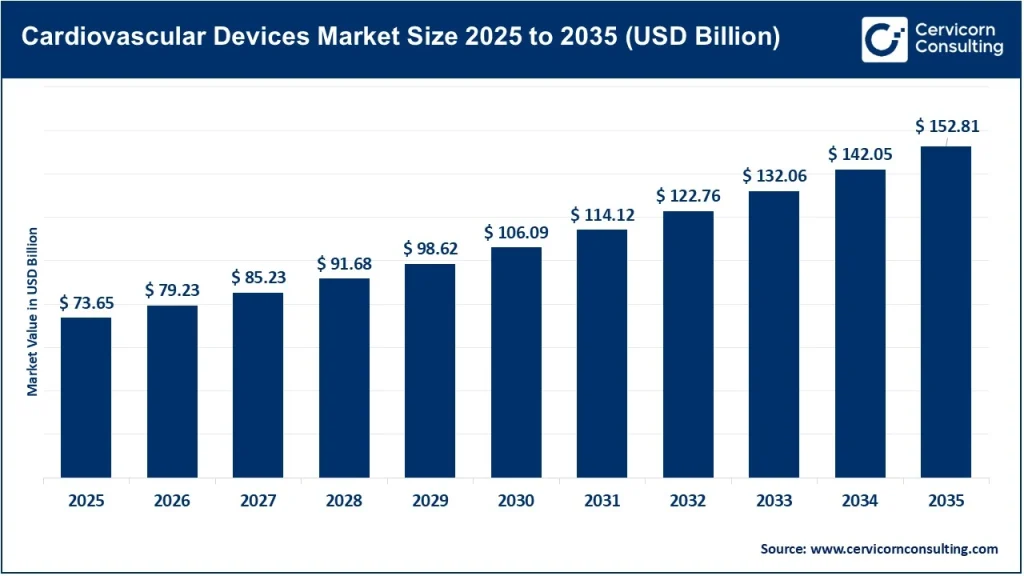
The global cardiovascular devices market was valued at approximately USD 73.65 billion in 2025 and is projected to reach nearly USD 152.81 billion by 2035, growing at a CAGR of 7.6%.
What is the Cardiovascular Devices Market?
The cardiovascular devices market encompasses a broad range of medical technologies designed to diagnose, monitor, manage, and treat disorders affecting the heart and blood vessels. These devices are utilized across hospitals, ambulatory surgical centers, specialty cardiac clinics, and home healthcare settings.
The market includes:
- Diagnostic and monitoring devices
- Electrocardiogram (ECG) systems
- Holter monitors
- Implantable cardiac monitors
- Cardiac imaging systems
- Therapeutic and surgical devices
- Coronary stents
- Pacemakers
- Implantable cardioverter defibrillators (ICDs)
- Heart valves
- Catheters
- Ventricular assist devices (VADs)
- Electrophysiology devices
These solutions play a vital role in preventing complications, improving survival rates, reducing hospitalizations, and enhancing the quality of life for patients with cardiovascular conditions.
Get a Free Sample: https://www.cervicornconsulting.com/sample/2986
Why is the Cardiovascular Devices Market Important?
Cardiovascular diseases such as coronary artery disease, heart failure, arrhythmias, hypertension, and stroke continue to pose major public health challenges globally. The cardiovascular devices market is important because it provides healthcare professionals with the tools necessary for accurate diagnosis, timely intervention, and effective treatment.
Several factors underscore its significance:
- Supports early detection of heart-related disorders.
- Enables minimally invasive treatment procedures.
- Reduces mortality and morbidity associated with cardiovascular diseases.
- Improves patient outcomes and recovery times.
- Facilitates remote monitoring and long-term disease management.
- Reduces healthcare costs through preventive interventions.
- Addresses the healthcare needs of aging populations worldwide.
The growing adoption of advanced cardiovascular technologies is helping healthcare systems manage increasing patient volumes while delivering higher standards of care.
Cardiovascular Devices Market Growth Factors
The cardiovascular devices market is experiencing robust growth due to the rising incidence of cardiovascular diseases worldwide, increasing geriatric population susceptible to heart disorders, growing prevalence of obesity and diabetes, rapid technological advancements in minimally invasive cardiac procedures, expanding adoption of AI-powered diagnostic solutions, rising demand for remote patient monitoring systems, increasing healthcare expenditure in developing economies, favorable reimbursement policies in developed nations, growing awareness regarding preventive cardiac care, expanding access to healthcare infrastructure, continuous innovations in implantable devices such as pacemakers and defibrillators, increasing use of transcatheter heart valve replacement technologies, and strong investments in research and development by leading medical device manufacturers aimed at improving patient outcomes and reducing procedural risks.
Key Market Dynamics
Rising Global Burden of Cardiovascular Diseases
According to international health organizations, cardiovascular diseases account for nearly one-third of all global deaths. Sedentary lifestyles, poor dietary habits, smoking, alcohol consumption, and rising stress levels have significantly increased the risk of heart-related disorders.
This growing disease burden is creating substantial demand for advanced diagnostic and therapeutic cardiovascular devices.
Increasing Preference for Minimally Invasive Procedures
Patients and healthcare providers increasingly prefer minimally invasive interventions due to:
- Reduced surgical trauma
- Shorter hospital stays
- Faster recovery
- Lower risk of complications
- Improved patient satisfaction
Technologies such as drug-eluting stents, transcatheter heart valves, and catheter-based interventions are gaining widespread adoption globally.
Technological Advancements
Innovations in device design and digital healthcare are transforming cardiovascular care.
Examples include:
- AI-assisted ECG analysis
- Wireless cardiac monitoring systems
- Leadless pacemakers
- Smart wearable heart monitors
- Robotic-assisted cardiovascular surgeries
- Cloud-connected diagnostic platforms
These advancements improve diagnostic accuracy and facilitate personalized treatment strategies.
Major Companies Operating in the Cardiovascular Devices Market
Leading Industry Players Overview
| Company | Specialization | Key Focus Areas | Notable Features | 2025 Revenue* | Market Share* | Global Presence |
|---|---|---|---|---|---|---|
| Medtronic plc | Cardiac rhythm management, structural heart solutions, coronary and peripheral vascular devices | Pacemakers, ICDs, transcatheter valves, cardiac ablation systems | Strong R&D pipeline, broad cardiovascular portfolio, global leadership in implantable devices | Approximately USD 33–35 Billion | ~15–18% | More than 150 countries |
| Abbott Laboratories | Cardiovascular diagnostics and interventional cardiology | Coronary stents, heart failure management, structural heart devices, cardiac monitoring | Known for MitraClip and advanced diagnostic technologies | Approximately USD 42–44 Billion | ~12–15% | Operations in over 160 countries |
| Boston Scientific Corporation | Interventional cardiology and electrophysiology | Drug-eluting stents, electrophysiology systems, cardiac rhythm management | Strong presence in minimally invasive therapies | Approximately USD 17–18 Billion | ~10–12% | Presence in over 130 countries |
| Edwards Lifesciences Corporation | Structural heart therapies | Transcatheter aortic valve replacement (TAVR), surgical valves, critical care monitoring | Pioneer in transcatheter heart valve technologies | Approximately USD 6–7 Billion | ~6–8% | Operations across North America, Europe, Asia-Pacific, and Latin America |
| Terumo Corporation | Cardiovascular and vascular intervention technologies | Catheters, guidewires, vascular access systems, cardiac surgery products | Strong expertise in interventional cardiology solutions | Approximately USD 7–8 Billion | ~5–7% | More than 160 countries |
Leading Trends and Their Impact on the Cardiovascular Devices Market
Artificial Intelligence in Cardiac Diagnostics
AI algorithms are increasingly being integrated into ECG systems, imaging platforms, and diagnostic software.
Impact
- Faster diagnosis
- Improved accuracy
- Reduced physician workload
- Better risk prediction
Healthcare providers are leveraging AI to detect arrhythmias, heart failure risks, and coronary artery disease at earlier stages.
Growth of Remote Patient Monitoring
Remote monitoring technologies are becoming central to cardiovascular disease management.
Impact
- Continuous patient monitoring
- Reduced hospital admissions
- Enhanced chronic disease management
- Improved patient engagement
Wearable ECG patches, smartwatches, and implantable monitoring systems are driving this trend.
Expansion of Structural Heart Interventions
Structural heart procedures have transformed treatment options for high-risk patients.
Impact
- Reduced need for open-heart surgery
- Increased procedural success rates
- Faster patient recovery
- Improved outcomes for elderly populations
Technologies such as TAVR and transcatheter mitral valve repair are experiencing strong adoption.
Rise of Leadless Pacemakers
Traditional pacemakers require leads that can sometimes lead to complications.
Leadless pacemakers offer:
- Smaller size
- Lower infection risk
- Improved patient comfort
- Simplified implantation procedures
The technology is expected to become increasingly mainstream in coming years.
Wearable Cardiovascular Technologies
Consumer and clinical-grade wearable devices are bridging the gap between healthcare providers and patients.
Impact
- Early detection of abnormalities
- Increased preventive care
- Better patient compliance
- Real-time health monitoring
The convergence of wearable technologies and digital health platforms is creating new opportunities for cardiovascular device manufacturers.
Robotic-Assisted Cardiac Procedures
Robotics is enhancing precision in cardiovascular interventions.
Impact
- Improved procedural accuracy
- Reduced radiation exposure
- Enhanced physician control
- Better patient outcomes
The adoption of robotic systems is expected to increase as healthcare institutions seek advanced surgical capabilities.
Successful Examples of Cardiovascular Devices Around the World
Medtronic Micra Leadless Pacemaker
The Micra leadless pacemaker represents a major advancement in cardiac rhythm management. Unlike traditional pacemakers, it is implanted directly into the heart without leads.
Success Factors
- Minimally invasive implantation
- Lower complication rates
- Improved patient comfort
- Strong global adoption
The device has transformed treatment for patients with bradycardia and other rhythm disorders.
Abbott MitraClip System
The MitraClip system provides a minimally invasive solution for treating mitral regurgitation.
Success Factors
- Alternative to open-heart surgery
- Reduced hospitalization
- Improved quality of life
- Widespread clinical acceptance
It has become a benchmark therapy for structural heart disease treatment.
Edwards Sapien Transcatheter Heart Valve
The Sapien valve is among the most successful transcatheter aortic valve replacement technologies globally.
Success Factors
- Effective treatment for severe aortic stenosis
- Reduced procedural risk
- Strong clinical outcomes
- Global regulatory approvals
Its success has significantly expanded the structural heart intervention market.
Boston Scientific WATCHMAN Device
The WATCHMAN device is designed to reduce stroke risk in patients with non-valvular atrial fibrillation.
Success Factors
- Alternative to long-term anticoagulants
- Lower bleeding risks
- Growing physician adoption
- Proven clinical effectiveness
The device has gained significant traction in North America, Europe, and Asia-Pacific.
Terumo Guidewire and Catheter Technologies
Terumo has established itself as a global leader in catheter-based cardiovascular interventions.
Success Factors
- High procedural precision
- Strong physician preference
- Broad product portfolio
- Global market reach
Its technologies support a wide range of coronary and peripheral vascular procedures.
Global Regional Analysis
North America
North America remains the largest cardiovascular devices market globally due to advanced healthcare infrastructure, high healthcare expenditure, strong reimbursement systems, and widespread adoption of innovative medical technologies.
Key Growth Drivers
- High prevalence of cardiovascular diseases
- Strong presence of major industry players
- Favorable reimbursement policies
- Significant R&D investments
- Growing demand for minimally invasive procedures
Government Initiatives and Policies
The United States government continues to support cardiovascular healthcare through:
- National Heart, Lung, and Blood Institute (NHLBI) research programs
- Funding for cardiovascular disease prevention initiatives
- Expansion of digital health and telemedicine programs
- FDA accelerated approval pathways for breakthrough medical devices
Canada is also investing heavily in cardiac care programs and digital health transformation initiatives to improve patient outcomes.
Europe
Europe represents a mature yet highly innovative market characterized by advanced healthcare systems and strong regulatory frameworks.
Key Growth Drivers
- Aging population
- Growing prevalence of chronic diseases
- Increasing adoption of transcatheter procedures
- Strong healthcare spending
Government Initiatives and Policies
European governments actively support cardiovascular disease prevention through:
- European Society of Cardiology guidelines
- National cardiac screening programs
- Public health campaigns targeting smoking and obesity
- Funding for medical technology innovation
The European Union Medical Device Regulation (MDR) has also strengthened patient safety and product quality standards.
Key Countries
- Germany
- United Kingdom
- France
- Italy
- Spain
These countries continue to invest in advanced cardiovascular treatment centers and research programs.
Asia-Pacific
Asia-Pacific is expected to witness the fastest growth in the cardiovascular devices market.
Key Growth Drivers
- Large patient population
- Increasing healthcare expenditure
- Rising prevalence of diabetes and hypertension
- Expanding hospital infrastructure
- Growing medical tourism industry
Government Initiatives and Policies
China
The Chinese government is promoting healthcare modernization through:
- Healthy China 2030 initiative
- Investments in medical device manufacturing
- Expansion of cardiovascular care services
- Support for AI-enabled healthcare technologies
India
India is witnessing rapid market growth supported by:
- Ayushman Bharat healthcare scheme
- National Program for Prevention and Control of Cardiovascular Diseases
- Expansion of tertiary care hospitals
- Increased public-private healthcare partnerships
Japan
Japan continues to support innovation through:
- Advanced reimbursement systems
- Aging population healthcare programs
- Investments in digital healthcare solutions
- Support for robotic-assisted surgeries
Emerging Opportunities
- Affordable cardiovascular devices
- Telecardiology solutions
- AI-enabled diagnostics
- Portable monitoring systems
Latin America
Latin America is gradually becoming an important growth market for cardiovascular devices.
Key Growth Drivers
- Increasing urbanization
- Growing healthcare awareness
- Rising incidence of cardiovascular diseases
- Improving healthcare infrastructure
Government Initiatives and Policies
Countries such as Brazil and Mexico are implementing:
- National cardiovascular health programs
- Public screening initiatives
- Investments in hospital modernization
- Expanded healthcare coverage
Healthcare reforms are helping improve patient access to advanced cardiac therapies.
Middle East and Africa
The Middle East and Africa region is witnessing steady growth due to healthcare modernization and increasing investments in specialized cardiac care.
Key Growth Drivers
- Rising prevalence of lifestyle diseases
- Expanding healthcare infrastructure
- Growth in private healthcare investments
- Increasing adoption of advanced medical technologies
Government Initiatives and Policies
Saudi Arabia
Vision 2030 includes significant healthcare transformation goals aimed at improving cardiovascular care services and medical technology adoption.
United Arab Emirates
The UAE is investing in:
- Smart healthcare initiatives
- Specialized cardiac centers
- AI-driven healthcare solutions
- Medical innovation ecosystems
South Africa
Government efforts focus on:
- Strengthening public healthcare systems
- Expanding access to cardiovascular treatment
- Improving disease awareness and prevention programs
As healthcare infrastructure continues to develop across the region, demand for advanced cardiovascular devices is expected to increase substantially.
To Get Detailed Overview, Contact Us: https://www.cervicornconsulting.com/contact-us
Read Report: Active Electronic Components Market Revenue, Trends, and Strategic Insights by 2035