


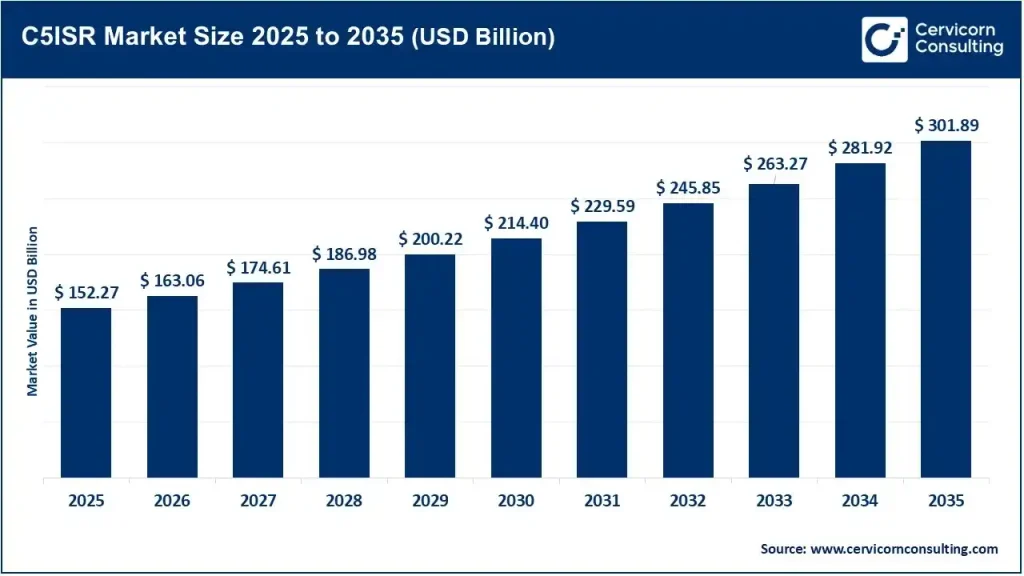
C5ISR Market Size
The global C5ISR market was valued at approximately USD 152.27 billion in 2025 and is projected to reach USD 301.89 billion by 2035, representing a 7.08% CAGR from 2026 to 2035.
C5ISR market growth factors
The global C5ISR market is expanding as defense organizations increasingly prioritize real-time situational awareness, network-centric warfare, multi-domain operations, secure communications, electronic warfare, cyber resilience, and rapid decision-making across land, air, sea, space, and cyberspace. C5ISR integrates command, control, communications, computers, combat systems, intelligence, surveillance, and reconnaissance capabilities into interconnected defense architectures, enabling military forces to collect, process, share, and act on information faster.
Growth is being supported by defense modernization programs, increasing geopolitical tensions, the proliferation of unmanned systems, growing demand for intelligence-led operations, satellite-enabled ISR, artificial intelligence, cloud computing, advanced sensors, software-defined radios, electronic warfare, cyber defense, and autonomous systems. The increasing need to connect legacy platforms with new digital systems is also creating opportunities for C5ISR upgrades and retrofit programs.
\In the United States, the Department of Defense’s CJADC2 approach is designed to integrate data, AI, advanced networks, sensors, and decision-support capabilities across multiple domains, while the FY2025 budget allocated approximately USD 1.433 billion for CJADC2 research, development, testing, and evaluation. Similar modernization efforts across NATO, Europe, India, Israel, Japan, South Korea, Australia, and Middle Eastern countries are increasing demand for interoperable command-and-control infrastructure.
Meanwhile, the growing importance of electromagnetic-spectrum dominance and cyber operations is encouraging militaries to invest in electronic intelligence, signals intelligence, counter-UAS, secure tactical communications, and adaptive electronic warfare. These factors, combined with rising defense expenditure and the requirement for faster sensor-to-shooter decision cycles, are positioning C5ISR as a core technology layer for next-generation military operations.
Get a Free Sample: https://www.cervicornconsulting.com/sample/3026
What is the C5ISR market?
C5ISR stands for Command, Control, Communications, Computers, Combat Systems, Intelligence, Surveillance, and Reconnaissance. It represents an integrated ecosystem of technologies that enables military organizations to collect information from multiple sources, communicate securely, analyze battlefield data, coordinate forces, and support operational decisions.
C5ISR systems can combine tactical communications, command-and-control software, radars, electro-optical and infrared sensors, satellites, unmanned aerial systems, electronic warfare equipment, cyber capabilities, intelligence databases, battle management systems, and secure computing infrastructure.
Rather than operating individual systems in isolation, modern C5ISR architectures seek to connect sensors, command centers, communications networks, weapons platforms, and personnel into a coordinated information environment. This creates a continuous flow of data from sensor to command center to decision-maker and, increasingly, from sensor to shooter.
The market encompasses hardware, software, and services and is used across land, naval, airborne, and space platforms. Key applications include intelligence and surveillance, reconnaissance, command and control, communications, electronic warfare, battlefield management, cybersecurity, and mission computing.
Why is the C5ISR market important?
C5ISR has become increasingly important because modern military operations generate enormous quantities of information. Satellites, drones, radars, cameras, signals intelligence systems, cyber sensors, and battlefield platforms continuously produce data. Without an integrated architecture, this information can remain fragmented across different commands and platforms.
C5ISR helps transform this information into actionable intelligence. By integrating sensors, communications, computing, and command systems, military organizations can improve situational awareness, shorten decision-making cycles, coordinate distributed forces, and respond more effectively to rapidly changing threats.
The technology is particularly important for multi-domain operations, where forces operating on land, at sea, in the air, in space, and in cyberspace must work together. The U.S. Army’s C5ISR Center, for example, conducts experimentation involving network modernization, multi-domain operations, Project Convergence, and technologies designed to connect capabilities across domains.
C5ISR also supports survivability. Secure communications, electronic warfare, cyber protection, counter-UAS technologies, and resilient networks can help forces operate in environments where communications are disrupted or contested.
C5ISR market company landscape
The C5ISR competitive landscape includes large defense primes, technology companies, systems integrators, communications specialists, intelligence providers, and electronic warfare companies. The following companies are among the prominent participants requested for this analysis.
BAE Systems
Company: BAE Systems
Specialization: Defense electronics, electronic warfare, intelligence, cybersecurity, communications, mission systems, and combat platforms.
Key Focus Areas: Electronic warfare, cyber and electromagnetic activities, ISR, tactical systems, space and mission systems, communications, and intelligence.
Notable Features: Strong presence across the United States, United Kingdom, Europe, Saudi Arabia, and Australia, with extensive multi-domain defense capabilities.
2025 Revenue: BAE Systems reported £28.336 billion in IFRS revenue for 2025, while reported sales were £30.662 billion. Its Electronic Systems sector generated £7.528 billion in 2025 sales.
C5ISR Market Share: Industry estimates place BAE Systems’ C5ISR share at approximately 6–9%, although this is an industry estimate rather than a company-reported figure.
Global Presence: BAE Systems operates in more than 40 countries and had approximately 111,400 employees at the end of 2025.
BAE Systems is particularly well positioned in electronic warfare and electromagnetic-spectrum operations. Its portfolio includes systems designed to disrupt adversary communications, radars, and command networks. Its software-defined SIGINT and electronic-warfare capabilities also reflect the market’s movement toward rapidly upgradeable C5ISR architectures.
CACI International Inc.
Company: CACI International Inc.
Specialization: National security technology, intelligence, electronic warfare, cyber, communications, mission systems, and IT modernization.
Key Focus Areas: Signals intelligence, electronic warfare, intelligence analysis, secure networks, software, battlefield IT, and mission support.
Notable Features: Strong exposure to U.S. national security customers and growing software-centric capabilities.
2025 Revenue: CACI generated USD 8.63 billion in fiscal 2025 revenue, representing 12.6% growth from the previous year.
C5ISR Market Share: A standalone C5ISR market-share percentage is not publicly disclosed by CACI.
Global Presence: CACI has significant U.S. operations and international activity, including a U.K. business serving customers across more than 50 global markets.
CACI is especially relevant to the software, intelligence, cyber, and data side of C5ISR. Its focus on national-security priorities and software-enabled capabilities makes it well positioned as militaries move from hardware-centric architectures toward software-defined and continuously upgradeable systems.
Collins Aerospace
Company: Collins Aerospace, an RTX business
Specialization: Aerospace and defense systems, avionics, communications, sensors, mission systems, navigation, and connected aircraft technologies.
Key Focus Areas: Military avionics, secure communications, navigation, ISR-related systems, mission computing, sensors, and aerospace electronics.
Notable Features: Broad aerospace technology portfolio and integration across aircraft and defense platforms.
2025 Revenue: Collins Aerospace reported USD 27.585 billion in 2025 consolidated net sales. RTX reported total 2025 net sales of USD 88.603 billion.
C5ISR Market Share: A standalone Collins Aerospace C5ISR market share is not separately disclosed.
Global Presence: Collins Aerospace serves customers across North America, Europe, Asia-Pacific, and other international markets through the wider RTX ecosystem.
Collins contributes to C5ISR through aerospace electronics, communications, sensors, avionics, navigation, and mission technologies. Its position is particularly important as airborne platforms become increasingly dependent on connected sensors, resilient communications, and networked mission systems.
Elbit Systems Ltd.
Company: Elbit Systems Ltd.
Specialization: Defense electronics, C4I, cyber, electronic warfare, ISR, unmanned systems, electro-optics, aerospace systems, and land systems.
Key Focus Areas: Battlefield management, C4I, electronic warfare, intelligence, surveillance, reconnaissance, unmanned platforms, and networked warfare.
Notable Features: Strong Israeli technology base combined with extensive international defense operations.
2025 Revenue: Elbit Systems generated USD 7.939 billion in 2025 revenue, up 16.3% from 2024. C4I and Cyber revenue increased 16% year over year, while ISTAR and EW revenue also increased 16%.
C5ISR Market Share: Industry estimates place Elbit Systems at approximately 3–5% of the C5ISR market.
Global Presence: Elbit employs more than 20,000 people across dozens of countries on five continents.
Elbit’s strength lies in combining C4I, cyber, ISR, EW, electro-optics, unmanned systems, and battlefield management. Its approach closely aligns with the industry’s transition toward networked warfare and integrated battlefield intelligence. Elbit describes its C4I capabilities as enabling battlefield participants and platforms to communicate and operate through integrated digital warfare architectures.
General Dynamics Corporation
Company: General Dynamics Corporation
Specialization: Defense systems, combat vehicles, naval platforms, mission systems, communications, IT, and C5ISR solutions.
Key Focus Areas: Mission command, tactical communications, combat management, battlefield networking, intelligence, IT modernization, and platform integration.
Notable Features: Major U.S. defense prime with extensive land, naval, aerospace, and technology capabilities.
2025 Revenue: General Dynamics achieved record revenue of USD 52.6 billion in 2025, including USD 39.5 billion from its defense businesses.
C5ISR Market Share: Industry estimates place General Dynamics at approximately 4–7% of the C5ISR market.
Global Presence: Strong U.S. footprint with international defense and aerospace programs.
General Dynamics is particularly important in mission systems, tactical communications, combat platforms, and integrated command architectures. Its Technologies segment specifically identifies C5ISR solutions as part of its portfolio, demonstrating its direct exposure to the market.
Leading trends and their impact on the C5ISR market
Artificial intelligence and machine learning
AI is becoming an important layer within C5ISR architectures. Military organizations are using AI to process large volumes of sensor data, identify patterns, support target recognition, prioritize threats, and accelerate decision-making. The impact is a shift from simply collecting information toward automated intelligence and decision support.
Multi-domain command and control
The traditional separation between land, sea, air, space, and cyber operations is declining. Multi-domain C2 architectures are increasingly designed to share information across operational environments. The U.S. CJADC2 approach is an important example, integrating data, AI, networks, and sensors across domains.
Software-defined and open architectures
Defense organizations increasingly want systems that can be upgraded without replacing entire platforms. Open architectures and software-defined systems enable faster insertion of new capabilities and can reduce technology obsolescence.
BAE Systems’ software-defined SIGINT approach illustrates this trend, with open architectures designed to adapt to evolving threats.
Electronic warfare and electromagnetic-spectrum dominance
Electronic warfare is becoming central to C5ISR because adversaries increasingly target communications, radar, navigation, and data links. Military organizations are investing in systems capable of detecting, analyzing, protecting, disrupting, and exploiting electromagnetic signals.
The growing emphasis on cyber-electromagnetic operations is encouraging integration between electronic warfare, cyber defense, intelligence, and command systems.
Counter-UAS and autonomous systems
The rapid proliferation of drones is increasing demand for integrated detection, identification, tracking, electronic warfare, and command systems. C5ISR networks are increasingly expected to connect sensors and counter-UAS systems with commanders and other battlefield assets.
U.S. Army experimentation in 2025 included C5ISR technologies that connect small UAS with aided target recognition to accelerate battlefield target detection.
Space-based ISR
Satellites are becoming increasingly important sources of intelligence, communications, positioning, and surveillance data. NATO’s 2025 Integrated Air and Missile Defence Policy specifically highlights the importance of space-based data for early warning, satellite communications, ISR, targeting, and positioning/navigation/timing.
Successful examples of C5ISR around the world
United States: Project Convergence and CJADC2
The United States represents one of the most advanced C5ISR ecosystems. Project Convergence is designed to experiment with sensor-to-shooter technologies, AI, networking, and Joint All-Domain Command and Control. The U.S. Army describes the initiative as supporting faster targeting and decision dominance.
CJADC2 further expands this approach by connecting capabilities across land, sea, air, space, and cyberspace. Its FY2025 investment demonstrates the U.S. government’s long-term commitment to integrated command and control.
Israel: integrated battlefield intelligence
Israel has developed a strong ecosystem around C4I, electronic warfare, ISR, cyber, unmanned systems, and battlefield management. Elbit Systems’ C4I and Cyber activities demonstrate the country’s emphasis on connecting battlefield participants and platforms through digital networks.
The country’s experience with complex security environments has also accelerated demand for real-time intelligence, surveillance, electronic warfare, counter-UAS, and rapid decision-support capabilities.
NATO and Europe: integrated air and missile defense
NATO is increasingly focused on interoperable systems capable of sharing information among member states. Its Integrated Air and Missile Defence architecture relies on data from space, sensors, command systems, and allied forces. NATO’s 2025 policy emphasizes information sharing to improve situational awareness and cognitive superiority during joint multi-domain operations.
India: indigenous C5ISR development
India is building its domestic defense technology ecosystem through policies focused on indigenization, domestic manufacturing, innovation, and defense R&D. The Defence Acquisition Procedure 2020 introduced mechanisms supporting indigenous design, development, manufacturing, iDEX, Make-I, Make-II, and Make-III programs.
The Indian government has also amended procurement procedures to prioritize indigenous sourcing and simplify iDEX procurement, supporting startups and domestic technology developers.
Global regional analysis, government initiatives, and policies shaping the market
North America
North America remains a leading C5ISR market, supported primarily by U.S. defense modernization, advanced military technology programs, and substantial government R&D expenditure. The United States is investing in CJADC2, Project Convergence, advanced battle management, tactical networking, cyber capabilities, electronic warfare, space-based ISR, and autonomous systems.
The region benefits from the presence of major defense contractors including BAE Systems, CACI, General Dynamics, RTX, Lockheed Martin, Northrop Grumman, and L3Harris. U.S. government procurement policies also emphasize interoperability, resilient communications, open architectures, and rapid technology insertion.
Europe
Europe is experiencing increasing demand for C5ISR as NATO members strengthen defense capabilities and seek greater interoperability. The Russia-Ukraine war has reinforced the importance of real-time ISR, secure communications, electronic warfare, unmanned systems, cyber resilience, and integrated air and missile defense.
European governments are increasing defense investment while seeking greater industrial cooperation. NATO’s emphasis on information sharing, space-based ISR, joint operations, and integrated air and missile defense is creating opportunities for C5ISR suppliers.
The United Kingdom, France, Germany, Italy, Poland, and Nordic countries are particularly important markets for advanced communications, ISR, EW, command systems, and network modernization.
Asia-Pacific
Asia-Pacific is expected to become one of the fastest-growing C5ISR regions as countries modernize military capabilities and respond to increasingly complex regional security environments.
China, India, Japan, South Korea, and Australia are investing in surveillance, communications, space systems, unmanned platforms, electronic warfare, cybersecurity, and command-and-control capabilities.
Japan and Australia are emphasizing interoperability with allied forces, while South Korea is investing in advanced surveillance, command systems, missile defense, and network-centric capabilities. India’s focus on self-reliance and domestic defense manufacturing is creating additional opportunities for local C5ISR suppliers and international technology partnerships.
Middle East & Africa
The Middle East is an important C5ISR opportunity because of demand for border surveillance, counter-UAS technologies, missile defense, secure communications, intelligence systems, and electronic warfare.
Saudi Arabia, the United Arab Emirates, Israel, and other regional defense markets are investing in advanced sensors, command centers, unmanned systems, cybersecurity, and integrated surveillance architectures. Regional procurement is increasingly moving beyond individual platforms toward integrated systems that combine sensors, communications, intelligence, and command capabilities.
Latin America
Latin American countries represent a smaller but emerging opportunity for C5ISR technologies. Demand is primarily associated with border surveillance, maritime security, counter-narcotics operations, disaster response, critical infrastructure protection, and homeland security.
As governments modernize surveillance infrastructure, opportunities are emerging for communications networks, ISR systems, command centers, drones, secure data platforms, and integrated monitoring solutions.
Government policies shaping future C5ISR demand
Government policy is likely to remain one of the strongest determinants of C5ISR investment. The United States is advancing CJADC2 and related multi-domain modernization programs, while NATO is strengthening interoperability, information sharing, and integrated air and missile defense.
India’s Defence Acquisition Procedure 2020, combined with Make in India and Aatmanirbhar Bharat objectives, is encouraging domestic development and procurement of defense technologies. The framework also supports innovation through iDEX and technology-development programs.
Across Europe and other allied markets, policies emphasizing defense readiness, interoperability, sovereign capabilities, cyber resilience, and domestic industrial capacity are supporting long-term demand for C5ISR systems.
The policy environment is therefore shifting from conventional equipment procurement toward networked, interoperable, software-enabled, data-centric defense architectures. This creates opportunities for companies capable of integrating sensors, communications, intelligence, cybersecurity, AI, electronic warfare, and command systems into unified operational environments.
To Get Detailed Overview, Contact Us: https://www.cervicornconsulting.com/contact-us
Read Report: AI Automation Market Revenue, Trends, and Strategic Insights by 2035