


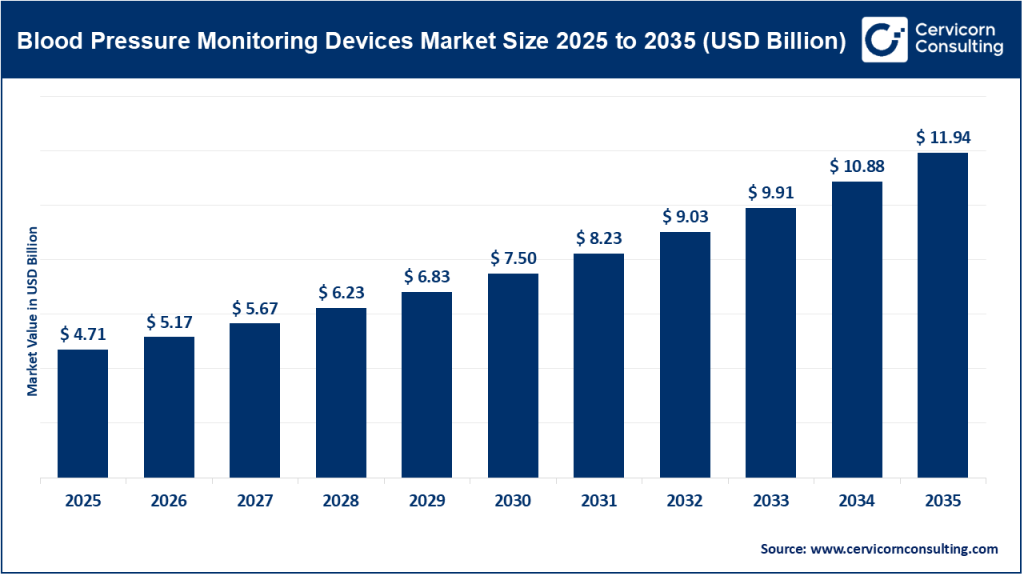
Blood Pressure Monitoring Devices Market Size
The global blood pressure monitoring devices market size was worth USD 4.71 billion in 2025 and is anticipated to expand to around USD 11.94 billion by 2035, registering a compound annual growth rate (CAGR) of 9.7% from 2026 to 2035.
What Is the Blood Pressure Monitoring Devices Market?
The blood pressure monitoring devices market refers to the global industry involved in the development, manufacturing, distribution, and sales of devices that measure blood pressure — a critical vital sign. These devices include:
-
Automated blood pressure monitors (digital arm and wrist devices)
-
Manual sphygmomanometers
-
Wearable and cuffless monitors
-
Smart and connected devices integrated with apps and telehealth platforms
The market spans multiple applications — from clinical and hospital-based monitoring to remote/homecare and preventive screening services. These devices are essential in diagnosing, managing, and monitoring hypertension and related cardiovascular conditions, particularly as awareness of preventive health care grows.
Get a Free Sample: https://www.cervicornconsulting.com/sample/2898
Market Trends
Several key trends are shaping the blood pressure monitoring devices market:
Technological Advancements
-
Connected and smart devices are rapidly gaining traction. These devices often link with mobile apps and telemedicine platforms to store readings, share data with clinicians, and support long-term health tracking.
-
Wearable and cuffless monitors are among the fastest-growing technology segments, driven by consumer preference for continuous and hassle‑free monitoring.
-
AI-powered analytics is an emerging trend — many new devices now use predictive algorithms to aid clinicians in hypertension management.
Remote & Home Monitoring
-
The shift toward home healthcare monitoring has accelerated with the expansion of telehealth services and remote patient monitoring programs. Patients increasingly prefer devices that can deliver consistent readings without frequent clinic visits.
-
Clinical settings continue to demand high-precision digital monitors, but home use is growing especially fast due to convenience and rising hypertension awareness.
Distribution Channel Shifts
-
Retail pharmacies remain the largest distribution channel, supported by pharmacist recommendations and widespread availability.
-
E-commerce and online platforms are growing quickly as consumers increasingly purchase devices online for convenience and competitive pricing.
Market Dynamics
Key Drivers
-
Rising Chronic Disease Burden: The global prevalence of hypertension and cardiovascular diseases is driving demand for both clinical and home blood pressure monitoring devices.
-
Telehealth Expansion: Remote patient monitoring solutions are boosting demand for connected devices that transmit readings to healthcare providers.
-
Technological Innovation: Advances in digital sensors, wearable technology, and cloud-based healthcare infrastructure are facilitating more accurate and real-time monitoring capabilities.
Market Restraints
-
High Cost of Advanced Devices: Smart, wearable, or AI-enabled monitoring systems are costlier to develop and purchase, which may limit uptake in price-sensitive regions.
-
Regulatory and Standardization Challenges: Strict testing and approval requirements add complexity and time to product launches, especially for innovative or connected devices.
Opportunities
-
Integration with IoT & Predictive Health: IoT-enabled and predictive health platforms create opportunities for enhanced patient management and subscription healthcare models.
-
Emerging Markets: Rapidly growing healthcare systems in Asia-Pacific, Latin America, and Middle East/Africa provide fertile ground for broader adoption of both basic and advanced blood pressure monitors.
Challenges
-
Shortage of Skilled Operators: Devices, especially advanced models, require trained personnel to operate and interpret data accurately.
-
Supply Chain & Data Security: Precision components and cybersecurity concerns present ongoing risks to both production and device utility.
Regional Analysis
Asia-Pacific
-
Dominant and fastest growing region, accounting for the largest share of global revenue.
-
Growth driven by high hypertension prevalence, expanding home healthcare, strong demand in countries like China and India, and increased smartphone adoption.
North America
-
Historically the largest medical device market, supported by advanced infrastructure, reimbursement policies, and high adoption of connected health technology.
-
Connected and smart devices are widely used in chronic care and maternal/child healthcare segments.
Europe
-
Strong emphasis on preventive healthcare and widespread use of digital monitors.
-
Growth is steady, though slower compared to Asia-Pacific and North America. Germany, France, the UK, and Italy lead demand within the region.
LAMEA (Latin America, Middle East & Africa)
-
Smaller market share, but modest growth is expected due to increasing public health investments and rising awareness of cardiovascular health.
-
Brazil, Mexico, Saudi Arabia, UAE, and South Africa show particularly strong demand trends.
Recent Developments Impacting the Market
The market continues to evolve with innovations and expansions among leading players:
Industry Growth & Company Expansion
-
Omron Healthcare reported strong revenue growth, driven by demand for home blood pressure monitoring devices.
-
Citizen Systems expanded its operations in Southeast Asia to strengthen distribution and mitigate supply chain risks.
-
A&D Medical launched an AI-powered remote monitoring platform to enhance disease management and monitoring workflows.
Technological Developments
-
Wearable & Connected Devices: Wearable blood pressure monitors that provide real-time readings and mobile connectivity are reshaping home healthcare.
-
AI-Enhanced Analytics: Machine learning is being integrated into monitoring devices to support clinical decision-making and predictive trends.
-
Telehealth Integration: Increased device standardization with telehealth platforms and EHR systems supports a more seamless patient–provider experience.
Sustainability Focus
-
Manufacturers are adopting eco-friendly production methods, including recyclable materials and reduced electronic waste, attracting regulatory and consumer support.
Conclusion
The blood pressure monitoring devices market is experiencing rapid transformation — powered by rising hypertension rates, digital innovation, and a shift toward home and remote monitoring solutions. Growth is being led by Asia-Pacific and North America, with Europe and LAMEA also emerging as meaningful contributors. Ongoing advances in connected technologies, AI-driven analytics, and consumer-centric design are poised to expand the market further through 2035. However, challenges remain around cost, regulation, data security, and trained workforce availability.
To Get Detailed Overview, Contact Us: https://www.cervicornconsulting.com/contact-us
Read Report: Fruits and Vegetables Market Revenue, Trends, and Strategic Insights by 2035