


Table of Contents
ToggleBiopharmaceutical Market Size
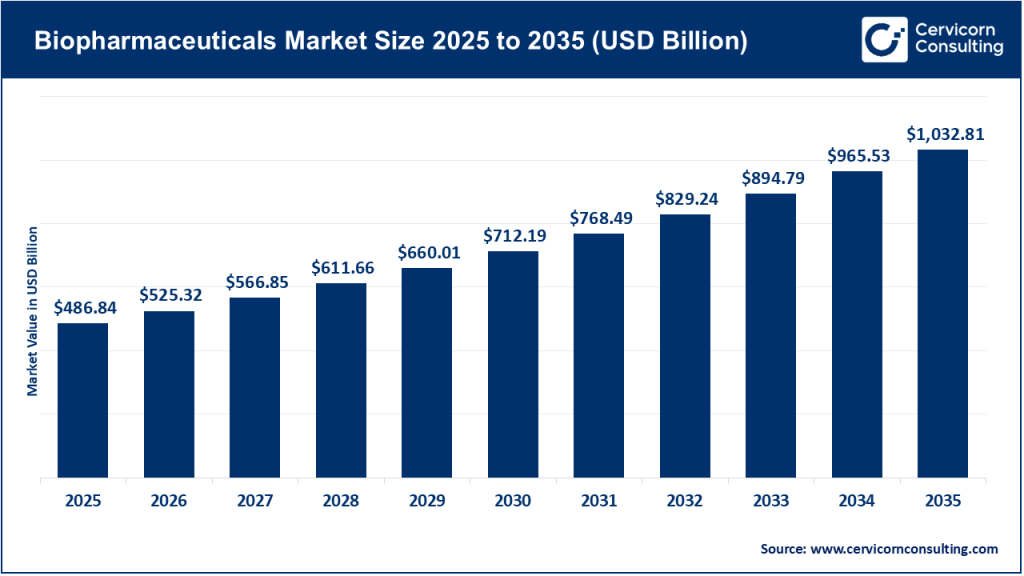
The global biopharmaceutical market size was valued at approximately USD 486.84 billion in 2025 and is projected to reach nearly USD 1,032.81 billion by 2035, growing at a CAGR of 7.81%.
What is the Biopharmaceutical Market?
The biopharmaceutical market refers to the global industry involved in the research, development, manufacturing, and commercialization of therapeutic products derived from biological sources. Unlike traditional pharmaceuticals that are chemically synthesized, biopharmaceuticals are produced using living organisms, biological processes, recombinant DNA technology, cell cultures, and advanced biotechnology platforms.
Biopharmaceutical products include:
- Monoclonal antibodies
- Recombinant proteins
- Vaccines
- Gene therapies
- Cell therapies
- Biosimilars
- Blood-derived products
- RNA-based therapeutics
These products are widely used in treating cancer, autoimmune disorders, infectious diseases, diabetes, cardiovascular diseases, neurological disorders, and rare genetic conditions.
Get a Free Sample: https://www.cervicornconsulting.com/sample/2650
Why is the Biopharmaceutical Market Important?
The biopharmaceutical market plays a crucial role in addressing some of the world’s most challenging healthcare issues. Traditional drug therapies often provide symptomatic relief, whereas biopharmaceuticals can target disease mechanisms at the molecular level, improving treatment outcomes and patient quality of life.
The importance of the market can be attributed to several factors:
- Development of highly targeted therapies with improved efficacy
- Enhanced treatment options for previously untreatable diseases
- Expansion of personalized and precision medicine
- Faster response to emerging infectious diseases
- Significant reduction in hospitalization and disease burden
- Improved survival rates for cancer and rare disease patients
- Support for healthcare innovation and economic growth
The COVID-19 pandemic further highlighted the importance of biotechnology-driven pharmaceutical innovation, showcasing the industry’s ability to rapidly develop vaccines and therapeutic solutions on a global scale.
Biopharmaceutical Market Growth Factors
The growth of the biopharmaceutical market is being driven by rising prevalence of chronic diseases, increasing incidence of cancer and autoimmune disorders, growing investments in biotechnology research and development, expanding adoption of personalized medicine, advancements in gene and cell therapy technologies, increasing demand for biologics and biosimilars, favorable regulatory pathways for innovative therapies, rising healthcare expenditure across developed and emerging economies, expanding applications of artificial intelligence in drug discovery, increasing collaborations between pharmaceutical and biotechnology companies, growing aging population worldwide, enhanced manufacturing capabilities through bioprocessing innovations, and continuous breakthroughs in genomics, proteomics, and precision medicine that are accelerating the development of next-generation therapeutic solutions.
Key Market Dynamics Driving Industry Expansion
Rising Burden of Chronic Diseases
Chronic illnesses such as cancer, diabetes, rheumatoid arthritis, multiple sclerosis, and inflammatory bowel diseases are becoming increasingly prevalent worldwide. Biopharmaceutical therapies offer highly targeted treatment options that improve patient outcomes while reducing adverse effects.
Growing Demand for Precision Medicine
Healthcare providers are increasingly adopting personalized treatment approaches based on genetic, molecular, and biomarker information. Biopharmaceutical products are central to this transition, enabling customized therapies tailored to individual patients.
Technological Advancements in Biotechnology
Innovations in:
- CRISPR gene editing
- Synthetic biology
- Next-generation sequencing
- Artificial intelligence
- Machine learning
- Single-cell analysis
are significantly accelerating drug discovery and development timelines.
Expansion of Biosimilars
The expiration of patents for several blockbuster biologics has created a rapidly expanding biosimilar market, improving patient access while reducing healthcare costs.
Major Companies Shaping the Biopharmaceutical Market
Company Analysis and Competitive Landscape
| Company | Specialization | Key Focus Areas | Notable Features | 2025 Revenue (Approx.) | Market Share (Approx.) | Global Presence |
|---|---|---|---|---|---|---|
| F. Hoffmann-La Roche Ltd | Oncology, Diagnostics, Biologics | Cancer therapies, diagnostics, immunology | Strong oncology portfolio and diagnostics integration | USD 72 Billion | 6-8% | 100+ countries |
| Novartis AG | Innovative Medicines, Gene Therapy | Oncology, cardiovascular, immunology | Leadership in gene therapy and targeted medicines | USD 56 Billion | 5-7% | 140+ countries |
| AbbVie Inc. | Immunology, Oncology | Autoimmune diseases, cancer, neuroscience | Blockbuster biologics and diversified portfolio | USD 58 Billion | 4-6% | 175+ countries |
| Johnson & Johnson Services, Inc. | Pharmaceuticals, Medical Technology | Oncology, immunology, infectious diseases | Extensive healthcare ecosystem | USD 90 Billion+ | 5-7% | 150+ countries |
| Merck & Co., Inc. | Oncology, Vaccines | Immuno-oncology, vaccines, infectious diseases | Strong leadership in cancer immunotherapy | USD 66 Billion | 4-6% | 140+ countries |
F. Hoffmann-La Roche Ltd
F. Hoffmann-La Roche Ltd remains a dominant force in the biopharmaceutical market, particularly in oncology and diagnostics. The company has built one of the world’s strongest biologics portfolios through continuous innovation in monoclonal antibodies and targeted therapies.
Strategic Focus
- Precision oncology
- Immunotherapy
- Personalized healthcare
- Companion diagnostics
- Rare disease treatments
Novartis AG
Novartis has established itself as a leader in innovative medicines, particularly in gene therapy and advanced biologics. The company continues investing heavily in next-generation therapeutic platforms.
Strategic Focus
- Cell and gene therapy
- Cardiovascular disease treatment
- Oncology innovation
- Radioligand therapies
- Digital healthcare solutions
AbbVie Inc.
AbbVie has achieved significant success through its immunology and oncology portfolios. The company’s expertise in biologics has helped it maintain a strong position within the global biopharmaceutical landscape.
Strategic Focus
- Immunology therapies
- Oncology treatments
- Neuroscience innovation
- Rare diseases
- Advanced biologics
Johnson & Johnson Services, Inc.
Johnson & Johnson leverages its diversified healthcare ecosystem to drive innovation across pharmaceuticals, biotechnology, and medical devices.
Strategic Focus
- Cancer treatment
- Autoimmune disorders
- Infectious diseases
- Vaccine development
- Precision medicine
Merck & Co., Inc.
Merck continues to lead the immuno-oncology segment through innovative cancer therapies and vaccine development programs.
Strategic Focus
- Immunotherapy
- Oncology
- Vaccines
- Infectious diseases
- Biologic drug development
Leading Trends Transforming the Biopharmaceutical Market
Gene Therapy Revolution
Gene therapies are transforming the treatment of inherited disorders by targeting the underlying genetic causes of diseases rather than managing symptoms.
Market Impact
- Expansion of curative treatments
- Growth in rare disease therapeutics
- Increased biotech investment
- Enhanced regulatory support
Cell Therapy Advancements
CAR-T cell therapies and stem cell treatments are demonstrating remarkable clinical success, particularly in oncology.
Impact on Industry
- Creation of new treatment paradigms
- Improved patient outcomes
- Higher healthcare value
- Expansion of personalized medicine
Artificial Intelligence in Drug Discovery
AI technologies are significantly improving target identification, molecule screening, clinical trial design, and drug development efficiency.
Benefits
- Reduced R&D costs
- Faster drug discovery
- Higher success rates
- Improved clinical outcomes
Growth of Biosimilars
The biosimilar segment is becoming increasingly important as healthcare systems seek cost-effective alternatives to branded biologics.
Industry Effects
- Enhanced patient access
- Lower treatment costs
- Increased competition
- Expanded healthcare affordability
mRNA Technology Expansion
Following the success of mRNA vaccines, companies are exploring mRNA-based treatments for:
- Cancer
- Rare diseases
- Autoimmune disorders
- Infectious diseases
This trend is expected to create substantial future growth opportunities.
Successful Examples of the Biopharmaceutical Market Around the World
Oncology Biologics in the United States
The United States has become a global leader in biopharmaceutical innovation, with advanced biologic therapies significantly improving cancer survival rates. The integration of precision medicine, genomic testing, and targeted biologics has transformed oncology treatment pathways.
Success Factors
- Strong research ecosystem
- Venture capital investment
- FDA support for innovation
- Academic-industry collaboration
Gene Therapy Development in Europe
European countries have emerged as pioneers in gene therapy research and commercialization. Several groundbreaking therapies for rare genetic disorders have originated from European biotechnology ecosystems.
Key Advantages
- Advanced regulatory frameworks
- Strong academic research
- Government funding programs
- Collaborative innovation networks
Biosimilar Leadership in Asia-Pacific
Countries such as South Korea and India have become global hubs for biosimilar development and manufacturing.
Outcomes
- Reduced treatment costs
- Expanded access to biologics
- Increased export opportunities
- Strengthened biotechnology capabilities
Vaccine Innovation Worldwide
The rapid development and commercialization of advanced vaccines demonstrated the global biopharmaceutical industry’s ability to respond effectively to public health emergencies.
Impact
- Accelerated innovation
- Enhanced manufacturing capacity
- Improved global healthcare preparedness
- Strengthened biotechnology infrastructure
Global Regional Analysis of the Biopharmaceutical Market
North America
North America remains the largest biopharmaceutical market globally due to robust R&D investments, advanced healthcare infrastructure, strong regulatory support, and the presence of major industry players.
Market Drivers
- High healthcare spending
- Strong biotechnology ecosystem
- Advanced clinical research capabilities
- Favorable reimbursement frameworks
Government Initiatives and Policies
United States
Key initiatives include:
- FDA accelerated approval programs
- Orphan Drug Act incentives
- Breakthrough Therapy Designation pathways
- National Institutes of Health (NIH) funding programs
- Cancer Moonshot initiatives
These programs encourage innovation and accelerate commercialization of advanced therapies.
Canada
Government support includes:
- Strategic Innovation Fund
- Biotechnology research grants
- Life sciences investment programs
- Precision medicine initiatives
Europe
Europe represents a major hub for biotechnology innovation, pharmaceutical manufacturing, and advanced therapy development.
Market Drivers
- Strong healthcare systems
- Aging population
- Rising chronic disease prevalence
- Extensive research collaboration
Government Initiatives and Policies
European Union
Key policies include:
- European Pharmaceutical Strategy
- Horizon Europe research funding
- Advanced Therapy Medicinal Product (ATMP) framework
- Rare disease support programs
These initiatives strengthen Europe’s competitiveness in biotechnology and biopharmaceutical innovation.
Germany
Germany supports biopharmaceutical development through:
- BioRegio programs
- Innovation grants
- Industry-academia partnerships
- Biotechnology cluster development
United Kingdom
The UK government promotes growth through:
- Life Sciences Vision strategy
- Genomics programs
- Cell and Gene Therapy Catapult
- R&D tax incentives
Asia-Pacific
Asia-Pacific is experiencing the fastest growth in the global biopharmaceutical market.
Market Drivers
- Growing healthcare expenditure
- Large patient populations
- Expanding biotechnology capabilities
- Increasing government support
Government Initiatives and Policies
China
China has implemented several measures including:
- Healthy China 2030 strategy
- Biotech innovation funding
- Accelerated drug approval pathways
- National precision medicine programs
These initiatives have significantly strengthened China’s biotechnology ecosystem.
Japan
Government support focuses on:
- Regenerative medicine regulations
- Fast-track approvals
- Precision healthcare programs
- Advanced biotechnology investments
India
India continues strengthening its position through:
- Biotechnology Industry Research Assistance Council (BIRAC)
- National Biopharma Mission
- Production-linked incentive schemes
- Biosimilar development support
The country is becoming a major global manufacturing hub for biologics and biosimilars.
South Korea
South Korea supports industry growth through:
- Bioeconomy development strategies
- Biotechnology innovation funding
- Cell and gene therapy initiatives
- Global export promotion programs
Latin America
Latin America is gradually emerging as an important market for biopharmaceutical products.
Market Drivers
- Improved healthcare access
- Rising chronic disease burden
- Expanding biologics adoption
- Increasing healthcare investments
Government Initiatives and Policies
Countries including Brazil and Mexico are implementing policies focused on:
- Local biologics production
- Biosimilar approvals
- Healthcare modernization
- Public-private partnerships
These initiatives are improving access to advanced therapies.
Middle East and Africa
The Middle East and Africa region is witnessing increasing adoption of advanced biopharmaceutical therapies.
Market Drivers
- Healthcare infrastructure development
- Rising healthcare expenditure
- Government diversification programs
- Growing awareness of innovative therapies
Government Initiatives and Policies
Saudi Arabia
Key programs include:
- Vision 2030 healthcare transformation
- Biotechnology investment initiatives
- Pharmaceutical localization strategies
- Research collaboration programs
United Arab Emirates
The UAE supports market growth through:
- National biotechnology strategies
- Innovation-focused healthcare policies
- Investment incentives
- Advanced research centers
South Africa
Government initiatives emphasize:
- Biotechnology innovation
- Public healthcare modernization
- Local manufacturing support
- Research and development funding
Future Opportunities in the Biopharmaceutical Market
Several emerging opportunities are expected to reshape the industry landscape:
- Expansion of personalized medicine
- Commercialization of gene-editing therapies
- Development of next-generation vaccines
- Growth of AI-enabled drug discovery
- Increasing biosimilar adoption
- Expansion of digital therapeutics integration
- Advanced bioprocessing technologies
- Rare disease treatment innovation
- Regenerative medicine advancements
- Sustainable biomanufacturing solutions
The combination of scientific innovation, supportive government policies, increasing healthcare demand, and growing investment in biotechnology positions the biopharmaceutical market as one of the most transformative and high-growth sectors within the global healthcare industry.
To Get Detailed Overview, Contact Us: https://www.cervicornconsulting.com/contact-us
Read Report: Generative AI in Hardware Market Revenue, Trends, and Strategic Insights by 2035