


Biofertilizer Market: How Can Companies Turn Sustainable Agriculture Demand into Profitable Growth?
The shift toward sustainable agriculture is creating new opportunities for biofertilizer manufacturers, agricultural input suppliers, and microbial technology companies. However, growing interest in biological crop inputs does not automatically translate into repeat purchases or commercially viable products. Companies must address a more practical question: which products, crops, and markets offer the strongest combination of farmer demand, reliable field performance, and attractive margins?
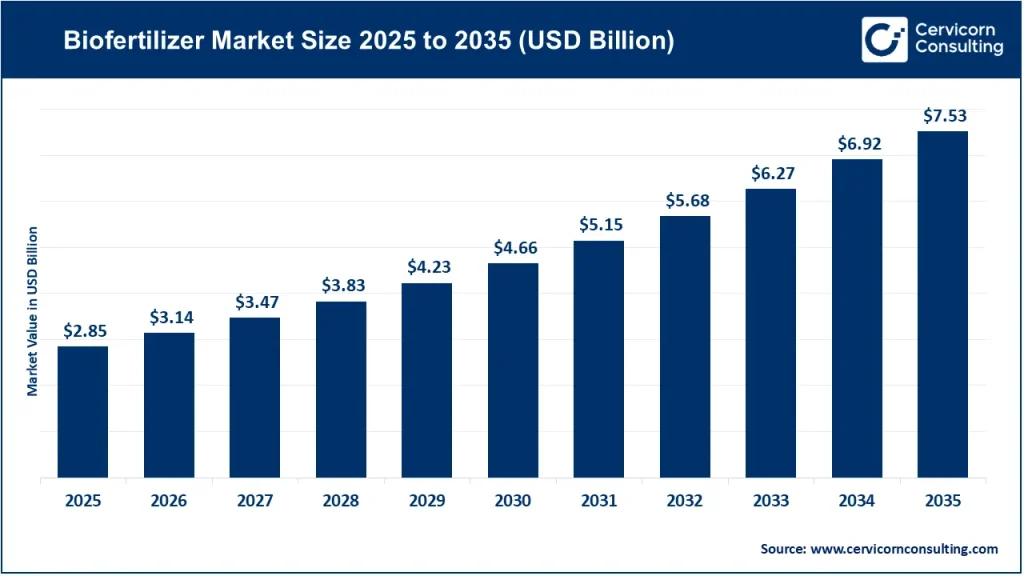
The global biofertilizer market was valued at approximately USD 2.85 billion in 2025 and is projected to reach USD 7.53 billion by 2035, expanding at a compound annual growth rate (CAGR) of 10.20% from 2026 to 2035. This growth outlook reflects opportunities associated with sustainable nutrient management, microbial innovation, and the need to improve agricultural productivity. The commercial outcome, however, will depend on how effectively companies translate these trends into products that work under real farming conditions.
Why Is Biofertilizer Demand Growing, and Where Is the Commercial Opportunity?
Biofertilizers use beneficial microorganisms to improve nutrient availability, support plant growth, and strengthen soil biological activity. Unlike conventional fertilizers that directly supply nutrients, microbial products can help plants access nutrients already present in the soil or convert nutrients into more usable forms.
This distinction is important for companies deciding where to compete. Demand for sustainable agricultural inputs is not uniform across crops, soil conditions, farming systems, or geographies. A formulation that performs well in one environment may deliver inconsistent results in another.
For manufacturers, the opportunity lies in identifying specific agricultural needs rather than developing products around sustainability claims alone. Nitrogen-fixing microorganisms can be relevant to legumes and selected cropping systems, while phosphate-solubilizing products may address nutrient availability challenges in particular soils. Mycorrhizal products can also support nutrient acquisition and root development in suitable crop and soil conditions.
Commercial success therefore depends on matching microbial capabilities with the requirements of a defined customer segment. Companies that establish clear product applications and demonstrate repeatable field performance may be better positioned to build lasting distribution relationships.
Get a Free Sample: https://www.cervicornconsulting.com/sample/2795
Which Biofertilizer Segments Should Manufacturers Prioritize?
Product development decisions increasingly require a balance between market size, technical feasibility, competitive intensity, and the economics of serving farmers.
Cervicorn Consulting’s market analysis identifies Rhizobium as a leading microorganism segment, with an estimated 40.2% share in 2025. Its established role in biological nitrogen fixation, particularly in legume production, provides a useful example of how a clearly defined agricultural application can support product adoption.
However, a large existing segment is not necessarily the best entry point for every company. Established categories may also attract strong competition, established dealer relationships, and pricing pressure. New entrants need to determine whether they can differentiate through formulation stability, crop-specific performance, application convenience, or technical support.
Other opportunities include phosphate-solubilizing microorganisms, Azotobacter-based products, and mycorrhizal formulations. Their commercial attractiveness depends on local crop economics, nutrient deficiencies, soil conditions, and the availability of credible field evidence.
Before allocating R&D and production budgets, companies should assess:
- Addressable demand: Which crops and farming regions have a clear need for the proposed microbial solution?
- Performance differentiation: Can the product demonstrate a measurable advantage over competing products or existing nutrient-management practices?
- Production economics: Can the formulation be manufactured consistently at a cost that supports viable margins?
- Market access: Do existing distributors, agronomists, cooperatives, or agricultural input retailers have the capability to support adoption?
These factors help distinguish technically promising products from commercially scalable opportunities.
Can Seed Treatment Become a More Scalable Route to Market?
Application method influences both farmer convenience and the economics of product distribution. Seed treatment accounted for an estimated 48.1% of the biofertilizer market by application mode in 2025, according to Cervicorn Consulting.
Its commercial appeal comes from the opportunity to introduce beneficial microorganisms at an early stage of crop development. Seed-based application can also fit into existing planting practices, potentially reducing the need for farmers to adopt an entirely separate application process.
For manufacturers, seed treatment may offer opportunities to work with seed companies, coating technology providers, and agricultural input distributors. Partnerships can expand market access while integrating biological products into established agricultural workflows.
Nevertheless, compatibility must be evaluated carefully. Microbial viability can be affected by seed-treatment chemicals, coating materials, moisture, storage conditions, and the interval between treatment and planting. Products must be tested under the conditions in which customers will actually store, handle, and use them.
Soil treatment and other application methods may be more appropriate for different crops or microbial technologies. The decision should be based on application effectiveness, farmer practices, cost per hectare, and the ability to maintain microbial viability throughout distribution.
Why Product Stability and Quality Control Can Determine Profitability
Biofertilizers present a manufacturing challenge that differs from that of many conventional agricultural inputs. A product may meet its initial specifications but lose effectiveness if viable microbial populations decline during storage or transportation.
Temperature sensitivity, moisture exposure, contamination risks, carrier-material selection, and formulation consistency can all influence commercial performance. These challenges become particularly important when products move through multiple distribution intermediaries or are sold across regions with different climatic conditions.
A manufacturer expanding into a new geography should therefore evaluate more than production capacity. It must understand local storage infrastructure, transportation conditions, product registration requirements, and the time products are likely to spend in the supply chain.
Investment in fermentation controls, contamination prevention, stability testing, suitable packaging, and shelf-life validation can reduce the risk of product failure. Liquid, powdered, carrier-based, and encapsulated formulations each present different trade-offs involving manufacturing cost, handling requirements, and microbial survival.
Encapsulation and advanced formulation technologies may offer opportunities to improve stability or control microbial delivery. However, their value should be measured against additional production costs, the target crop’s requirements, and the price customers are willing to pay.
For decision-makers, the central issue is not simply whether a technology improves shelf life. It is whether the improvement reduces returns, expands the serviceable market, improves repeat purchases, or produces a sufficient financial return on investment.
How Should Companies Select Their Next Geographic Market?
Regional expansion requires a more detailed assessment than comparing headline market growth rates. Agricultural practices, crop mix, fertilizer economics, regulatory systems, farmer purchasing power, and distribution structures can vary significantly between countries.
Cervicorn Consulting estimates that North America represented approximately 39.5% of the biofertilizer market in 2025, while Asia-Pacific is identified as a key growth region. These regional dynamics suggest different commercial priorities rather than a single expansion strategy.
In North America, companies may evaluate opportunities linked to commercial farming, established agricultural input channels, and demand for specialized biological products. Product differentiation, field evidence, and integration with existing crop-management programs can influence competitiveness.
In Asia-Pacific, the combination of extensive agricultural activity and diverse crop systems creates opportunities for products designed around local farming requirements. However, manufacturers must account for differences in farm size, purchasing power, distribution reach, and technical support needs. Products that perform well commercially in one country may require different packaging, pricing, or application guidance in another.
Companies considering international expansion should compare markets using a consistent set of criteria: addressable crop acreage, product suitability, competitor presence, registration timelines, distribution costs, achievable pricing, and expected time to profitability.
A smaller market with established distribution partners and clear product-market fit may provide a more attractive entry point than a larger market requiring substantial investment in farmer education and regulatory approvals.
What Does the Competitive Landscape Mean for Investment Decisions?
The biofertilizer industry includes established agricultural input companies, microbial technology developers, biological crop-protection specialists, and regional manufacturers. Companies identified in Cervicorn Consulting’s market coverage include Novozymes, Lallemand Inc., National Fertilizers Limited, Gujarat State Fertilizers & Chemicals Ltd., Rizobacter Argentina S.A., Koppert Biological Systems, Symborg, T. Stanes and Company Limited, BioConsortia, and Kula Bio.
Their presence illustrates the range of capabilities relevant to competition, including microbial development, formulation, manufacturing, agronomic expertise, and distribution.
For companies evaluating competitors or potential acquisition targets, brand recognition alone provides limited insight. A more useful assessment examines product portfolios, target crops, geographic coverage, formulation capabilities, registration status, partnerships, manufacturing capacity, and evidence of field performance.
Partnerships may be particularly relevant for businesses seeking to accelerate market entry without building every capability internally. A microbial technology developer may benefit from a manufacturer’s production infrastructure, while an established agricultural input company may gain access to differentiated biological products through licensing or collaboration.
Acquisitions and joint ventures also require careful evaluation of intellectual property, strain ownership, manufacturing reproducibility, regulatory obligations, and the transferability of performance claims across agricultural environments.
How Can Biofertilizer Companies Build a Sustainable Route to Revenue?
Market adoption depends not only on product efficacy but also on whether farmers can understand, afford, and consistently use the product. This makes distribution strategy and technical support important commercial considerations.
Direct sales can be suitable for large commercial farms, institutional customers, and agricultural businesses that require application guidance or customized solutions. Dealer networks can provide wider geographic reach, while partnerships with seed companies and other agricultural input providers may integrate biofertilizers into established purchasing channels.
For smaller farms, the cost of adoption includes more than the purchase price. Farmers may need demonstrations, clear application instructions, assurance of compatibility with existing inputs, and evidence that the product can deliver value under local conditions.
Field demonstrations and independently credible performance data can help address these concerns. Companies should measure outcomes such as yield response, nutrient-use efficiency, consistency across growing conditions, cost per hectare, and repeat-purchase rates rather than relying exclusively on initial product sales.
The economics also need to work across the distribution chain. Dealer margins, transport costs, storage requirements, seasonal demand, product returns, and farmer payment cycles can all influence profitability. A product with strong technical performance may still struggle if its pricing and distribution model do not fit local purchasing behavior.
What Should Management Evaluate Before Expanding Production Capacity?
The biofertilizer market’s growth outlook can encourage manufacturers to invest in additional fermentation capacity, new product lines, or geographic expansion. Yet scaling production before validating demand and operational performance can create underutilized assets and working-capital pressure.
Before committing to major investments, management teams should establish a clear view of expected demand by product, crop, and region. They should also test whether production processes can consistently meet microbial count, purity, stability, and shelf-life requirements at higher volumes.
A practical expansion decision should consider the following:
- Demand validation: Are distributor orders supported by actual farmer demand and repeat purchases?
- Capacity utilization: Can forecast sales support the proposed production scale across seasonal demand cycles?
- Unit economics: Do gross margins remain attractive after packaging, quality testing, logistics, channel margins, and product returns?
- Regulatory readiness: Are product registrations, labeling, and applicable quality requirements in place for the intended markets?
- Commercial resilience: Can the business maintain supply and product quality when demand rises or distribution conditions deteriorate?
Phased investment can reduce exposure. Companies may first validate performance in selected crops and regions, establish distribution partnerships, and expand capacity as sales and product stability data become more reliable.
The Strategic Outlook for the Biofertilizer Market
Biofertilizers are becoming an increasingly relevant part of agricultural input strategies, but the industry’s long-term commercial potential will depend on more than demand for sustainable farming. Product reliability, crop-specific effectiveness, manufacturing economics, farmer confidence, and access to distribution will determine which companies can convert market growth into profitable operations.
For manufacturers, the priority is to identify where microbial technology solves a measurable agricultural problem and can be delivered consistently at an acceptable cost. For investors, it is to distinguish scalable businesses from those whose growth depends on unproven performance claims or costly market development. For established agricultural input companies, partnerships and targeted portfolio expansion may offer a route to biological innovation without duplicating existing capabilities.
The most useful growth strategy will combine market attractiveness with operational readiness. Companies that align product development, regional selection, production investment, and commercial execution are better positioned to build durable positions in the evolving biofertilizer industry.
To Get Detailed Overview, Contact Us: https://www.cervicornconsulting.com/contact-us