


Automotive Software Market: How Should Automakers Prioritize Software-Defined Vehicles, AI and Long-Term Revenue?
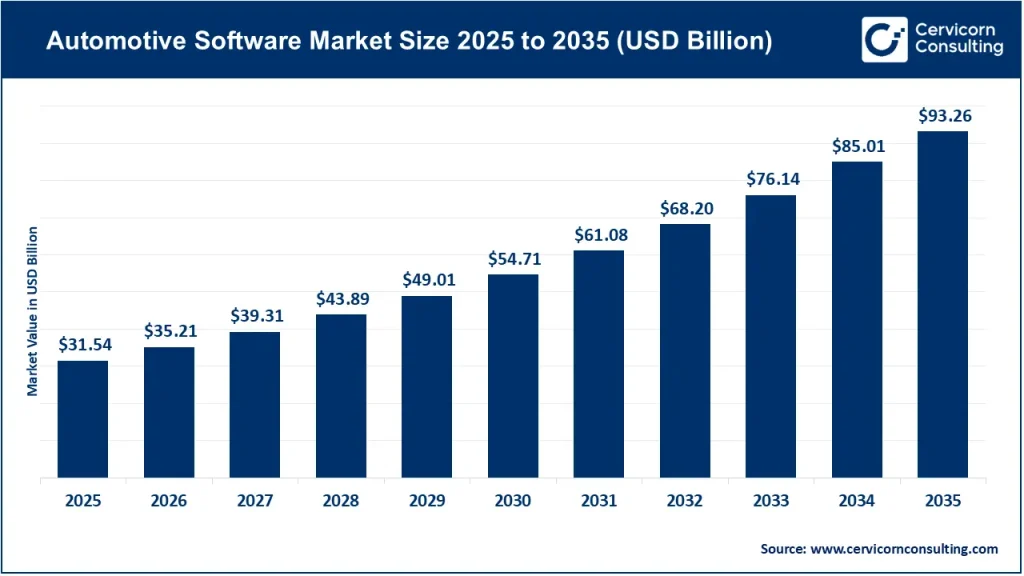
The global automotive software market was valued at USD 31.54 billion in 2025 and is projected to reach USD 93.26 billion by 2035, growing at a CAGR of 11.45% from 2026 to 2035. As vehicles become increasingly connected, electric and software-driven, automakers and technology suppliers face a strategic question: which software capabilities deserve investment first, and how can those investments generate sustainable returns?
The transition from hardware-centric vehicles to software-defined vehicles (SDVs) is changing product development, vehicle architecture, supplier relationships and after-sales business models. For companies operating across automotive electronics, embedded software, cloud platforms and artificial intelligence, growth will depend not only on technological capabilities but also on integration costs, safety requirements and the ability to commercialize software throughout a vehicle’s lifecycle.
Software-Defined Vehicles Are Changing Automotive Investment Priorities
Traditional vehicle architectures rely on multiple electronic control units (ECUs) to manage individual functions. Software-defined vehicles increasingly use centralized computing and zonal architectures, allowing manufacturers to consolidate hardware, simplify wiring and introduce software updates after vehicles leave the factory.
According to the International Energy Agency’s Global EV Outlook 2026, this transition enables manufacturers to improve functions such as advanced driver-assistance systems (ADAS) and battery management through over-the-air (OTA) updates. However, the cost benefits of new architectures depend partly on achieving sufficient production volumes to distribute development costs across more vehicles.
For automakers, the investment decision is therefore not simply whether to adopt an SDV architecture. It is whether the expected savings in hardware, engineering and maintenance justify the upfront costs of platform redesign, software integration and validation.
Manufacturers with multiple vehicle platforms should assess whether a common software architecture can support different models without extensive customization. Suppliers, meanwhile, need to determine whether their products can integrate with centralized computing platforms and evolving automotive operating systems.
Get a Free Sample: https://www.cervicornconsulting.com/sample/2803
AI and Predictive Maintenance: Where Can Companies Capture Measurable Value?
Artificial intelligence is expanding the role of automotive software beyond conventional vehicle control and infotainment. Potential applications include predictive maintenance, driver-assistance systems, battery diagnostics, manufacturing quality control and fleet optimization.
For automakers and commercial fleet operators, predictive maintenance can help identify component degradation before it causes unplanned downtime. For software vendors, this creates opportunities to develop recurring services around vehicle data, diagnostics and performance monitoring.
However, investment decisions should be based on measurable operating benefits rather than AI adoption alone. Companies should evaluate the availability and quality of vehicle data, model accuracy, integration requirements and the cost of deploying software across different vehicle platforms.
A practical starting point is to prioritize applications with clearly measurable outcomes, such as reduced diagnostic time, fewer unexpected service events or improved battery performance. More complex applications should be scaled after their technical reliability and financial benefits have been demonstrated.
Cybersecurity and OTA Updates Are Becoming Lifecycle Requirements
Connected vehicles create opportunities for remote diagnostics, feature upgrades and continuous performance improvements. They also introduce cybersecurity risks that extend beyond vehicle delivery.
Software vulnerabilities, insecure interfaces and weaknesses in third-party components can affect vehicle safety, customer confidence and regulatory compliance. Manufacturers must therefore consider cybersecurity during software development, system integration, deployment and ongoing maintenance.
OTA update capabilities require similar scrutiny. An update platform must support secure distribution, compatibility testing, recovery mechanisms and reliable installation across different vehicle configurations. A failed update can create operational disruption and additional warranty or service costs.
For automotive software suppliers, cybersecurity and validation capabilities can become important competitive differentiators. Companies should evaluate suppliers based on their ability to support secure development practices, software traceability, vulnerability management and long-term maintenance—not solely on initial licensing costs.
Can Software Subscriptions Create Sustainable Revenue?
Software-defined vehicles allow manufacturers to introduce digital features and performance improvements after the initial vehicle sale. Potential business models include subscription-based services, feature activation, connected navigation, fleet analytics and advanced driver-assistance capabilities.
Yet the existence of a technically deliverable feature does not guarantee customer willingness to pay. Subscription strategies must account for vehicle ownership patterns, customer expectations, regional purchasing power, feature usage and competing alternatives.
Automakers should assess three factors before commercializing software features:
- Customer value: Does the feature solve a recurring problem or provide a meaningful improvement?
- Commercial viability: Can expected subscription revenue cover development, cloud infrastructure, support and ongoing validation costs?
- Customer acceptance: Will buyers pay separately for the feature, or do they expect it to be included in the vehicle price?
Software vendors should also evaluate whether licensing, usage-based pricing or long-term service contracts offer the most sustainable revenue model. The appropriate approach will differ between passenger vehicles, commercial fleets and premium vehicle segments.
Supplier Selection: Why Integration Capabilities Matter
The automotive software ecosystem includes operating-system providers, embedded software developers, semiconductor companies, cybersecurity specialists, cloud providers and engineering service firms. This creates opportunities for specialized suppliers but also increases the complexity of vendor selection.
A low-cost software component may create additional expenses if it requires extensive customization or cannot integrate efficiently with existing vehicle systems. OEMs and Tier 1 suppliers should assess the total cost of ownership across development, testing, deployment, maintenance and future upgrades.
Supplier evaluations should consider:
- Compatibility with existing electronic architectures and software platforms.
- Experience in automotive-grade software development and validation.
- Cybersecurity processes and regulatory readiness.
- Ability to support multiple vehicle programs and extended product lifecycles.
- Engineering capacity, technical support and long-term commercial stability.
Partnerships that combine embedded software expertise with virtualization and testing capabilities can also help companies identify integration issues earlier. In July 2025, Tata Elxsi and Synopsys announced a partnership focused on software-defined vehicle development using virtual electronic control units, supporting earlier software validation and reducing dependence on physical prototypes.
For decision-makers, such developments highlight the importance of evaluating not just individual software products but also the engineering ecosystem required to bring them into production.
Regional Strategy: Where Should Automotive Software Companies Expand?
Regional investment decisions depend on vehicle production, electrification, software capabilities, regulatory requirements and OEM relationships.
North America offers opportunities in connected vehicles, cloud-based platforms, automotive AI and advanced vehicle architectures. Suppliers seeking to enter this market should assess OEM procurement requirements, established technology partnerships and the costs of supporting long-term software programs.
Europe requires close attention to vehicle safety, cybersecurity, software compliance and the transition toward more integrated electronic architectures. Suppliers with strong validation and lifecycle-management capabilities may be better positioned to address these requirements.
Asia-Pacific combines large-scale automotive manufacturing with EV adoption and growing software engineering capabilities. For suppliers, the region offers opportunities to build OEM relationships, participate in development programs and adapt solutions to different vehicle price points and production volumes.
Expansion strategies should be based on addressable demand within specific vehicle categories and applications, rather than total regional market size alone. Companies should compare expected contract value, customer concentration, localization requirements and the time needed to qualify as an automotive supplier.
Key Business Decisions for Automotive Software Companies
As the automotive software market expands, companies need to align technology investments with commercial priorities.
Automakers should determine which software functions can be standardized across vehicle platforms and which require model-specific development. Tier 1 suppliers should assess how centralized computing and software-defined architectures may change demand for traditional hardware-linked solutions. Software vendors should identify applications with measurable customer value and recurring revenue potential.
Investors and corporate strategy teams should also distinguish between market growth and profitable growth. Strong demand for automotive software does not automatically translate into attractive margins when development costs, validation requirements and long sales cycles remain high.
A focused evaluation of application-level demand, competitive positioning, customer adoption and regional opportunities can help companies direct resources toward the most commercially viable segments.
Conclusion
The automotive software market is moving toward a model in which vehicle functionality, customer experience and lifecycle services increasingly depend on software. Software-defined architectures, AI-enabled diagnostics, cybersecurity and OTA updates are creating new opportunities for automakers and technology suppliers, but they also require disciplined investment decisions.
Companies that connect software development with measurable operational improvements, scalable architectures and sustainable commercial models will be better positioned to capture long-term value. The priority is not to invest in every emerging technology, but to identify where software can improve vehicle economics, strengthen customer relationships and create a defensible competitive advantage.
To Get Detailed Overview, Contact Us: https://www.cervicornconsulting.com/contact-us