


Automotive Airbags and Seatbelts Market: How Can Suppliers Balance Safety Innovation, Cost and OEM Demand?
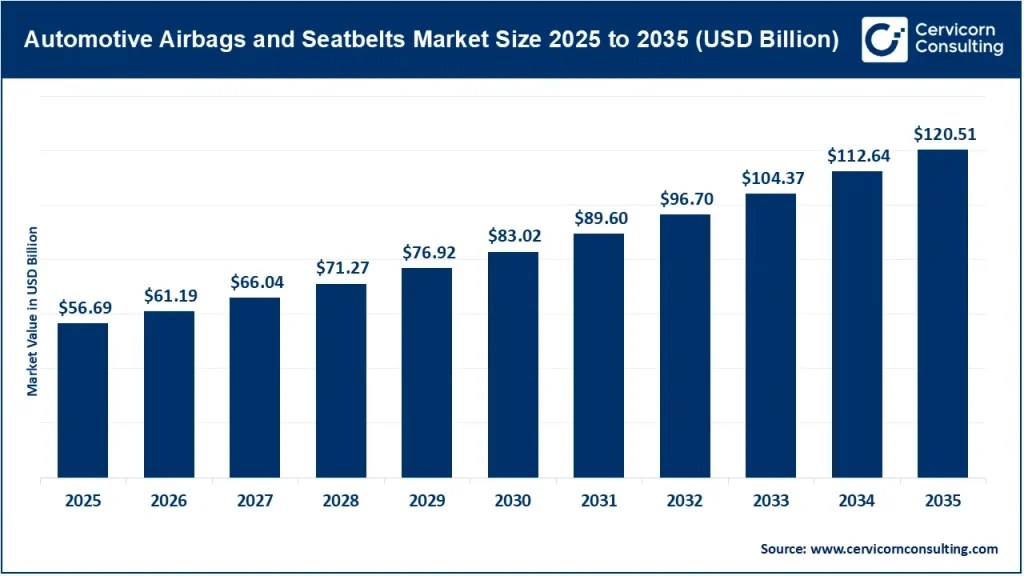
The global automotive airbags and seatbelts market was valued at USD 56.69 billion in 2025 and is projected to reach USD 120.51 billion by 2035, growing at a CAGR of 7.83% from 2026 to 2035. For automakers and component suppliers, this growth creates opportunities in advanced restraint systems, but success will depend on meeting safety requirements while managing manufacturing costs, vehicle-platform complexity and supply-chain risks.
Safety Regulations Are Reshaping Product and Investment Priorities
Automotive safety requirements and consumer expectations are increasing demand for airbags, seatbelts and integrated occupant-protection systems. However, manufacturers must evaluate how safety requirements differ across markets, vehicle categories and price segments before allocating investment.
Asia-Pacific accounted for approximately 39.8% of the market, supported by vehicle production, regulatory developments and the presence of major automotive manufacturers. For suppliers, this creates opportunities to strengthen OEM relationships and local production capabilities. Investment decisions should consider vehicle production forecasts, local sourcing requirements, customer concentration and the cost of establishing manufacturing capacity.
Advanced Restraint Systems Create Opportunities Beyond Standard Components
Airbags accounted for approximately 57.2% of the market, while front airbags represented around 46.3% of the airbag-type segment, according to Cervicorn Consulting. Three-point seatbelts accounted for approximately 52.7% of the seatbelt-type segment.
These established products continue to underpin demand, but manufacturers are also developing side and curtain airbags, seatbelt pretensioners, load limiters and adaptive restraint technologies. The commercial opportunity lies in identifying which features automakers are likely to adopt across mass-market vehicles and which will remain concentrated in premium models.
Suppliers should compare the development cost, testing requirements, production scalability and expected OEM demand for each technology. Advanced systems may offer higher value per vehicle, but their commercial attractiveness depends on manufacturing economics, integration complexity and the ability to meet customer validation requirements.
Get a Free Sample: https://www.cervicornconsulting.com/sample/2793
Electric Vehicles Require Platform-Specific Safety Planning
Battery electric vehicles accounted for approximately 45.8% of the market’s electric-vehicle segment in 2024. As EV platforms evolve, restraint-system suppliers must account for vehicle-specific structures, seating configurations, interior layouts and electronic architectures.
These changes can affect airbag positioning, occupant detection, crash-response calibration and the integration of restraint control units with vehicle electronics. Suppliers should assess opportunities by vehicle platform rather than treating EV production growth as a uniform increase in component demand.
For procurement teams, evaluating common components across multiple vehicle platforms can help reduce costs. For suppliers, modular designs and early collaboration with OEM engineering teams can improve integration efficiency and strengthen the prospects of securing long-term contracts.
How Can Manufacturers Control Costs Without Compromising Safety?
Cost pressure remains a key consideration as automakers balance vehicle affordability with increasingly sophisticated safety systems. Component suppliers must manage material prices, production yields, testing expenses and quality-control requirements while maintaining consistent performance.
Standardization across vehicle platforms can improve manufacturing efficiency, while localized production may reduce logistics costs and support just-in-time delivery. However, these approaches need to be assessed against customer specifications, production volumes and quality requirements.
Supplier selection should therefore consider more than unit price. OEMs also need to evaluate manufacturing capacity, defect rates, product traceability, delivery reliability and the supplier’s ability to support future platform upgrades.
What Does the Competitive Landscape Mean for Suppliers?
Established companies such as Autoliv, ZF Friedrichshafen, Joyson Safety Systems, Hyundai Mobis and Toyoda Gosei compete across different restraint-system categories. Competition increasingly involves engineering capabilities, OEM relationships, manufacturing scale and the ability to deliver integrated safety solutions.
Autoliv’s 2025 annual filing reported production of 143 million complete seatbelt systems, including 100 million fitted with pretensioners, alongside 143 million side airbags and 61 million frontal airbags. This illustrates the manufacturing scale and operational coordination required to serve global automakers.
For companies evaluating market entry or expansion, competitive benchmarking should examine regional manufacturing footprints, customer relationships, product portfolios, technology capabilities and contract opportunities. Smaller suppliers may find more practical entry points in specialized components, materials or engineering services than in competing directly with established global system integrators.
Strategic Priorities for 2026–2034
Automotive safety suppliers can strengthen investment decisions by focusing on four priorities:
-
Product development: Identify restraint technologies with clear OEM demand and commercially viable adoption potential.
-
Regional expansion: Compare vehicle production growth, sourcing policies and manufacturing costs before selecting target markets.
-
Operational efficiency: Improve production scalability, quality assurance and supply-chain resilience without weakening safety performance.
-
Customer diversification: Assess dependence on individual automakers and identify opportunities across passenger cars, commercial vehicles and electric vehicles.
Conclusion
The automotive airbags and seatbelts market presents opportunities across established restraint components and emerging adaptive safety technologies. However, market growth alone does not guarantee profitability. Suppliers must align product investment with OEM requirements, regional demand, manufacturing economics and competitive capabilities.
Companies planning capacity expansion, technology investment or market entry should evaluate segment-level demand, regional opportunities and competitor positioning together. This approach can help distinguish attractive growth areas from segments where high development costs, established competitors or limited vehicle volumes may constrain returns.
To Get Detailed Overview, Contact Us: https://www.cervicornconsulting.com/contact-us