


Table of Contents
ToggleArtificial Intelligence (AI) Robots Market Size
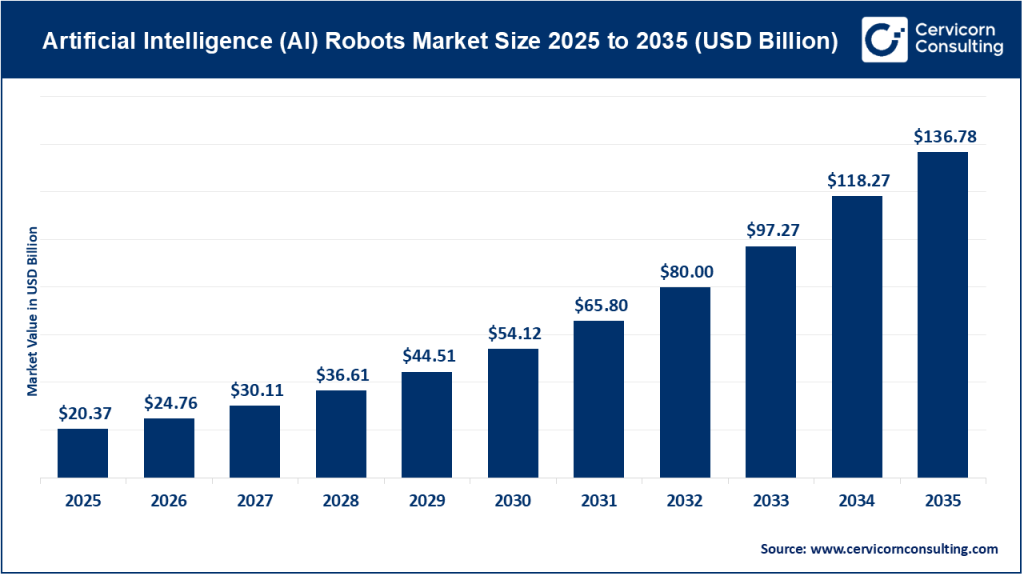
The global artificial intelligence (AI) robots market was valued at approximately USD 20.37 billion in 2025 and is projected to reach nearly USD 136.78 billion by 2035, growing at a CAGR of 20.98%.
Artificial Intelligence (AI) Robots Market Growth Factors
The artificial intelligence (AI) robots market is experiencing remarkable growth due to rapid advancements in machine learning, computer vision, natural language processing (NLP), edge AI computing, and autonomous navigation technologies. Growing labor shortages across manufacturing, logistics, healthcare, agriculture, and retail are encouraging organizations to deploy intelligent robots capable of performing repetitive, dangerous, and precision-based tasks with minimal human intervention. Increasing investments by governments and private enterprises in Industry 4.0 initiatives, smart factories, autonomous vehicles, warehouse automation, and robotics research are accelerating adoption worldwide.
The proliferation of cloud computing, high-performance AI processors, 5G connectivity, and IoT-enabled ecosystems further enhances robot intelligence and real-time decision-making capabilities. Rising demand for collaborative robots (cobots), service robots, medical robots, defense robots, and autonomous mobile robots (AMRs), coupled with declining hardware costs and improvements in sensor technologies, continues to expand commercial opportunities.
Furthermore, generative AI and foundation AI models are enabling robots to better understand human instructions, adapt to dynamic environments, and perform increasingly complex tasks, positioning AI-powered robotics as one of the fastest-growing technology sectors globally.
What is the Artificial Intelligence (AI) Robots Market?
The Artificial Intelligence (AI) Robots Market encompasses intelligent robotic systems equipped with AI technologies that enable machines to perceive, learn, reason, make decisions, and perform tasks autonomously or semi-autonomously. Unlike conventional industrial robots that follow predefined programming, AI robots continuously improve their performance by analyzing data, recognizing patterns, and adapting to changing environments.
AI robots combine several technologies, including:
- Machine Learning
- Deep Learning
- Computer Vision
- Natural Language Processing
- Edge Computing
- Sensor Fusion
- Autonomous Navigation
- Reinforcement Learning
These robots are widely used across industries such as:
- Manufacturing
- Healthcare
- Agriculture
- Defense
- Logistics
- Retail
- Hospitality
- Mining
- Construction
- Education
- Smart Cities
The market includes industrial robots, collaborative robots, autonomous mobile robots, humanoid robots, healthcare robots, warehouse robots, inspection robots, military robots, and consumer robots.
Why is the Artificial Intelligence (AI) Robots Market Important?
Artificial intelligence robots are transforming global industries by significantly improving productivity, safety, operational efficiency, and decision-making. Businesses increasingly rely on AI robots to automate labor-intensive operations, reduce operational costs, and enhance precision.
Some of the major reasons the market is becoming increasingly important include:
Workforce Shortage Solution
Many countries are facing aging populations and labor shortages. AI robots help maintain productivity without relying entirely on human labor.
Increased Industrial Productivity
AI-powered robots operate continuously with minimal downtime, improving manufacturing throughput and reducing production costs.
Improved Workplace Safety
Dangerous jobs involving chemicals, mining, nuclear facilities, and heavy machinery can be performed by intelligent robots, minimizing workplace accidents.
Healthcare Transformation
Surgical robots, rehabilitation robots, hospital delivery robots, and AI-assisted diagnostic systems improve patient care and operational efficiency.
Supply Chain Optimization
Warehouse automation, autonomous forklifts, robotic picking systems, and AI-powered inventory management are revolutionizing logistics.
Enhanced Decision Making
AI robots continuously analyze environmental data and optimize their actions in real time, making them suitable for dynamic industrial environments.
Major Companies Driving the Artificial Intelligence (AI) Robots Market
| Company | Specialization | Key Focus Areas | Notable Features | 2025 Revenue* | Estimated Market Share | Global Presence |
|---|---|---|---|---|---|---|
| Alphabet | AI platforms, autonomous systems, robotics research | DeepMind, Waymo, cloud AI, robotics software | Advanced AI models, autonomous driving, cloud robotics | Approximately USD 390B | Strong AI infrastructure presence | North America, Europe, Asia-Pacific |
| Microsoft Corporation | Enterprise AI, cloud robotics | Azure AI, robotics development, industrial automation | AI cloud ecosystem, robotics integration | Approximately USD 282B | Major enterprise AI provider | Over 190 countries |
| IBM Corporation | Enterprise AI and automation | Watson AI, industrial robotics, hybrid cloud | AI decision support, industrial automation | Approximately USD 66B | Strong enterprise automation | Global operations across 170+ countries |
| Intel Corporation | AI processors and robotics hardware | Edge AI, robotics processors, computer vision | AI chips for industrial robotics | Approximately USD 54B | Major semiconductor supplier | Worldwide manufacturing and partnerships |
| NVIDIA Corporation | AI computing, robotics platforms | Jetson, Isaac Platform, autonomous robots | GPU acceleration, robot simulation, physical AI | Approximately USD 130B+ (AI-related revenue estimate) | Leading AI computing platform | Global ecosystem spanning automotive, healthcare, logistics, manufacturing |
*Revenues represent overall company revenue or widely cited AI-related estimates rather than revenue exclusively from AI robotics.
Leading Trends in the Artificial Intelligence (AI) Robots Market and Their Impact
1. Rise of Humanoid Robots
Humanoid robots are moving beyond research laboratories into logistics, manufacturing, retail, and healthcare. Companies are investing heavily in robots capable of performing tasks originally designed for humans.
Impact
- Expands automation opportunities
- Addresses workforce shortages
- Accelerates AI software innovation
2. Generative AI Integration
Large language models now enable robots to understand natural language instructions and execute complex workflows.
Impact
- Improved human-robot interaction
- Reduced programming requirements
- Faster enterprise adoption
3. Edge AI Computing
AI processing is increasingly occurring directly on robots rather than in remote cloud servers.
Impact
- Lower latency
- Faster decision-making
- Improved data privacy
- Reliable operation in remote environments
4. Collaborative Robots (Cobots)
Cobots safely work alongside humans without extensive safety barriers.
Impact
- Increased SME adoption
- Improved manufacturing flexibility
- Reduced installation costs
5. AI-Powered Warehouse Automation
Warehouses increasingly deploy autonomous mobile robots for inventory movement, order fulfillment, and sorting.
Impact
- Faster deliveries
- Reduced logistics costs
- Higher operational efficiency
6. Digital Twins and Robot Simulation
Simulation platforms allow robots to be trained virtually before real-world deployment.
Impact
- Faster development cycles
- Lower testing costs
- Improved robot reliability
7. AI Robotics in Healthcare
Hospitals increasingly deploy intelligent robots for surgery, patient monitoring, rehabilitation, and pharmaceutical delivery.
Impact
- Better patient outcomes
- Reduced clinician workload
- Improved healthcare efficiency
8. Physical AI Platforms
Technology providers are increasingly focusing on “physical AI”—software and computing platforms that power robots across industries rather than building robots themselves.
Impact
- Faster robotics innovation
- Standardized development platforms
- Broader ecosystem collaboration
Successful Examples of Artificial Intelligence (AI) Robots Around the World
Waymo Autonomous Driving Robots (United States)
Waymo combines advanced AI, machine learning, LiDAR, and computer vision to operate autonomous ride-hailing services. It represents one of the most successful real-world applications of AI robotics in transportation.
Amazon Warehouse Robotics (United States)
Amazon utilizes hundreds of thousands of AI-powered mobile robots for inventory movement, package sorting, and warehouse automation, dramatically improving fulfillment efficiency.
Da Vinci Surgical Robot
Widely adopted in hospitals worldwide, the Da Vinci robotic surgical system enables minimally invasive surgeries with enhanced precision, dexterity, and visualization.
FANUC Smart Factory Robots (Japan)
FANUC integrates AI with industrial robotics to optimize production, predictive maintenance, and manufacturing automation across automotive and electronics industries.
ABB Collaborative Robots (Switzerland)
ABB develops intelligent collaborative robots used in electronics, automotive, food processing, pharmaceuticals, and logistics, enabling flexible automation.
Boston Dynamics Intelligent Robots (United States)
Robots such as Spot and Stretch demonstrate AI-powered mobility for industrial inspection, warehouse automation, and infrastructure monitoring.
Agricultural Robots (Netherlands & Australia)
AI-enabled agricultural robots perform autonomous harvesting, crop monitoring, precision spraying, and soil analysis, improving sustainability and productivity.
AI Delivery Robots (China)
Autonomous delivery robots are increasingly deployed in urban areas, university campuses, hospitals, and commercial districts to provide contactless logistics services.
Global Regional Analysis of the Artificial Intelligence (AI) Robots Market
North America
North America remains one of the largest markets due to its mature AI ecosystem, strong robotics startups, advanced semiconductor capabilities, and significant enterprise investments.
Key Drivers
- High AI investments
- Cloud computing leadership
- Advanced manufacturing
- Defense modernization
- Strong venture capital ecosystem
Government Initiatives
- National AI research funding
- Robotics innovation grants
- Manufacturing modernization programs
- Defense AI investments
- Semiconductor manufacturing incentives
Europe
Europe emphasizes industrial automation, collaborative robotics, sustainable manufacturing, and responsible AI development.
Key Drivers
- Smart manufacturing adoption
- Automotive automation
- Healthcare robotics
- Labor shortages
- Strong industrial base
Government Policies
- European AI Act
- Horizon Europe research funding
- Digital Europe Programme
- Industry 5.0 initiatives
- National robotics innovation strategies
These initiatives encourage trustworthy AI deployment while supporting robotics research, industrial competitiveness, and cross-border innovation.
Asia-Pacific
Asia-Pacific represents the fastest-growing AI robotics market, driven by large-scale manufacturing, electronics production, aging populations, and extensive government support.
China
China is investing heavily in humanoid robots, industrial automation, AI chips, and intelligent manufacturing. Recent developments include significant funding for robotics innovation and public listings by domestic robotics firms.
Japan
Japan remains a global leader in industrial robotics due to its advanced manufacturing sector and aging workforce.
South Korea
South Korea aggressively promotes smart factories, semiconductor manufacturing, and service robotics.
India
India is witnessing growing adoption of AI robots across manufacturing, logistics, healthcare, and agriculture through digital transformation initiatives and Industry 4.0 adoption.
Government Initiatives
- National AI strategies
- Smart factory programs
- Semiconductor incentives
- Robotics R&D funding
- Automation tax incentives
- Public-private AI partnerships
Latin America
Robotics adoption is increasing in mining, agriculture, food processing, and logistics.
Market Drivers
- Agricultural automation
- Mining robotics
- Warehouse modernization
- Manufacturing investments
Government Support
- Industrial modernization initiatives
- Digital transformation policies
- Technology innovation funding
- Workforce upskilling programs
Middle East & Africa
The Middle East is increasingly investing in AI-powered robotics for smart cities, healthcare, logistics, energy, and public services.
Key Drivers
- Smart city development
- Oil and gas automation
- Healthcare modernization
- Infrastructure projects
- AI-enabled security systems
Government Initiatives
- National AI strategies in Gulf countries
- Smart city programs
- Economic diversification initiatives
- Public investment in robotics research
- Innovation-focused regulatory frameworks
African countries are also exploring AI robotics for agriculture, healthcare delivery, mining, and infrastructure monitoring, supported by digital transformation programs and international technology partnerships.
To Get Detailed Overview, Contact Us: https://www.cervicornconsulting.com/contact-us
Read Report: India Health Insurance Market Revenue, Trends, and Strategic Insights by 2035