


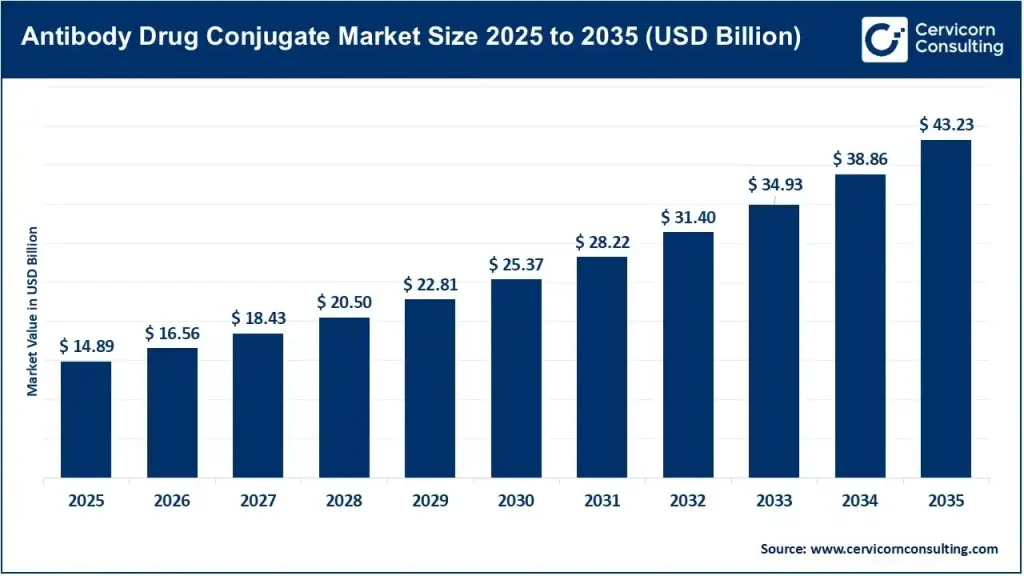
Antibody Drug Conjugate (ADC) Market Size
The global antibody drug conjugate (ADC) market was valued at approximately USD 14.89 billion in 2025 and is projected to reach around USD 43.23 billion by 2035, expanding at a CAGR of approximately 11.2% during the forecast period.
Antibody Drug Conjugate (ADC) Market Growth Factors
The antibody drug conjugate market growth is being driven by the rising global burden of cancer, increasing adoption of targeted oncology treatments, growing clinical validation of ADC efficacy, expansion of ADC indications, advances in antibody engineering, development of more stable and selective linkers, improved payload technologies and increasing investments from pharmaceutical and biotechnology companies. The ability of ADCs to combine antigen-specific targeting with highly potent cytotoxic mechanisms is particularly attractive for tumors where conventional chemotherapy is associated with substantial systemic toxicity.
In addition, the success of HER2-, TROP2-, Nectin-4-, CD30-, CD79b- and other antigen-directed ADCs is encouraging researchers to investigate additional targets and tumor types. The growing use of companion diagnostics and biomarker-based patient selection is also improving the precision of treatment. Partnerships, licensing agreements and acquisitions are accelerating technology transfer between large pharmaceutical companies and specialized ADC developers, while China, Japan, the United States and Europe are increasingly becoming centers for ADC research and commercialization. Government support for innovative biologics, faster regulatory pathways for serious diseases and continued investment in cancer research further strengthen the market’s long-term growth prospects.
Get a Free Sample: https://www.cervicornconsulting.com/sample/3009
What Is the Antibody Drug Conjugate (ADC) Market?
An antibody drug conjugate is a targeted therapeutic generally composed of three principal components:
- Monoclonal antibody – recognizes a specific antigen on cancer cells.
- Linker – connects the antibody to the therapeutic payload and controls when and how the payload is released.
- Cytotoxic payload – a highly potent drug designed to kill the targeted cancer cell.
After an ADC binds to an antigen on a tumor cell, the complex is generally internalized. The linker and cellular processing mechanisms then allow the cytotoxic payload to become active, producing cell death. Depending on the ADC design, some payloads may also exert a bystander effect on nearby tumor cells.
This architecture makes ADCs different from conventional chemotherapy because the therapeutic payload is associated with a targeting antibody rather than being distributed in the same manner throughout the body.
The development of ADC technology has advanced substantially since the first FDA-approved ADC. Research reviews note that numerous ADCs have entered clinical use, establishing the technology as one of the fastest-growing areas of anticancer drug development.
Why Is the ADC Market Important?
The ADC market is important because it addresses a fundamental challenge in cancer treatment: how to deliver powerful anticancer agents to malignant cells while minimizing damage to healthy tissues.
Traditional chemotherapy can affect both cancerous and rapidly dividing healthy cells, potentially causing significant adverse effects. ADCs attempt to improve therapeutic selectivity by using antibodies to recognize specific molecular targets.
The importance of ADCs is also increasing because of their ability to expand precision oncology beyond conventional antibody therapies. An antibody may block a growth signal or activate an immune response, whereas an ADC can deliver a highly potent cytotoxic payload directly to a targeted cancer cell.
Clinical and commercial successes have demonstrated the potential of this approach. Enhertu, for example, has expanded from HER2-positive breast cancer into additional HER2-defined populations and other tumor types. In January 2025, the FDA approved Enhertu for unresectable or metastatic HR-positive, HER2-low or HER2-ultralow breast cancer following progression on endocrine therapy.
Leading Companies in the Antibody Drug Conjugate Market
| Company | Specialization | Key Focus Areas | Notable Features | 2025 Revenue* | Indicative ADC Market Share** | Global Presence |
|---|---|---|---|---|---|---|
| Pfizer Inc. | Oncology and biopharmaceuticals | Padcev, ADC oncology portfolio | Nectin-4 targeting; major oncology commercialization capabilities | USD 62.6B company revenue; Padcev USD 1.94B | ~10.4% based on Padcev revenue | ~200 countries and territories |
| Daiichi Sankyo Company, Limited | Oncology and ADC innovation | Enhertu, Datroway and DXd ADC platform | Strong deruxtecan-based ADC technology | Enhertu USD 3.72B; Datroway USD 228M | ~21.2% based on disclosed ADC revenues | Japan, U.S., Europe and other global markets |
| AstraZeneca plc | Oncology and precision medicine | Enhertu, Datroway and next-generation ADCs | Global co-development and commercialization with Daiichi Sankyo | Company revenue not used as ADC revenue proxy | ~28.9% analyst-estimated market position | Global |
| F. Hoffmann-La Roche Ltd. | Oncology and biologics | Kadcyla, Polivy | Established HER2 and hematologic oncology franchises | Kadcyla USD 2.025B; Polivy USD 1.47B | ~18.8% based on disclosed ADC revenues | Global |
| Gilead Sciences, Inc. | Biopharmaceuticals and oncology | Trodelvy | TROP2-directed ADC with expanding breast cancer applications | Trodelvy USD 1.4B | ~7.5% based on disclosed ADC revenue | Global |
Pfizer Inc.
Pfizer Inc. has a significant position in ADC oncology through Padcev (enfortumab vedotin), a Nectin-4-directed ADC. Pfizer reported USD 1.94 billion in Padcev revenue in 2025, while total company revenue reached USD 62.6 billion. Pfizer supplies products in approximately 200 countries and territories, giving its oncology portfolio a broad commercial footprint.
The company’s ADC strategy benefits from its global clinical-development infrastructure, regulatory capabilities and oncology commercialization network.
Daiichi Sankyo Company, Limited
Daiichi Sankyo Company, Limited has become one of the industry’s most influential ADC innovators through its DXd ADC platform. Its flagship ADC, Enhertu, targets HER2 and has demonstrated applications across several cancers.
Daiichi Sankyo reported approximately USD 3.721 billion in FY2025 Enhertu revenue, while Datroway, its TROP2-directed ADC, generated approximately USD 228 million. The company is also advancing other DXd-based ADCs targeting B7-H3, HER3 and CDH6.
AstraZeneca plc
AstraZeneca plc has established a major ADC presence through its strategic partnership with Daiichi Sankyo. Enhertu and Datroway provide access to high-value breast cancer, lung cancer and other oncology markets, while the companies continue to develop additional ADC candidates.
Industry analysis estimates AstraZeneca’s ADC market position at approximately 28.9% in 2025, although this figure should be viewed as an analyst estimate rather than an audited company-reported market share.
F. Hoffmann-La Roche Ltd.
F. Hoffmann-La Roche Ltd. has extensive experience with targeted cancer therapies. Its ADC portfolio includes Kadcyla (ado-trastuzumab emtansine) and Polivy (polatuzumab vedotin).
Roche reported CHF-equivalent sales of approximately 2.025 billion for Kadcyla and 1.47 billion for Polivy in 2025 in its financial reporting. Kadcyla remains an important HER2-directed therapy, while Polivy strengthens Roche’s position in hematologic malignancies.
Gilead Sciences, Inc.
Gilead Sciences, Inc. participates in the ADC market primarily through Trodelvy (sacituzumab govitecan), a TROP2-directed ADC. Gilead reported USD 1.4 billion in Trodelvy sales for full-year 2025, representing 6% growth over 2024, supported by higher demand in breast cancer treatment.
Trodelvy demonstrates the potential of TROP2 as an ADC target and illustrates how expansion into additional cancer indications can strengthen the commercial performance of ADC products.
Leading Trends and Their Impact on the ADC Market
1. Expansion of HER2-Directed ADCs
HER2 remains one of the most commercially validated ADC targets. Enhertu’s expansion into HER2-positive, HER2-low and HER2-ultralow populations is increasing the potential treatment population.
In December 2025, the FDA approved Enhertu plus pertuzumab for first-line treatment of unresectable or metastatic HER2-positive breast cancer.
Impact: Broader biomarker definitions and additional indications can significantly increase the addressable market for successful ADCs.
2. Increasing Focus on TROP2
TROP2-directed ADCs are becoming increasingly important because TROP2 is expressed across several epithelial cancers. Trodelvy and Datroway have established commercial and clinical validation of this target.
Impact: Competition around TROP2 is encouraging companies to differentiate products through payload selection, linker design, dosing schedules and clinical positioning.
3. Next-Generation Linkers
Linker technology is increasingly important in ADC development. Cleavable linkers can facilitate payload release inside target cells, while advances in linker chemistry seek to improve stability in circulation and control payload release.
Cleavable linkers accounted for approximately 67.7% of the ADC market by technology in 2025, according to one market estimate.
Impact: Better linker technology can improve therapeutic windows and reduce premature payload release.
4. More Potent Payloads
Researchers are developing payloads capable of delivering substantial cytotoxic activity at very low concentrations. Topoisomerase inhibitors, microtubule inhibitors and other payload classes are being evaluated across multiple ADC platforms.
Impact: New payloads can allow developers to target tumors that were previously difficult to treat with conventional ADC designs.
5. Biomarker Expansion
ADC development is moving beyond highly expressed tumor antigens. Enhertu’s approval in HER2-low and HER2-ultralow breast cancer demonstrates how improvements in drug design can potentially extend treatment to patients with lower levels of target expression.
Impact: Biomarker expansion could substantially increase patient populations and change how oncology diagnostics are integrated with treatment decisions.
6. ADC Combinations
ADC developers are increasingly evaluating combinations with immunotherapies, chemotherapy, targeted therapies and other antibody-based treatments.
Impact: Combination strategies may improve response depth and durability, while creating opportunities to use ADCs earlier in treatment pathways.
7. Strategic Partnerships and Licensing
The complexity of ADC development is encouraging partnerships between pharmaceutical companies and biotechnology firms with specialized antibody, linker or payload platforms.
Impact: Partnerships reduce development barriers, provide access to specialized technology and accelerate global commercialization.
8. Rapid Growth of China’s ADC Ecosystem
China has become a major center for innovative antibody development. Recent analysis highlights how government policies supporting biopharmaceutical innovation and modernization of drug discovery and regulatory processes have helped Chinese companies develop sophisticated ADCs.
Impact: Greater competition from Chinese developers is increasing the number of ADC candidates and accelerating global licensing activity.
Successful Examples of the Antibody Drug Conjugate Market Around the World
Enhertu – United States, Japan and Europe
Enhertu represents one of the strongest global examples of ADC commercialization. Developed by Daiichi Sankyo and AstraZeneca, it has expanded across HER2-positive and lower HER2-expression breast cancer populations as well as other tumor types.
Its continued regulatory expansion demonstrates how a successful ADC can evolve from a single indication into a multi-tumor franchise.
Padcev – United States and International Markets
Padcev demonstrates the commercial potential of targeting Nectin-4, particularly in urothelial cancer. Pfizer reported USD 1.94 billion in Padcev revenue in 2025, demonstrating the scale that a commercially successful ADC can reach.
Trodelvy – United States and Global Oncology Markets
Trodelvy provides an important example of TROP2-targeted ADC commercialization. Gilead reported full-year 2025 sales of approximately USD 1.4 billion, supported by breast cancer demand.
Kadcyla – Global HER2 Oncology
Roche’s Kadcyla remains a foundational example of HER2-directed ADC development. Its continued commercial contribution illustrates the long-term value that can be generated when an ADC becomes integrated into established oncology treatment pathways.
Polivy – Global Hematologic Oncology
Polivy demonstrates the application of ADC technology outside solid tumors. Its CD79b-directed approach has strengthened ADC adoption in B-cell malignancies, with Roche reporting USD 1.47 billion in 2025 sales.
Global Regional Analysis
North America
North America remains the largest ADC market, accounting for approximately 39.8% of global revenue in 2025 according to one market estimate. The United States is particularly important because of its concentration of pharmaceutical companies, biotechnology startups, academic cancer centers, clinical-trial infrastructure and venture capital.
The U.S. FDA has played a critical role in the development of the market through approvals for ADCs and expanded indications. The 2025 approval of Enhertu for HER2-low and HER2-ultralow breast cancer illustrates the continued regulatory expansion of ADC applications.
Government initiatives and policies: Federal funding for cancer research, FDA expedited-development mechanisms for serious diseases, orphan-drug pathways, breakthrough-therapy programs and accelerated approval mechanisms support the development and commercialization of innovative oncology medicines.
Europe
Europe represents another major ADC development and commercialization center, supported by sophisticated healthcare systems, established pharmaceutical companies and the regulatory framework of the European Medicines Agency.
European countries are particularly important for clinical trials, oncology research, biologics manufacturing and market access. Companies such as Roche and AstraZeneca maintain substantial ADC capabilities across the region.
Government initiatives and policies: The EU’s broader pharmaceutical innovation framework, Horizon Europe research funding, European Medicines Agency regulatory pathways and national cancer strategies support oncology research and innovation. The European regulatory environment also encourages development of medicines addressing significant unmet medical needs.
Asia Pacific
Asia Pacific is expected to be one of the fastest-growing regions for ADCs. Japan is particularly significant because Daiichi Sankyo has developed one of the industry’s leading ADC technology platforms.
China has also emerged as an increasingly important ADC development center. Research published in Nature Reviews Drug Discovery highlights the role of Chinese government policies in supporting biopharmaceutical innovation and modernizing drug discovery and regulatory systems.
Government initiatives and policies: Japan’s support for pharmaceutical innovation, China’s policies promoting innovative biologics and domestic drug development, and increasing investment in biotechnology infrastructure are strengthening the regional ADC ecosystem.
The growing number of Chinese ADC developers is also contributing to global competition. Recent research indicates that approximately two-thirds of certain recently approved cancer ADCs and monospecific antibody products originated in China, highlighting the country’s growing role in antibody innovation.
Latin America
Latin America is a developing ADC market characterized by increasing cancer-treatment demand and gradual expansion of access to advanced oncology medicines. Brazil and Mexico are among the region’s most important pharmaceutical markets.
Government initiatives and policies: National cancer-control programs, modernization of healthcare infrastructure and efforts to expand access to innovative oncology medicines can support ADC adoption. However, pricing, reimbursement and unequal access to specialized diagnostics remain important considerations.
Middle East & Africa
The Middle East and Africa represent emerging opportunities for ADC manufacturers as cancer diagnosis and treatment infrastructure improves. Gulf countries with high healthcare investment are increasingly adopting advanced oncology therapies.
Government initiatives and policies: Healthcare modernization programs, investment in specialist cancer centers and national strategies aimed at improving cancer diagnosis and treatment are supporting demand for innovative therapies. However, affordability, reimbursement and access to biomarker testing remain significant barriers.
Government Initiatives and Policies Shaping the Global ADC Market
Government policy is becoming increasingly important to the ADC ecosystem because these therapies require sophisticated research, specialized manufacturing, companion diagnostics and complex clinical development.
In the United States, FDA approvals and expedited regulatory pathways have helped ADCs reach patients with serious cancers more quickly. The agency’s continuing expansion of ADC indications demonstrates the importance of evidence-based regulatory innovation.
In Europe, regulatory support for innovative medicines, centralized scientific review and public research programs create an environment favorable to advanced biologic therapies.
In Japan, strong pharmaceutical R&D capabilities and government support for innovative drug development have helped companies such as Daiichi Sankyo build globally competitive ADC platforms.
In China, government policies supporting innovative biopharmaceutical development have contributed to rapid growth in domestic antibody and ADC research. China’s transformation into a major source of innovative antibody medicines is increasingly affecting the global competitive landscape.
Across markets, policies encouraging cancer research, precision medicine, clinical-trial modernization, companion diagnostics and biotechnology manufacturing are likely to remain important drivers of ADC commercialization.
Market Outlook and Investment Opportunities
The commercial trajectory of ADCs is attracting substantial investment because successful products can generate significant revenue while creating platforms for follow-on products. The market’s evolution is moving from first-generation ADCs toward increasingly sophisticated systems involving site-specific conjugation, optimized drug-to-antibody ratios, novel payloads, improved linkers and multi-indication development.
The commercial success of Enhertu, Padcev, Trodelvy, Kadcyla and Polivy demonstrates that ADCs can achieve substantial market penetration when target biology, payload potency, clinical efficacy and safety are successfully balanced.
At the same time, the competitive environment is becoming more complex. Companies must differentiate their ADCs not only through clinical efficacy but also through target selection, biomarker strategy, safety profile, manufacturing efficiency and combination potential.
The growing number of ADC candidates entering clinical development, increasing activity from Chinese biotechnology companies, expanding pharmaceutical partnerships and continuous regulatory approvals indicate that ADCs will remain a major focus of oncology innovation. For pharmaceutical companies, biotechnology developers, investors, contract manufacturers and diagnostic providers, this creates opportunities across the entire ADC value chain—from antibody discovery and linker chemistry to payload manufacturing, conjugation technologies, companion diagnostics and global commercialization.
To Get Detailed Overview, Contact Us: https://www.cervicornconsulting.com/contact-us
Read Report: Specialty Care Market Revenue, Trends, and Strategic Insights by 2035