


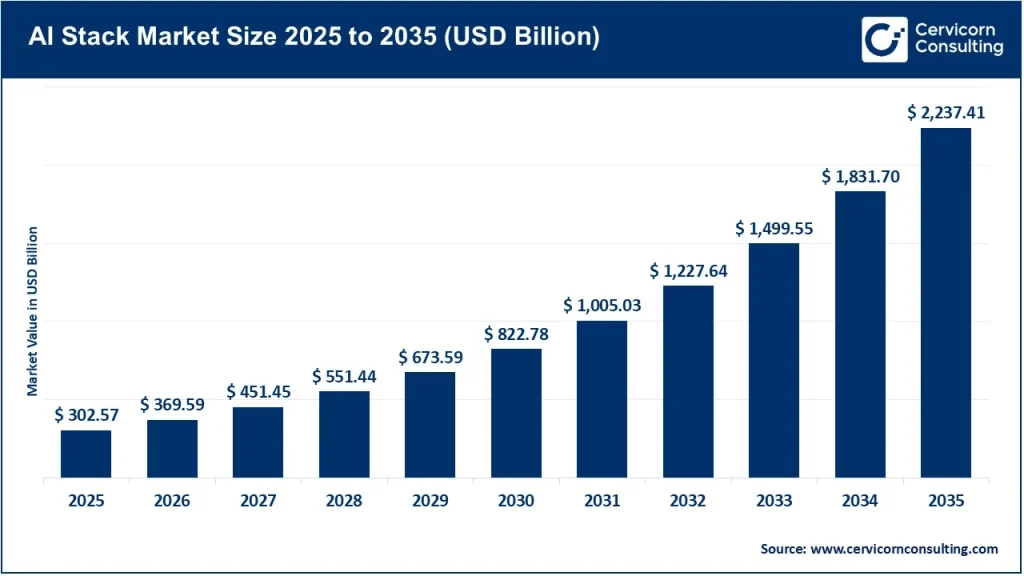
AI Stack Market Size
The global AI stack market reached an estimated valuation of USD 302.57 billion in 2025 and is projected to grow substantially, attaining approximately USD 2,237.41 billion by 2035. This growth reflects a strong compound annual growth rate (CAGR) of around 22.1% throughout the forecast period.
What is the AI Stack Market?
The AI stack market refers to the integrated ecosystem of technologies and infrastructure that support the development, deployment, management, and scaling of artificial intelligence applications. An AI stack includes several interconnected layers such as hardware accelerators, cloud computing platforms, data storage systems, machine learning frameworks, AI models, orchestration tools, and enterprise AI applications.
At the infrastructure level, companies use GPUs, AI accelerators, CPUs, networking systems, and data centers to process massive datasets and train AI models. The platform layer includes cloud services, AI development environments, machine learning frameworks, and data engineering platforms that simplify AI deployment. The application layer consists of enterprise software, generative AI tools, chatbots, predictive analytics systems, automation platforms, and intelligent business applications.
The increasing demand for generative AI, natural language processing, computer vision, robotics, and autonomous systems has transformed the AI stack into one of the most important technology ecosystems in the digital economy. Organizations are rapidly investing in AI stacks to support innovation, reduce operational costs, improve customer experiences, and gain competitive advantages.
Why is the AI Stack Market Important?
The AI stack market plays a critical role in accelerating global digital transformation. Modern businesses rely on AI technologies to process large volumes of data, automate repetitive tasks, improve decision-making, and create personalized experiences for customers. Without a scalable AI stack, enterprises face difficulties in managing AI workloads, deploying models efficiently, and ensuring real-time performance.
AI stacks are also essential for enabling innovation in industries such as healthcare, finance, retail, automotive, manufacturing, telecommunications, and education. Hospitals use AI-powered diagnostics and predictive analytics to improve patient outcomes. Financial institutions rely on AI models for fraud detection, algorithmic trading, and risk analysis. Retailers use AI-driven recommendation systems and supply chain optimization tools to improve operational efficiency.
Additionally, governments and public institutions are increasingly investing in national AI infrastructure to strengthen technological sovereignty, cybersecurity, and economic competitiveness. AI stacks support advancements in scientific research, smart cities, autonomous mobility, defense systems, and climate modeling.
The growing integration of AI into business operations has made the AI stack a foundational technology layer for the modern digital economy.
AI Stack Market Growth Factors
The AI stack market is expanding rapidly due to several major growth drivers, including increasing adoption of generative AI technologies, rising enterprise investments in cloud computing and AI infrastructure, growing demand for automation across industries, rapid advancements in GPUs and AI accelerators, expansion of large language models, increasing availability of big data, and growing government support for national AI strategies. The rising popularity of AI-powered applications such as virtual assistants, recommendation engines, predictive analytics, autonomous systems, and intelligent cybersecurity solutions is also accelerating market growth. Furthermore, businesses are adopting AI stacks to improve operational efficiency, reduce costs, enhance customer engagement, and accelerate innovation. The increasing collaboration between cloud providers, semiconductor manufacturers, and AI software developers is creating a highly integrated ecosystem that supports scalable AI deployment worldwide.
Get a Free Sample: https://www.cervicornconsulting.com/sample/2949
Key Components of the AI Stack Market
Hardware Infrastructure
Hardware infrastructure forms the foundation of the AI stack market. High-performance GPUs, AI accelerators, CPUs, networking systems, and advanced semiconductor technologies enable the training and deployment of large AI models. Companies are investing heavily in accelerated computing platforms to support generative AI workloads.
Cloud and Data Platforms
Cloud computing providers deliver scalable infrastructure, AI services, storage systems, and data processing capabilities that allow organizations to build and deploy AI solutions efficiently. Cloud-based AI stacks reduce infrastructure costs while improving accessibility and scalability.
AI Frameworks and Models
Machine learning frameworks, deep learning libraries, and large language models are critical elements of the AI stack. Open-source frameworks and proprietary AI platforms allow developers to create advanced AI applications for multiple industries.
Enterprise AI Applications
The application layer includes AI-powered business software, customer support systems, workflow automation tools, analytics platforms, and industry-specific AI solutions. Enterprises increasingly integrate these applications into daily operations to improve productivity and decision-making.
Major Companies in the AI Stack Market
The AI stack market is highly competitive, with major technology companies leading innovation in hardware, cloud infrastructure, AI software, and generative AI platforms.
| Company | Specialization | Key Focus Areas | Notable Features | 2024 Revenue | Market Share | Global Presence |
|---|---|---|---|---|---|---|
| NVIDIA | AI hardware and accelerated computing | GPUs, AI chips, AI supercomputing, generative AI infrastructure | CUDA ecosystem, DGX systems, AI accelerators, advanced GPUs | Approximately USD 130 billion | Leading share in AI accelerator market | North America, Europe, Asia-Pacific, Middle East |
| Microsoft | Cloud AI and enterprise software | Azure AI, enterprise AI integration, generative AI, productivity tools | Azure OpenAI integration, Copilot ecosystem, enterprise AI services | Approximately USD 245 billion | Strong share in enterprise AI cloud services | Global operations in over 190 countries |
| AI research and cloud AI | Generative AI, AI search, cloud AI, AI chips | Gemini AI models, Tensor Processing Units, Vertex AI | Approximately USD 350 billion | Major share in AI platforms and cloud AI | Worldwide presence with extensive data center network | |
| Amazon Web Services | Cloud infrastructure and AI services | AI cloud infrastructure, machine learning services, generative AI | Bedrock, SageMaker, scalable cloud AI infrastructure | Approximately USD 107 billion | Significant share in AI cloud infrastructure | Global cloud regions across multiple continents |
| OpenAI | Generative AI and large language models | Large language models, conversational AI, AI research | GPT models, enterprise AI APIs, multimodal AI systems | Estimated multi-billion-dollar annualized revenue | Rapidly expanding share in generative AI | Global enterprise and developer ecosystem |
NVIDIA’s Role in the AI Stack Market
NVIDIA has emerged as one of the most influential companies in the AI stack ecosystem due to its dominance in GPU technology and accelerated computing infrastructure. The company’s AI chips power data centers, supercomputers, autonomous vehicles, robotics systems, and generative AI models.
Its CUDA software ecosystem provides developers with tools to optimize AI training and inference workloads. NVIDIA’s DGX systems and AI supercomputing platforms are widely used by enterprises and research institutions for large-scale AI development.
The rapid growth of generative AI has significantly increased demand for NVIDIA GPUs, making the company a central player in global AI infrastructure expansion.
Microsoft’s AI Stack Strategy
Microsoft has strengthened its position in the AI stack market through Azure cloud services and strategic partnerships with OpenAI. The company integrates AI capabilities across its enterprise software ecosystem, including Microsoft 365, Dynamics, GitHub, and cybersecurity platforms.
The introduction of Copilot AI assistants has accelerated enterprise AI adoption by embedding generative AI into workplace productivity tools. Microsoft also provides scalable AI infrastructure through Azure AI services, allowing businesses to deploy machine learning and generative AI applications efficiently.
Its focus on responsible AI development, enterprise security, and cloud-based AI deployment has made Microsoft a major force in the global AI ecosystem.
Google’s Leadership in AI Innovation
Google remains one of the pioneers in artificial intelligence research and development. The company has developed advanced AI technologies such as transformer models, generative AI systems, AI search capabilities, and Tensor Processing Units (TPUs).
Google Cloud offers enterprise AI services through Vertex AI, enabling organizations to build, train, and deploy machine learning models at scale. The company’s Gemini AI models are designed to compete in the rapidly growing generative AI market.
Google’s investments in AI infrastructure, data centers, and AI research continue to shape the future of the AI stack market.
Amazon Web Services and AI Cloud Expansion
Amazon Web Services plays a major role in providing cloud infrastructure for AI development and deployment. AWS offers a broad range of AI and machine learning services that help enterprises integrate AI into their operations.
Services such as Amazon SageMaker and Amazon Bedrock simplify AI model development and deployment. AWS also supports generative AI applications through scalable cloud computing resources and AI optimization tools.
The company’s extensive global cloud infrastructure network enables organizations to access AI services with high scalability and reliability.
OpenAI and the Rise of Generative AI
OpenAI has transformed the AI stack market through the development of large language models and conversational AI systems. Its GPT models have become widely adopted for content generation, coding assistance, customer support, research, and enterprise automation.
OpenAI’s API ecosystem allows developers and enterprises to integrate advanced generative AI capabilities into software applications. The company’s multimodal AI models support text, image, audio, and video understanding, expanding the possibilities of AI-driven innovation.
The rapid adoption of generative AI applications has accelerated investments in AI infrastructure, cloud computing, and model optimization technologies.
Leading Trends in the AI Stack Market and Their Impact
Growth of Generative AI
Generative AI is one of the most transformative trends in the AI stack market. Organizations are increasingly deploying AI-powered content generation, code development, virtual assistants, and automation tools.
This trend is driving higher demand for advanced GPUs, AI accelerators, cloud infrastructure, and large language models.
Expansion of AI Cloud Services
Cloud providers are expanding AI-as-a-service offerings to simplify AI adoption for businesses. Organizations can now access AI models, development frameworks, and scalable infrastructure without building expensive on-premise systems.
This trend is reducing barriers to entry and accelerating AI adoption among small and medium-sized enterprises.
AI Chips and Semiconductor Innovation
Semiconductor companies are developing specialized AI processors to improve training speed, energy efficiency, and inference performance. AI chips are becoming increasingly important for supporting large-scale generative AI workloads.
The race to develop next-generation AI hardware is intensifying competition within the AI stack ecosystem.
Edge AI Deployment
Edge AI enables AI processing directly on devices such as smartphones, autonomous vehicles, industrial equipment, and IoT systems. This trend reduces latency and improves real-time decision-making capabilities.
Industries such as healthcare, manufacturing, and automotive are rapidly adopting edge AI solutions.
Responsible AI and Regulatory Compliance
Governments and enterprises are emphasizing ethical AI practices, transparency, cybersecurity, and data privacy. Responsible AI frameworks are becoming essential for building trust and ensuring compliance with evolving regulations.
Companies are increasingly investing in AI governance, bias detection, and secure AI deployment.
Successful Examples of AI Stack Market Applications Around the World
Healthcare AI in the United States
Hospitals and healthcare providers in the United States are using AI stacks for diagnostics, medical imaging, predictive analytics, and drug discovery. AI-powered healthcare systems improve operational efficiency and patient outcomes.
Smart Manufacturing in Germany
Germany’s manufacturing sector uses AI-driven automation, predictive maintenance, robotics, and industrial IoT platforms to improve production efficiency and reduce operational costs.
AI-Powered Financial Services in Singapore
Singapore has become a leading AI innovation hub in Asia. Financial institutions use AI for fraud detection, customer analytics, digital banking, and automated financial advisory services.
Autonomous Mobility in China
China is investing heavily in autonomous vehicles, AI chips, smart transportation systems, and intelligent city infrastructure. AI stack technologies are supporting rapid advancements in mobility and urban development.
Retail Personalization in Japan
Japanese retailers are using AI-powered recommendation systems, inventory optimization, and customer analytics to improve consumer engagement and operational efficiency.
Global Regional Analysis of the AI Stack Market
North America
North America dominates the AI stack market due to strong investments in AI research, cloud infrastructure, semiconductor development, and enterprise AI adoption. The United States is home to major AI companies such as NVIDIA, Microsoft, Google, Amazon Web Services, and OpenAI.
The region benefits from advanced digital infrastructure, venture capital funding, and government support for AI innovation. Increasing adoption of generative AI and cloud computing continues to strengthen North America’s market leadership.
Europe
Europe is focusing on responsible AI development, data privacy, and ethical AI regulations. Countries such as Germany, France, and the United Kingdom are investing in AI research, industrial automation, and AI startups.
The European Union is implementing AI governance frameworks to ensure transparency, accountability, and cybersecurity. European manufacturers are also integrating AI into industrial operations and smart factories.
Asia-Pacific
Asia-Pacific is one of the fastest-growing regions in the AI stack market. China, Japan, South Korea, India, and Singapore are investing heavily in AI infrastructure, semiconductor manufacturing, and AI-driven digital transformation.
China is rapidly expanding its AI ecosystem through government-backed initiatives and large-scale AI investments. India is emerging as a major AI adoption market due to its growing technology sector and digital economy.
Latin America
Latin America is gradually adopting AI technologies in sectors such as banking, retail, telecommunications, and healthcare. Governments and enterprises are investing in cloud infrastructure and digital transformation initiatives.
Brazil and Mexico are among the leading countries driving AI adoption in the region.
Middle East and Africa
The Middle East is investing significantly in AI-powered smart cities, digital government initiatives, and intelligent infrastructure. Countries such as the United Arab Emirates and Saudi Arabia are implementing national AI strategies to diversify their economies.
Africa is witnessing increasing adoption of AI in agriculture, fintech, healthcare, and education, supported by growing digital connectivity and technology investments.
Government Initiatives and Policies Shaping the AI Stack Market
Governments worldwide are introducing national AI strategies, funding programs, and regulatory frameworks to strengthen AI innovation and competitiveness.
United States
The United States government is investing in semiconductor manufacturing, AI research, and advanced computing infrastructure. Policies supporting AI innovation, cybersecurity, and domestic chip production are strengthening the country’s AI ecosystem.
European Union
The European Union is implementing comprehensive AI regulations focused on transparency, ethical AI usage, and data privacy. The AI Act aims to establish standardized rules for responsible AI deployment.
China
China has launched aggressive national AI development programs aimed at becoming a global AI leader. The government supports AI startups, semiconductor manufacturing, smart cities, and autonomous technologies.
India
India is promoting AI adoption through initiatives focused on digital transformation, smart governance, healthcare innovation, and startup development. Government programs are encouraging AI integration across public and private sectors.
United Arab Emirates
The UAE has established national AI strategies and smart city initiatives to accelerate digital transformation. Investments in AI infrastructure and government AI adoption are driving regional market growth.
Future Outlook of the AI Stack Market
The future of the AI stack market is expected to be shaped by continued advancements in generative AI, quantum computing, AI chips, autonomous systems, and cloud-native AI platforms. Enterprises will increasingly adopt integrated AI ecosystems that combine hardware acceleration, scalable cloud infrastructure, advanced AI models, and automation platforms.
As AI technologies become more sophisticated and accessible, the AI stack market will continue to evolve into one of the most critical components of the global technology industry. Increasing demand for intelligent automation, real-time analytics, and AI-driven business transformation will further accelerate market expansion over the coming decade.
To Get Detailed Overview, Contact Us: https://www.cervicornconsulting.com/contact-us
Read Report: Digital Water Market Revenue, Trends, and Strategic Insights by 2035