


AI-Powered Digital Twin Market: Where Should Companies Prioritize Investment in Intelligent Virtual Models?
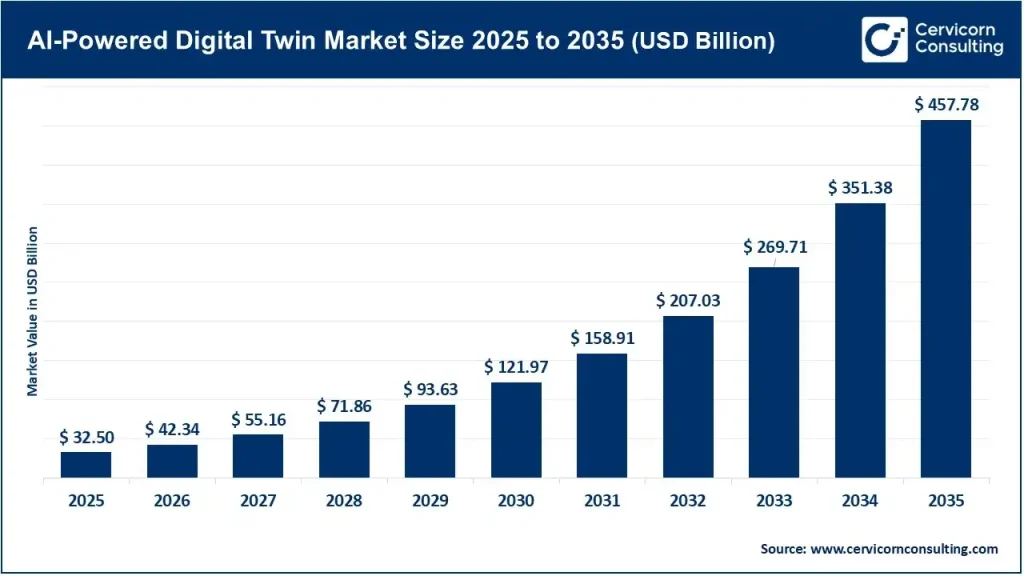
The global AI-powered digital twin market was valued at USD 32.50 billion in 2025 and is projected to reach approximately USD 457.78 billion by 2035, expanding at a CAGR of 30.2% from 2026 to 2035. The market is estimated to reach USD 42.34 billion in 2026, reflecting increasing investment in AI-driven simulation, predictive analytics, connected industrial assets, and real-time operational intelligence.
However, the commercial opportunity extends beyond creating virtual representations of physical assets. Companies are increasingly evaluating how AI-powered digital twins can improve production planning, reduce equipment downtime, optimize energy consumption, accelerate product development, and support decisions involving complex infrastructure.
For technology providers and industrial enterprises, the next challenge is determining which digital twin applications offer measurable business value, what level of AI and data integration is required, and how these solutions can scale across operations.
Why Are Companies Moving from Conventional Digital Twins to AI-Powered Systems?
Traditional digital twins primarily replicate physical assets, processes, or systems using engineering models, operational data, and simulation technologies. AI-powered digital twins extend these capabilities by incorporating machine learning, predictive analytics, computer vision, and generative AI to interpret changing conditions and evaluate potential outcomes.
This transition changes the role of digital twins from operational monitoring tools into decision-support systems.
Three developments are particularly important:
- Predictive rather than reactive operations: AI models can identify abnormal operating patterns and estimate potential equipment failures, allowing maintenance teams to intervene before breakdowns disrupt production.
- Simulation-based investment decisions: Companies can evaluate production changes, equipment upgrades, capacity expansion, and infrastructure modifications virtually before committing capital.
- Continuous operational optimization: Integration with IoT sensors, enterprise systems, and industrial control environments enables digital twins to analyze real-time performance and recommend adjustments.
For businesses, the investment case increasingly depends on how effectively these capabilities translate into lower operating costs, improved asset utilization, and better capital allocation.
Get a Free Sample: https://www.cervicornconsulting.com/sample/3087
Which Digital Twin Applications Should Companies Prioritize?
Not every digital twin application offers the same financial or operational benefits. Investment priorities should reflect asset criticality, data availability, operational complexity, and the cost of existing inefficiencies.
Predictive Maintenance: Can AI Reduce the Cost of Unplanned Downtime?
Predictive maintenance represented approximately 24% of the AI-powered digital twin market in 2025, making it the leading application segment.
Manufacturers, energy companies, and transportation operators can use AI-enabled digital twins to combine equipment histories, sensor readings, operating conditions, and maintenance records. These systems help identify developing faults and estimate when intervention may be required.
The strongest initial opportunities are generally found in operations where equipment failure creates significant production losses, safety risks, or expensive emergency repairs.
Business decisions to consider:
- Which critical assets contribute most to unplanned downtime?
- Can existing sensor infrastructure provide sufficiently reliable operating data?
- Would predictive maintenance deliver greater returns than replacing or upgrading equipment?
- How should maintenance budgets be allocated between high-risk and lower-priority assets?
Process and Business Optimization: Can Virtual Simulation Improve Resource Utilization?
Process digital twins are expected to register the fastest growth among digital twin types, while process and business optimization applications are gaining importance as enterprises move beyond individual asset monitoring.
AI-powered process twins can model production workflows, resource consumption, operating constraints, and interdependent processes. Companies can use these models to evaluate alternative production schedules, identify bottlenecks, and assess the consequences of operational changes.
For industrial businesses, this creates opportunities to improve throughput, reduce material waste, optimize energy consumption, and increase production capacity without immediately investing in additional physical infrastructure.
Business decisions to consider:
- Which production bottlenecks should be addressed first?
- Can process optimization increase output without expanding plant capacity?
- Which operational parameters have the greatest impact on production costs?
- Should companies prioritize individual production lines or enterprise-wide process twins?
Product Design and Development: Can Digital Twins Shorten Engineering Cycles?
Product digital twins allow engineering teams to simulate product performance under different operating conditions before manufacturing physical prototypes.
When combined with AI, these systems can help evaluate design alternatives, identify potential performance limitations, and improve engineering validation.
Automotive, aerospace, electronics, and industrial equipment manufacturers can use these capabilities to reduce repetitive physical testing, evaluate component performance, and accelerate product development.
The investment opportunity is particularly relevant for companies managing complex product configurations and expensive engineering validation processes.
Performance Monitoring and Optimization: How Can Companies Improve Asset Productivity?
Performance monitoring and optimization accounted for approximately 20% of the market in 2025.
AI-enabled digital twins can combine operational data from multiple assets to identify performance variations, evaluate operating conditions, and support efficiency improvements.
This application is relevant to energy infrastructure, manufacturing facilities, transportation networks, and other environments where asset utilization directly influences operating expenditure.
Companies should evaluate whether a digital twin can provide better operational visibility than existing monitoring systems and whether its recommendations can be integrated into actual operating workflows.
Which Industries Offer the Strongest Adoption Opportunities?
Manufacturing and industrial automation accounted for approximately 32% of the AI-powered digital twin market in 2025. However, opportunities are expanding across energy, transportation, healthcare, and infrastructure.
Manufacturing and Industrial Automation
Manufacturing remains the most established application environment because production facilities contain interconnected equipment, repetitive processes, and substantial volumes of operational data.
Manufacturers can prioritize digital twins for production lines, critical machinery, process optimization, and factory-wide performance monitoring.
The strategic consideration is whether to deploy separate asset-level twins or develop integrated system and process twins that provide visibility across entire production environments.
Energy and Utilities
Energy companies operate capital-intensive assets where maintenance failures, efficiency losses, and operational disruptions can have significant financial consequences.
AI-powered digital twins can support power plant optimization, grid monitoring, renewable energy forecasting, equipment maintenance, and infrastructure planning.
For utilities and energy operators, investment decisions should account for integration with existing control systems, cybersecurity requirements, asset lifecycles, and the ability to translate simulation results into operational improvements.
Automotive and Transportation
Automotive manufacturers can use digital twins across vehicle engineering, production systems, battery performance analysis, and connected vehicle operations.
Transportation operators can also evaluate applications involving fleet management, infrastructure monitoring, and predictive maintenance.
Companies should assess whether product-level twins, manufacturing twins, or connected fleet twins provide the greatest opportunity for cost reduction and operational differentiation.
Healthcare and Pharmaceuticals
Healthcare and pharmaceuticals represent an emerging growth opportunity, particularly in medical device simulation, hospital operations, drug development, and personalized treatment research.
AI-enabled digital twins can help model complex biological systems, evaluate treatment scenarios, and improve operational planning.
However, adoption requires careful consideration of clinical validation, patient data privacy, regulatory requirements, and model reliability. Healthcare companies should distinguish between operational digital twins and patient-specific clinical applications because their implementation requirements and risk profiles differ considerably.
What Should Companies Evaluate Before Investing in Digital Twin Technology?
The potential benefits of digital twins can be substantial, but implementation complexity can limit returns when technology investments are not aligned with operational requirements.
Companies should evaluate five critical areas before committing to large-scale deployment.
1. Data readiness and infrastructure
Digital twins depend on reliable data from sensors, industrial equipment, enterprise applications, and engineering systems. Incomplete asset information, inconsistent data formats, and disconnected systems can reduce model accuracy.
Companies should assess existing IoT infrastructure, data quality, connectivity, and integration requirements before selecting a platform.
2. AI model accuracy and simulation reliability
An AI-powered digital twin is only useful when its predictions and simulations are sufficiently reliable for the decisions being supported.
Enterprises should evaluate model validation methods, historical performance, simulation accuracy, and the ability to update models when physical operating conditions change.
3. Deployment architecture and cybersecurity
On-premises deployment accounted for approximately 44% of the market in 2025, while cloud-based deployment is expected to grow rapidly.
The appropriate architecture depends on data sensitivity, latency requirements, regulatory obligations, computing capacity, and the need to connect multiple operational locations.
Hybrid deployment may offer a practical option for organizations that require local processing alongside centralized analytics.
4. Integration with existing IT and OT systems
Digital twin implementations often involve integration with industrial control systems, enterprise resource planning platforms, manufacturing execution systems, engineering software, and IoT infrastructure.
Companies should evaluate interoperability, legacy equipment compatibility, vendor dependencies, and the long-term costs of maintaining connected systems.
5. Return on investment and scalability
Initial deployments should be evaluated against measurable operating outcomes rather than technology adoption targets.
Relevant indicators include equipment downtime, maintenance expenditure, production throughput, energy consumption, product development time, asset utilization, and operational risk.
Companies should establish baseline performance metrics and assess whether pilot deployments can be replicated across additional facilities or business units.
How Are Technology Investments and Industry Partnerships Shaping the Market?
Recent industry developments indicate that AI-powered digital twins are moving toward integrated industrial intelligence platforms rather than remaining standalone simulation tools.
- Tata Consulting Engineers: In February 2026, the company introduced its Cognitive Digital Twin and Industrial AI platform using NVIDIA accelerated computing and Omniverse technologies. The initiative targets manufacturing, energy, and infrastructure applications.
- Siemens: Its January 2026 launch of Digital Twin Composer, combining digital twin capabilities with NVIDIA Omniverse libraries and real-time engineering data, highlights the growing convergence of industrial engineering and AI-powered simulation.
- Wipro and Kongsberg Digital: Their April 2026 strategic partnership focuses on AI-powered digital twin solutions for energy and utilities, combining engineering models, operational data, and automation.
- Dassault Systèmes and Kyndryl: Their September 2026 collaboration in India brings virtual twin technologies together with IT infrastructure services, targeting infrastructure, manufacturing, retail, and pharmaceutical applications.
These developments indicate that competitive differentiation is increasingly dependent on combining AI capabilities with engineering expertise, industrial data integration, simulation technologies, and implementation services.
For technology providers, this creates opportunities in specialized software, systems integration, industrial analytics, cloud infrastructure, and digital twin lifecycle management.
Where Should Digital Twin Technology Providers Focus Their Market Expansion?
The competitive landscape includes established industrial software companies, engineering simulation providers, AI infrastructure companies, and enterprise technology vendors.
Companies such as Siemens, NVIDIA, Microsoft, IBM, GE Vernova, Ansys, PTC, Bentley Systems, Rockwell Automation, ABB, Hexagon, AVEVA, and Schneider Electric are positioned across different parts of the digital twin ecosystem.
However, competing across the entire technology stack may require substantial investment in software development, AI infrastructure, industrial partnerships, and customer support.
Technology providers should evaluate four strategic priorities:
- Industry-specific solutions: Develop applications for high-value industries rather than relying exclusively on generic digital twin platforms.
- Integration capabilities: Strengthen compatibility with existing industrial software, IoT infrastructure, and enterprise systems.
- Implementation and lifecycle services: Address the growing requirement for engineering integration, deployment, model validation, and ongoing maintenance.
- AI and simulation capabilities: Invest in predictive modeling, real-time simulation, generative AI, and edge analytics to improve solution differentiation.
The services segment is expected to grow faster than software and solutions, reflecting the importance of implementation expertise and integration support in enterprise adoption.
What Does the Regional Opportunity Mean for Market Participants?
North America accounted for approximately 39% of global AI-powered digital twin market revenue in 2025, supported by established industrial technology ecosystems, AI infrastructure, and enterprise digitalization.
Asia Pacific is expected to register the fastest growth, supported by industrial expansion, smart manufacturing initiatives, infrastructure investments, and increasing adoption of AI and IoT technologies.
For companies evaluating regional expansion, these differences have practical implications.
North America offers opportunities involving advanced industrial simulation, enterprise AI integration, aerospace, energy, and established manufacturing operations.
Asia Pacific presents opportunities in factory digitalization, industrial automation, infrastructure development, and localized digital twin solutions.
For international technology providers, market entry strategies should consider regional manufacturing concentrations, local technology partnerships, data governance requirements, and customer readiness for large-scale implementation.
Strategic Outlook: Turning Digital Twin Investments into Measurable Business Outcomes
The expansion of the AI-powered digital twin market reflects a broader transition toward predictive, simulation-driven, and increasingly autonomous business operations.
However, market growth alone does not determine which applications will generate sustainable returns. Companies must identify operational problems where AI-powered simulation can produce measurable improvements and prioritize deployments according to technical readiness, financial value, and scalability.
Manufacturers may find immediate opportunities in predictive maintenance and process optimization, while energy operators can prioritize asset reliability and infrastructure performance. Technology providers, meanwhile, need to determine which industry applications, software capabilities, and integration services offer the strongest competitive opportunities.
The central investment question is no longer whether a company should adopt digital twin technology, but which physical assets, processes, and business decisions should be digitally replicated first to generate the highest operational and financial value.
To Get Detailed Overview, Contact Us: https://www.cervicornconsulting.com/contact-us