


Table of Contents
ToggleAI in Energy Market Size
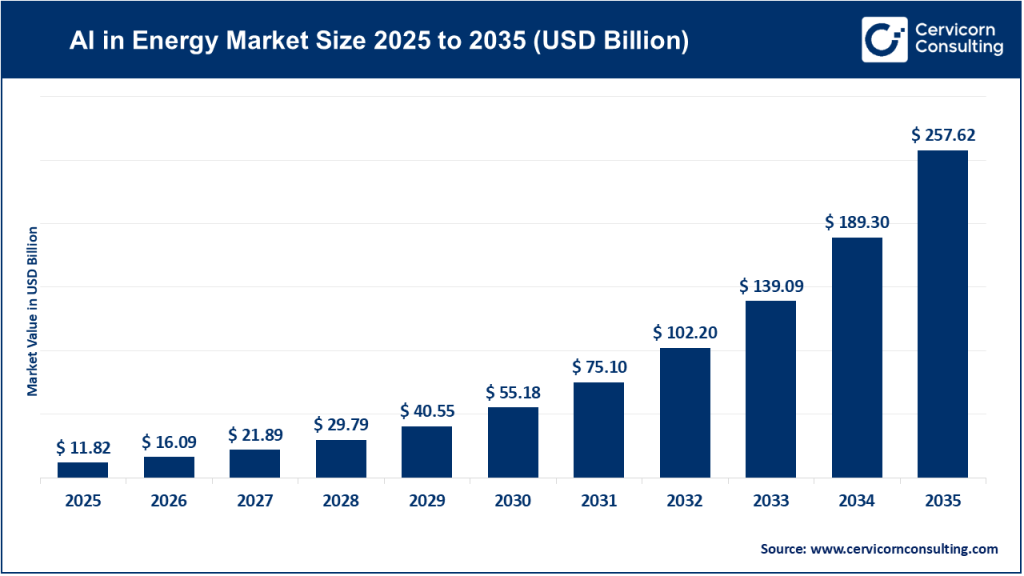
The global AI in energy market is expanding rapidly and is projected to grow from approximately USD 11.82 billion in 2025 to about USD 257.62 billion by 2035, reflecting strong adoption across generation, transmission, distribution, and consumption segments.
What Is AI in Energy Market?
The AI in energy market refers to the deployment of artificial intelligence technologies—such as machine learning, predictive analytics, digital twins, and intelligent automation—across energy production, grid infrastructure, storage, and consumption management systems.
AI solutions are widely used in:
- Smart grid management
- Renewable energy forecasting
- Predictive maintenance of equipment
- Demand-response optimization
- Energy trading analytics
- Carbon monitoring systems
- Infrastructure cybersecurity
These capabilities enable energy providers to improve operational reliability, reduce downtime, integrate renewable sources more effectively, and respond dynamically to changing consumption patterns. AI also supports decision-making by analyzing large volumes of real-time data from sensors, weather systems, distributed generation units, and consumer usage networks.
Increasing electrification, decentralized generation, and the transition toward net-zero economies are driving utilities to adopt AI-powered energy management platforms globally.
Why AI in Energy Market Is Important?
AI is transforming the energy sector because traditional grid infrastructure was not designed to handle decentralized renewable sources, variable generation patterns, and rising digital demand from modern economies.
Its importance lies in several strategic benefits:
Renewable Energy Integration
Solar and wind power fluctuate depending on environmental conditions. AI forecasting tools analyze weather and historical generation patterns to balance supply with demand efficiently.
Predictive Maintenance
Utilities use AI algorithms to detect anomalies in transformers, turbines, and pipelines before failures occur—reducing downtime and maintenance costs.
Smart Grid Optimization
AI enables real-time monitoring and automation of electricity distribution systems to prevent outages and enhance grid resilience.
Energy Efficiency
Intelligent consumption analytics helps households, industries, and data centers reduce electricity usage.
Carbon Reduction
AI improves emissions tracking and supports sustainability strategies through optimized generation planning.
Overall, AI enables utilities to move from reactive infrastructure management toward predictive and autonomous grid ecosystems.
Get a Free Sample: https://www.cervicornconsulting.com/sample/2917
AI in Energy Market Growth Factors
The growth of the AI in energy market is primarily driven by rising global electricity demand, accelerated deployment of renewable energy infrastructure, and the need for intelligent grid modernization capable of managing decentralized power systems efficiently. Increasing adoption of predictive maintenance platforms and smart meters is helping utilities reduce operational costs while improving asset performance, while regulatory pressure to reduce carbon emissions is encouraging companies to deploy AI-based analytics for sustainability monitoring and renewable optimization.
The expansion of smart cities, electrification of transportation, and growing reliance on data centers are further increasing the demand for AI-enabled energy management platforms, and strong investments in digital grid technologies across North America, Europe, and Asia-Pacific are accelerating adoption of machine learning solutions across generation, transmission, and distribution networks worldwide. Additionally, cloud computing integration and IoT-enabled infrastructure are enabling utilities to deploy scalable AI architectures capable of processing real-time operational data, strengthening grid reliability and supporting long-term energy transition strategies globally.
Key Companies Driving the AI in Energy Market
Below is a structured comparison of major players shaping the AI-driven energy transformation landscape.
| Company | Specialization | Key Focus Areas | Notable Features | 2024 Revenue | Market Share | Global Presence |
|---|---|---|---|---|---|---|
| Siemens AG | Industrial automation & smart infrastructure | Grid digitalization, smart substations, predictive maintenance | Digital twin platforms and AI-enabled grid analytics | ~$83B | Strong presence in utility automation | 190+ countries |
| Schneider Electric SE | Energy management & automation | Smart buildings, distributed energy systems, data-center energy optimization | AI-powered Wiser platform for home energy automation | ~$39B | Leader in smart energy solutions | 100+ countries |
| General Electric (GE Vernova) | Power generation & electrification | Wind turbines, grid optimization, predictive analytics | AI-enabled turbine diagnostics & grid software | ~$33B (energy division est.) | Major generation infrastructure share | Global utility-scale footprint |
| ABB Ltd. | Electrification & robotics | Smart grids, industrial automation, energy monitoring | AI-enabled substation automation | ~$32B | Strong industrial electrification presence | 100+ countries |
| IBM Corporation | Enterprise AI platforms | Energy analytics, grid forecasting, digital twins | Watson-based predictive analytics for utilities | ~$62B | Software-driven influence in utilities | Global cloud footprint |
These companies dominate innovation across grid modernization, predictive analytics, and intelligent energy management infrastructure.
Leading Trends and Their Impact
Several technological trends are shaping the AI in energy market globally.
Smart Grid Intelligence
AI-enabled smart grids automate electricity routing and outage detection while improving demand forecasting accuracy. This reduces transmission losses and enhances grid reliability.
Impact:
- Lower operational costs
- Faster outage recovery
- Increased renewable penetration
Renewable Forecasting Optimization
AI models predict solar irradiance and wind generation patterns using historical and meteorological data.
Impact:
- Improved generation scheduling
- Reduced curtailment losses
- Higher renewable utilization rates
Digital Twin Technology
Digital twins simulate real-time behavior of turbines, pipelines, and substations using AI analytics.
Impact:
- Predictive maintenance
- Extended asset lifespan
- Reduced downtime
AI-Driven Energy Trading Platforms
Machine learning algorithms forecast market price fluctuations and demand volatility.
Impact:
- Improved profitability
- Reduced trading risk
- Optimized energy procurement
AI Integration with IoT Sensors
IoT-enabled infrastructure generates real-time operational datasets that AI models use for automation and analytics.
Impact:
- Real-time monitoring
- Enhanced infrastructure resilience
- Improved safety compliance
Successful Examples of AI in Energy Market Around the World
AI adoption is already transforming energy systems across multiple countries.
United States
Utilities deploy AI-based outage prediction systems and distributed energy resource management platforms to stabilize grids with increasing renewable penetration. AI-powered forecasting tools are widely used to manage demand variability across regional electricity markets.
Germany
Germany’s energy transition strategy relies heavily on AI-enabled forecasting to balance solar and wind generation across the national grid. AI helps integrate intermittent renewable power sources efficiently into transmission networks.
China
China uses AI-driven smart grid infrastructure to manage large-scale renewable energy installations and ultra-high voltage transmission networks. AI improves power distribution efficiency across long-distance transmission corridors.
United Kingdom
AI-powered predictive maintenance systems monitor offshore wind turbines and optimize maintenance schedules to reduce downtime and improve generation reliability.
India
India is deploying AI-enabled smart meters under national digital grid modernization programs to improve consumption analytics, reduce transmission losses, and support smart city infrastructure development.
Global Regional Analysis Including Government Initiatives and Policies Shaping the Market
Government regulations and investments are playing a major role in accelerating adoption of AI technologies across energy infrastructure worldwide.
North America
North America dominates the global AI energy adoption landscape due to advanced digital infrastructure and strong utility investments.
Key drivers:
- Smart grid modernization programs
- Renewable deployment targets
- Digital twin integration
- Utility automation platforms
Government initiatives include:
U.S. Grid Modernization Initiative
Supports deployment of AI-enabled monitoring systems across national transmission infrastructure.
Inflation Reduction Act
Provides funding support for renewable deployment supported by digital grid technologies.
Impact:
Accelerates adoption of AI-based predictive maintenance and renewable optimization platforms across utilities.
Europe
Europe is a global leader in sustainability-driven AI adoption within energy systems.
Major drivers:
- Net-zero commitments
- Smart grid integration
- Offshore wind expansion
- Cross-border electricity markets
Government initiatives include:
European Green Deal
Supports digitalization of electricity infrastructure and renewable integration platforms.
Germany’s Energiewende Policy
Promotes renewable integration using predictive analytics platforms.
Impact:
Encourages utilities to deploy AI-based balancing systems for renewable-heavy grids.
Asia-Pacific
Asia-Pacific represents the fastest-growing regional market.
Major drivers:
- Rapid urbanization
- Smart city investments
- Grid expansion programs
- Electrification of transport systems
Government initiatives include:
China Smart Grid Strategy
Supports AI-based ultra-high voltage transmission monitoring.
India National Smart Grid Mission
Promotes deployment of intelligent metering infrastructure and digital distribution systems.
Impact:
Accelerates adoption of AI-powered demand-response platforms and consumption analytics solutions.
Middle East and Africa
This region is adopting AI technologies primarily to optimize large-scale energy infrastructure and renewable megaprojects.
Major drivers:
- Solar mega-parks
- Grid modernization investments
- Digital oilfield analytics
Government initiatives include:
Saudi Vision 2030
Supports AI integration into energy infrastructure modernization programs.
UAE Energy Strategy 2050
Promotes renewable forecasting and smart grid analytics adoption.
Impact:
Improves operational efficiency of utility-scale solar facilities and supports energy diversification strategies.
Latin America
Latin America is gradually adopting AI in hydropower optimization and renewable integration projects.
Major drivers:
- Hydropower forecasting
- Transmission optimization
- Smart meter deployment
Government initiatives include:
Brazil National Energy Expansion Plan
Supports digital grid upgrades and renewable balancing systems.
Impact:
Strengthens grid resilience and improves electricity reliability across remote regions.
To Get Detailed Overview, Contact Us: https://www.cervicornconsulting.com/contact-us
Read Report: Industrial Fasteners Market Revenue, Trends, and Strategic Insights by 2035