


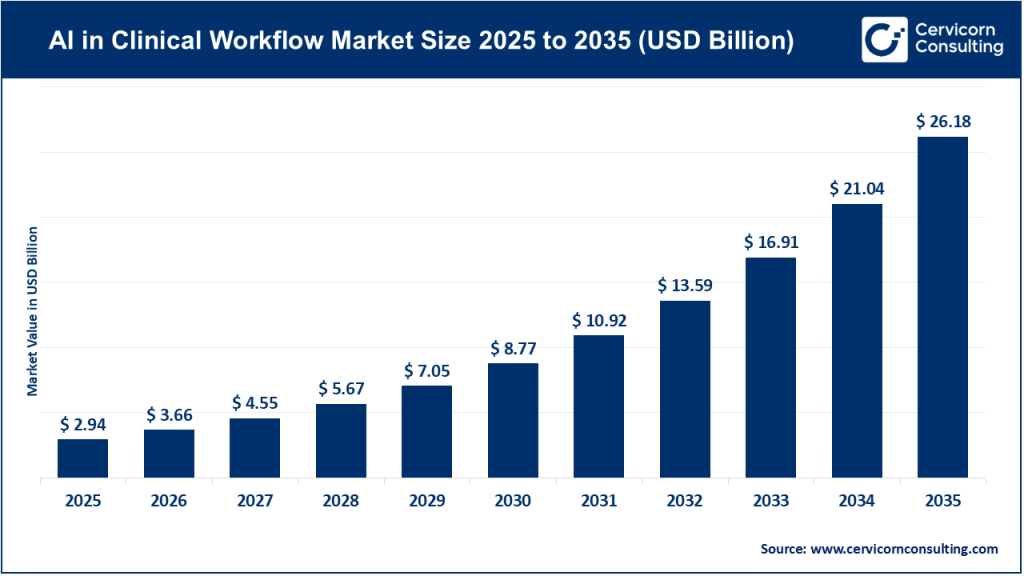
AI in Clinical Workflow Market Size and Forecast
The global AI in clinical workflow market was valued at approximately USD 2.94 billion in 2025, with a projected growth to USD 26.18 billion by 2035, representing a compound annual growth rate (CAGR) of nearly 24.5% through the forecast period.
This growth is primarily fueled by increased digital transformation in healthcare, the urgent need for automation in clinical processes, and rapid innovation in AI technologies that can be integrated into EHR platforms and clinical decision support systems. Systems such as real-time documentation, diagnostics, care coordination, and risk scoring are expected to contribute significantly to overall market expansion.
What Is the AI in Clinical Workflow Market?
The AI in clinical workflow market refers to the ecosystem of artificial intelligence‑enabled software and technologies designed to improve the efficiency, accuracy, and outcomes of clinical workflows in healthcare settings. These solutions use techniques such as machine learning (ML), natural language processing (NLP), computer vision, and generative AI to automate repetitive tasks, support clinical decision-making, streamline documentation, enhance diagnostics, and coordinate care across inpatient and outpatient environments. By embedding AI tools directly into existing electronic health record (EHR) systems and clinical processes, these technologies help clinicians, nurses, and administrators navigate patient care more effectively — from patient intake and medical note generation to predictive risk analysis and treatment recommendations.
Market Growth Factors
Several key factors are driving rapid growth in the AI clinical workflow market: the explosion of clinical and administrative data that healthcare systems must manage; increasing workforce burnout among clinicians due to high documentation workloads; pressure on hospitals and networks to improve operational efficiency and reduce costs; the rising adoption of digitization and EHR integration globally; advancements in NLP, ML, and generative AI that make real-time clinical insight and automation increasingly feasible; and the willingness of health systems to invest in AI technologies that enhance speed, accuracy, and value-based care delivery.
Collectively, these forces — coupled with healthcare organizations’ desire to improve patient outcomes and clinician satisfaction — are accelerating the deployment of AI-assisted workflows across diagnostics, documentation, care coordination, and administrative tasks, positioning this segment for remarkable expansion through the end of the decade.
Get a Free Sample: https://www.cervicornconsulting.com/sample/2889
Why Is the AI in Clinical Workflow Market Important?
Healthcare systems worldwide face growing patient demand, complex regulatory environments, and intense pressure to reduce costs while improving quality of care. AI in clinical workflows tackles these challenges by automating time-consuming tasks like documentation, facilitating real-time decision support, minimizing errors, and allowing clinicians to spend more time on direct patient care. Integrating AI boosts operational efficiency, reduces burnout (especially for nurses and physicians), improves care coordination, and enhances patient outcomes. The adoption of AI can also drive standardization of processes, enable predictive analytics for risk assessment, and support advanced population health management. For health systems struggling with workforce shortages and data overload, AI is rapidly transitioning from a “nice-to-have” to a strategic imperative.
Leading Companies in the AI Clinical Workflow Market
Here’s a deep dive into major players — focusing on company, specialization, key focus areas, notable features, 2024 revenue/market share, and global presence for each:
1. Microsoft Corporation
- Company: Microsoft Corporation (USA)
- Specialization: Cloud-based AI healthcare solutions, generative AI assistants, EHR interoperability
- Key Focus Areas: Ambient clinical documentation, predictive analytics, care coordination, AI-augmented clinical decision support
- Notable Features: Integration with Microsoft Azure, Dragon Copilot for real-time clinical note generation, deep partnerships with major EHR systems
- 2024 Revenue & Market Share: Microsoft’s healthcare AI segment is recognized as a leading contributor to the AI clinical workflow market due to its broad ecosystem and extensive enterprise adoption.
- Global Presence: Operates worldwide with healthcare partnerships in North America, Europe, Asia, and emerging markets; supports global cloud infrastructure for real-time AI solutions.
2. Epic Systems Corporation
- Company: Epic Systems Corporation (USA)
- Specialization: EHR platforms with embedded AI functionality
- Key Focus Areas: Clinical decision support, workflow optimization, risk assessment, documentation automation, patient pathway intelligence
- Notable Features: AI embedded directly into Epic’s EHR suite, enabling contextual insights without interrupting clinician workflows
- 2024 Revenue & Market Share: Epic maintains a leading market position with significant share due to its deep integration across major health systems, particularly in North America.
- Global Presence: Strong footprint in the United States with growing enterprise adoption in Europe and some Asia Pacific regions.
3. Oracle Health
- Company: Oracle Corporation’s Health division (USA)
- Specialization: Healthcare IT, data platforms, clinical workflow automation tools
- Key Focus Areas: EHR integration, workflow automation, data analytics, care coordination
- Notable Features: Oracle’s suite emphasizes interoperability and enterprise analytics for hospital systems seeking unified data and workflow solutions
- 2024 Revenue & Market Share: AI clinical workflow solutions contribute meaningfully to Oracle Health’s growth trajectory, though specific figures are not publicly segregated.
- Global Presence: Distributed globally with focus markets in North America, Europe, Middle East, and Asia Pacific.
4. GE Healthcare
- Company: GE Healthcare (USA)
- Specialization: AI innovation labs, imaging AI, integrated care continuum solutions
- Key Focus Areas: Deep learning for imaging workflows, predictive analytics, multi-disciplinary AI support tools, automation of diagnostic pathways
- Notable Features: AI Innovation Lab focusing on embedding intelligence across care cycles
- 2024 Revenue & Market Share: GE Healthcare is a major contributor in integrated workflow and imaging analytics sectors.
- Global Presence: Strong global footprint across North America, Europe, Asia Pacific, Latin America, and Africa.
5. Abridge AI
- Company: Abridge AI, Inc. (USA)
- Specialization: Clinical documentation automation using NLP and conversation understanding
- Key Focus Areas: Automated medical note creation, conversation summarization, clinician workload reduction
- Notable Features: Uses advanced NLP to convert patient-clinician dialogues into structured clinical documentation
- Revenue & Market Share: As a specialized startup, Abridge AI has rapidly grown its footprint; in 2025, it raised $250 million to enhance capabilities and expand deployments.
- Global Presence: Expanding primarily in U.S. healthcare systems with potential entrance into other mature markets.
Leading Trends in the AI Clinical Workflow Market and Their Impact
1. Ambient AI and Generative Assistants
Artificial intelligence assistants are transforming how clinicians document care and interact with EHRs. These tools listen in real time, draft documentation, surface insights, and automate routine tasks without disrupting workflows.
Impact: Less clinician burnout, faster documentation, improved data quality.
2. NLP-Driven Clinical Documentation
NLP that can understand and generate structured clinical notes from spoken language or text is accelerating adoption, enabling doctors to focus more on patient interaction and less on time-consuming paperwork.
Impact: Streamlines charting, enhances productivity, reduces error rates.
3. Predictive Analytics for Risk and Outcomes
Machine learning models now anticipate clinical deterioration, readmissions, and care escalation through real-time data analysis. Hospitals leveraging predictive insights can tailor interventions preemptively.
Impact: Improved outcomes, reduced costs, and strategic resource allocation.
4. Integration of AI with EHRs and Interoperability Platforms
Platforms that enable seamless integration between AI engines and EHR systems are unlocking cross-system workflows, enabling shared data insights, care coordination across providers, and unified clinical dashboards.
Impact: Reduced data silos, improved clinical interoperability, and cohesive care journeys.
5. Regulatory and Ethical Safeguards
As AI becomes more prevalent, standards for governance, explainability, and ethical deployment are gaining attention — helping ensure AI tools are safe, fair, and aligned to clinical needs.
Impact: Enhances trust, fosters safe adoption, and aligns innovation with patient welfare.
Successful Global Examples of AI in Clinical Workflows
1. Cedars-Sinai Connect (USA)
Cedars-Sinai in Los Angeles deployed an AI-powered platform to provide 24/7 care, automate patient intake, and assist in diagnostic workflows. The tool helped streamline administrative duties and allowed clinicians to focus more on patient counseling and treatment planning.
2. Johns Hopkins Predictive Analytics
A major U.S. health system implemented AI-driven predictive analytics to anticipate patient risk of deterioration and 30-day readmissions, resulting in optimized care planning and cost savings across departments.
3. Japanese Smart Hospital Initiatives
Under Japan’s “Society 5.0 Smart Hospitals” push, clinics are incorporating AI symptom intake systems, automating documentation, and integrating wearable data, signaling national commitment to digital health transformation.
4. EHR AI in China’s Tertiary Hospitals
Systems have been deployed widely in China’s tertiary care hospitals, integrating diagnostic support and AI-driven clinical operations to streamline management and enhance accuracy.
5. Eka Care & ABHA (India)
India’s government-backed Ayushman Bharat Digital Mission (ABDM) has enabled platforms like Eka Care to digitize over 110 million health records, laying the groundwork for AI-enabled workflows in documentation and data access across public health networks.
Global Regional Analysis Including Government Initiatives and Policies
North America
North America leads the AI clinical workflow market due to advanced digital infrastructure, a high rate of EHR adoption, strong investment in healthcare IT, and supportive reimbursement models. Government bodies are increasingly shaping policies around safe AI deployment in healthcare settings to ensure transparency, data privacy, and algorithmic fairness.
Europe
European countries emphasize ethical AI practices and robust data privacy frameworks. Nations like the UK are piloting AI tools within the NHS to automate documentation and improve diagnostic pathways, while Nordic healthcare systems are deploying ambient AI scribes for clinical encounters.
Asia Pacific
Asia Pacific is the fastest-growing region for AI clinical workflows, with increased adoption driven by digital transformation, “smart hospital” initiatives, and supportive government investments. Countries such as China and Japan prioritize population-scale AI systems for diagnostics, workflow automation, and predictive care management — while India’s AI healthcare Centers of Excellence and digital missions are laying a foundation for widespread adoption.
Latin America and Middle East & Africa
Emerging markets in Latin America and the Middle East are gradually integrating AI into clinical workflows, supported by health tech accelerators and strategic partnerships. Governments are investing in digital health infrastructure to improve access and quality of care, though adoption remains lower compared to Western markets due to cost and infrastructure challenges.
Market Challenges and Policy Considerations
Although the AI in clinical workflow market is advancing rapidly, several key challenges must be addressed:
- Data Privacy & Security: Ensuring patient data protection and compliance with regional regulations is critical.
- AI Governance & Trust: Policies must enable explainability, minimize bias, and establish clear accountability in AI-assisted decisions.
- Interoperability: Seamless integration across diverse EHR systems and care settings remains a technical hurdle.
- Workforce Training: Clinicians and administrators need training to adopt AI tools safely and effectively.
Policymakers and industry coalitions are working to establish trustworthy, ethical guidelines for development and deployment — balancing innovation with safety and equity.
To Get Detailed Overview, Contact Us: https://www.cervicornconsulting.com/contact-us
Read Report: AI in Digital Pathology Market Growth Drivers, Trends, Key Players and Regional Insights by 2035