


AI Agents in Healthcare Market: 6 Strategic Decisions Companies Should Make to Capture the Next Wave of Healthcare Automation
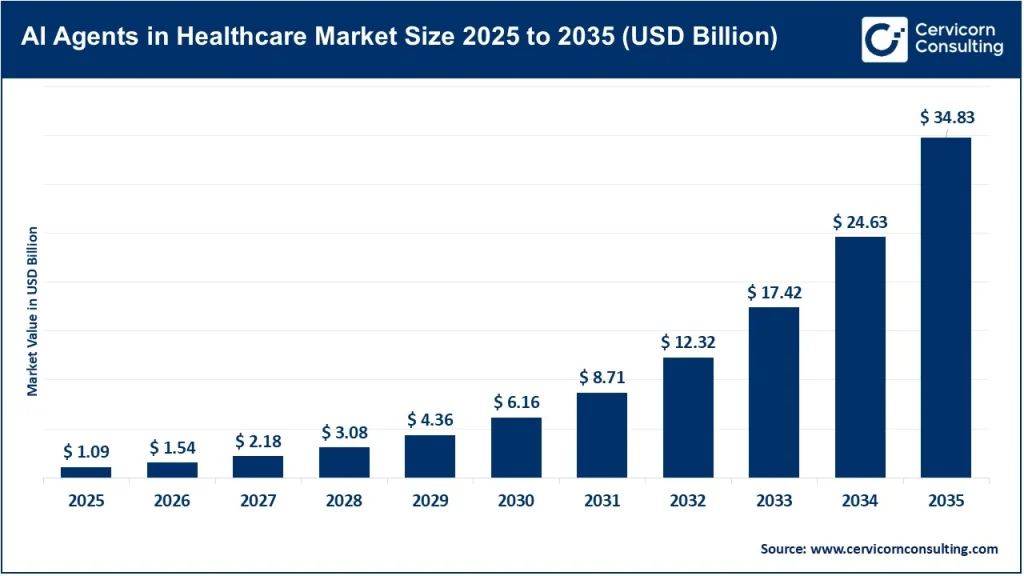
The global AI agents in healthcare market was valued at USD 1.09 billion in 2025 and is projected to reach approximately USD 34.83 billion by 2035, expanding at a compound annual growth rate (CAGR) of 41.4% from 2026 to 2035. Growth is being driven by healthcare organizations’ increasing demand for clinical workflow automation, administrative efficiency, intelligent patient engagement, and improved decision support. As healthcare systems face rising operational costs, workforce shortages, fragmented patient data, and pressure to improve care delivery, AI agents are emerging as a potential solution for managing complex, multi-step processes.
Unlike conventional healthcare AI applications that primarily generate predictions or recommendations, AI agents can interpret information, plan tasks, interact with connected systems, and execute defined workflows with varying degrees of human supervision. Applications include patient triage, clinical documentation, appointment scheduling, prior authorization, claims processing, patient monitoring, and drug discovery.
However, market expansion does not automatically translate into commercial success. Healthcare companies must determine which workflows offer measurable returns, how much autonomy their systems should have, which technologies can integrate with existing infrastructure, and what safeguards are necessary before deployment. The following six decisions can help organizations identify commercially viable opportunities and establish sustainable positions in the evolving AI agents in healthcare market.
1. Which Healthcare Workflows Should Companies Prioritize for AI Agent Deployment?
Healthcare organizations should prioritize workflows based on operational inefficiencies, transaction volumes, labor requirements, and the financial consequences of delays or errors. Deploying AI agents across multiple departments without identifying specific operational problems can increase implementation costs without producing measurable improvements.
The market currently offers opportunities across diagnosis and early detection, clinical decision support, patient monitoring, administrative automation, and revenue cycle management. However, each application has different purchasing requirements, implementation timelines, and risk profiles.
For example, hospitals dealing with high documentation workloads may prioritize clinical documentation agents that summarize consultations, prepare medical notes, and update electronic health records. Payers and healthcare providers may find stronger immediate business cases in prior authorization, claims processing, coding, and denial management, where repetitive workflows create measurable administrative costs.
Companies should evaluate the following applications before committing investment:
-
Clinical documentation: Automating medical note generation, discharge summaries, clinical coding assistance, and patient record updates.
-
Diagnosis and early detection: Supporting medical image interpretation, laboratory result analysis, risk identification, and clinical prioritization.
-
Patient monitoring: Tracking vital signs, medication adherence, symptoms, and changes in patient conditions to support timely intervention.
-
Revenue cycle management: Automating eligibility verification, prior authorization, claims follow-ups, billing documentation, and denial management.
-
Patient engagement: Managing appointment reminders, patient inquiries, care navigation, and post-treatment follow-ups.
The commercial opportunity is particularly attractive in workflows where organizations can establish baseline performance metrics. These include average documentation time, claim processing costs, authorization turnaround time, appointment no-show rates, and staff hours spent on repetitive activities.
Business decision: Companies should select their initial AI agent applications based on measurable operational inefficiencies rather than the number of possible AI use cases. A focused deployment with clearly defined financial and operational outcomes is generally a stronger starting point than a broad, organization-wide automation strategy.
Get a Free Sample: https://www.cervicornconsulting.com/sample/2971
2. Should Companies Invest in Single-Agent Systems or Multi-Agent Architectures?
Architecture selection will influence product development costs, integration complexity, deployment timelines, and the ability to expand across healthcare workflows.
Single-agent systems accounted for 63.4% of the AI agents in healthcare market in 2025, reflecting demand for focused applications that address specific operational requirements. These systems are generally easier to implement, validate, monitor, and integrate into existing healthcare IT environments.
For example, a single agent may handle clinical documentation, patient appointment scheduling, or insurance eligibility verification. This approach allows hospitals and technology vendors to address individual problems without redesigning their entire technology infrastructure.
Multi-agent systems, meanwhile, are gaining importance as healthcare organizations seek to coordinate interconnected workflows. Multiple specialized agents can work together to complete a broader process.
Consider a hospital admission workflow:
-
One agent collects patient information and verifies registration details.
-
Another checks insurance eligibility and authorization requirements.
-
A clinical agent summarizes relevant patient history for the care team.
-
A coordination agent manages bed allocation and admission scheduling.
-
A communication agent provides patients with relevant instructions and updates.
This coordinated approach can reduce manual handoffs and improve information flow between departments. However, it also introduces additional requirements for access control, agent coordination, error handling, and system monitoring.
Technology vendors must therefore decide whether to develop specialized standalone products or integrated platforms capable of supporting multiple agents.
Business decision: Companies entering the market should consider a single-agent architecture for clearly defined workflows and expand toward multi-agent systems when customer demand, integration readiness, and measurable returns justify greater complexity. Vendors should also ensure that individual agents can communicate through standardized interfaces to avoid creating disconnected products that are difficult to scale.
3. How Should Healthcare Companies Balance Clinical Autonomy and Human Oversight?
The level of autonomy granted to AI agents is one of the most important strategic decisions in healthcare deployment. Unlike many other industries, healthcare involves decisions that can directly affect patient safety, treatment outcomes, and clinical accountability.
An agent that prepares a consultation summary has a different risk profile from one that recommends a treatment pathway, modifies a medication order, or triggers an emergency intervention.
Healthcare companies should establish autonomy levels according to the clinical consequences of each action.
For instance:
-
Low-risk administrative tasks: Appointment reminders, document classification, routine scheduling, and information retrieval may support higher levels of automation within approved rules.
-
Moderate-risk operational tasks: Prior authorization preparation, coding assistance, patient intake, and clinical documentation should include verification mechanisms and exception handling.
-
High-risk clinical tasks: Diagnosis, treatment recommendations, medication changes, and emergency care decisions should retain appropriate clinician review and decision authority.
This distinction is important because technical accuracy alone does not establish clinical suitability. AI agents must also demonstrate consistent performance across different patient populations, clinical environments, data sources, and workflow conditions.
The 2026 NVIDIA State of AI in Healthcare and Life Sciences survey found that 47% of respondents were already using or assessing AI agents, including 22% reporting deployment within their organizations. Another 19% expected deployment within the following year. This indicates growing organizational interest, but adoption and successful clinical implementation are not the same.
Companies should develop governance mechanisms covering agent permissions, decision logs, escalation procedures, human approval requirements, and performance monitoring. These controls should be built into product architecture rather than added after deployment.
Business decision: AI developers should differentiate products through reliable human-in-the-loop controls, transparent decision trails, and configurable autonomy. Healthcare providers should define which tasks agents can execute independently, which require approval, and which must remain under direct clinical supervision.
4. Is the Existing Healthcare IT Infrastructure Ready to Support AI Agents?
Technology readiness is a critical factor determining whether AI agent deployments can move beyond pilot projects. Healthcare organizations operate through multiple interconnected systems, including electronic health records (EHRs), hospital information management systems (HIMS), laboratory information systems, medical imaging platforms, insurance databases, and patient communication applications.
AI agents need reliable access to relevant information across these systems to complete tasks accurately. When patient records are fragmented, data formats are inconsistent, or software platforms cannot exchange information, agents may produce incomplete outputs or fail to execute workflows correctly.
This creates an important distinction between AI model capability and enterprise deployment readiness.
Healthcare providers should evaluate the following infrastructure requirements:
-
EHR and HIMS integration: Determine whether agents can retrieve and update patient information through secure, standardized interfaces.
-
Data quality: Assess missing records, inconsistent patient identifiers, outdated information, and variations in clinical documentation.
-
Cloud and computing infrastructure: Evaluate whether existing infrastructure can support model inference, real-time processing, and increasing workloads.
-
Interoperability: Examine compatibility with healthcare data standards and existing third-party applications.
-
Identity and access management: Ensure agents receive only the permissions required for their assigned tasks.
-
Monitoring and auditability: Maintain records of agent activities, data access, decisions, and system-generated actions.
Infrastructure readiness is particularly relevant in Asia-Pacific markets, where healthcare digitization varies considerably between countries and provider categories. KPMG’s 2026 healthcare and life sciences analysis highlights fragmented electronic medical record adoption and interoperability as important constraints on scaling AI across Southeast Asia. It also emphasizes that data readiness, rather than model capability alone, can determine the success of implementation.
For AI technology vendors, this creates opportunities to develop integration platforms, healthcare-specific data infrastructure, interoperability solutions, and secure agent orchestration systems.
Business decision: Healthcare providers should conduct an infrastructure and data-readiness assessment before selecting an AI agent platform. Technology vendors should prioritize compatibility with existing healthcare systems instead of relying exclusively on standalone AI capabilities. Solutions that reduce integration complexity can have a stronger competitive advantage during enterprise procurement.
5. Which Customer Segments and Geographic Markets Offer the Strongest Commercial Opportunities?
Companies should avoid treating the healthcare AI agent market as a single customer category. Hospitals, insurance companies, pharmaceutical manufacturers, biotechnology firms, and research institutions have different operational requirements and purchasing priorities.
In 2025, healthcare providers accounted for 43.7% of the global market, making them the largest end-user segment. Healthcare payers represented 18.6%, pharmaceutical and biotechnology companies accounted for 17.4%, government and public health organizations contributed 11.2%, and research institutes and academic centers represented 9.1%.
These differences provide opportunities for companies to develop industry-specific products rather than compete through generic healthcare automation platforms.
Healthcare providers: Hospitals and healthcare networks offer opportunities in diagnosis support, patient monitoring, clinical documentation, care coordination, and administrative automation. Vendors should prioritize measurable improvements in patient throughput, clinician productivity, and operational efficiency.
Healthcare payers: Insurance companies can use AI agents for eligibility verification, prior authorization, claims processing, payment integrity, and denial management. Commercial positioning should focus on processing accuracy, turnaround time, compliance, and administrative cost reduction.
Pharmaceutical and biotechnology companies: This segment offers opportunities in scientific literature analysis, drug discovery, biomarker identification, clinical trial planning, pharmacovigilance, and regulatory documentation. The NVIDIA 2026 survey found that 48% of respondents from pharmaceutical and biotechnology organizations were using AI agents for drug discovery and biomarker identification. This highlights the importance of specialized agent solutions across life sciences research.
Government and public health organizations: Potential applications include population health monitoring, disease surveillance, public health communication, and healthcare resource allocation. Procurement requirements and data governance will be important considerations.
Research institutes and academic centers: These organizations represent opportunities for literature review, research data management, clinical study coordination, and scientific knowledge retrieval.
Regional expansion requires a different market-entry strategy
North America accounted for 41.8% of the global AI agents in healthcare market in 2025, supported by advanced healthcare IT infrastructure, established AI ecosystems, and growing adoption across providers and payers.
The region’s commercial attractiveness is supported by established technology vendors, healthcare innovation funding, and a relatively mature digital health environment. However, companies entering this market must account for competitive intensity, enterprise procurement requirements, data privacy obligations, and clinical validation expectations.
Asia-Pacific represents an important growth opportunity as healthcare providers accelerate digital transformation and seek ways to improve capacity without proportionately increasing administrative workloads.
The region also presents different levels of technology readiness. Markets with established EHR infrastructure may be suitable for integrated clinical and administrative agents, while markets with fragmented systems may require investment in data connectivity, cloud infrastructure, and workflow digitization before large-scale deployment.
Europe, meanwhile, requires close attention to data protection, healthcare interoperability, and regulatory requirements governing AI applications. Companies expanding across the region should evaluate how their product architecture aligns with applicable European AI and medical-device regulations.
Business decision: Companies should select target markets based on healthcare IT maturity, customer purchasing power, regulatory readiness, competitive intensity, and the availability of implementation partners. North America offers a substantial established customer base, while Asia-Pacific provides opportunities for localized solutions and infrastructure-led partnerships. Customer segmentation should determine product positioning, pricing, and market-entry priorities.
6. How Should Companies Build Trust, Regulatory Readiness, and a Defensible Competitive Position?
Healthcare AI agents require more than technical performance to achieve commercial acceptance. Providers, payers, and pharmaceutical companies must be confident that systems can handle sensitive information securely, operate within approved permissions, and provide traceable outputs.
Regulatory compliance and governance should therefore be considered core product-development requirements.
In the United States, companies must assess applicable HIPAA obligations when handling protected health information, alongside relevant FDA requirements where an AI agent forms part of a regulated medical device or software function. European deployments may involve GDPR and the EU AI Act, depending on the system’s intended use and classification.
In India, companies should consider the Digital Personal Data Protection Act, applicable rules and implementation requirements, as well as relevant healthcare and medical-device regulations.
The following areas require particular attention:
-
Data privacy: Establish clear rules for collecting, processing, storing, and sharing patient information.
-
Clinical validation: Test system performance across representative patient populations and real-world workflows.
-
Explainability: Provide sufficient information about the basis of recommendations and actions, particularly in clinical applications.
-
Human accountability: Define responsibility for approving, reviewing, and escalating high-risk decisions.
-
Cybersecurity: Protect connected systems against unauthorized access, prompt injection, data leakage, and other AI-specific security threats.
-
Continuous monitoring: Track performance degradation, inaccurate outputs, changes in model behavior, and emerging safety risks.
-
Vendor accountability: Establish clear contractual responsibilities covering data ownership, system availability, incident response, and liability.
Competitive positioning is equally important. The market includes large technology companies, healthcare IT providers, enterprise automation vendors, and specialized healthcare AI developers.
Companies such as Oracle, Microsoft, IBM, Google, Amazon Web Services, NVIDIA, Innovaccer, SoundHound AI, CitiusTech, and Databricks participate in different parts of the healthcare AI ecosystem. Their capabilities span cloud infrastructure, AI models, healthcare data platforms, enterprise software, analytics, and workflow automation.
Smaller technology providers may find it difficult to compete directly with these companies on computing infrastructure or general-purpose AI models. Instead, they can build differentiation through specialized clinical workflows, healthcare-specific data integration, regulatory expertise, and domain-focused agent applications.
For example, a vendor focused on automating prior authorization for specialty care may offer greater practical value to a payer or hospital than a general-purpose agent that requires extensive customization. Similarly, a pharmaceutical-focused agent capable of organizing scientific evidence and supporting clinical research workflows may address a more specific purchasing requirement than a broad AI assistant.
Companies should also assess their pricing models. Subscription-based software, usage-based pricing, enterprise licensing, and workflow-based contracts each create different revenue opportunities. Pricing should reflect measurable customer value, implementation requirements, ongoing infrastructure costs, and the level of technical support required.
Business decision: Healthcare AI companies should compete through domain expertise, integration capabilities, validated performance, and regulatory readiness rather than relying solely on model sophistication. Providers and payers should evaluate vendors based on total cost of ownership, security controls, clinical suitability, and measurable business outcomes.
Key Market Opportunities for AI Agents in Healthcare Companies
The market’s growth creates opportunities across several technology and application categories. However, the attractiveness of each opportunity depends on customer requirements, implementation complexity, and the ability to demonstrate measurable value.
| Opportunity area | Commercial potential | Key business consideration |
|---|---|---|
| Clinical documentation agents | High | Clinician adoption and EHR integration |
| Diagnosis and early detection | High | Clinical validation and regulatory requirements |
| Revenue cycle management agents | High | Claims accuracy and measurable cost reduction |
| Patient monitoring agents | High growth potential | Real-time data access and escalation protocols |
| Patient engagement agents | High growth potential | Patient experience and continuity of care |
| Multi-agent orchestration | High growth potential | Interoperability and governance |
| Drug discovery and research agents | High growth potential | Scientific accuracy and research integration |
| Healthcare data integration | Strategic infrastructure opportunity | Data quality, security, and system compatibility |
The strongest opportunities may not necessarily be in developing another general-purpose healthcare chatbot. Companies capable of solving expensive, repetitive, and interconnected healthcare workflows have opportunities to establish more defensible positions.
What Should Companies Prioritize Before Investing in Healthcare AI Agents?
The next phase of market development will depend on how effectively companies translate AI capabilities into reliable, scalable healthcare workflows. Organizations should evaluate investment opportunities through a combination of commercial feasibility, technology readiness, regulatory requirements, and customer demand.
Five priorities deserve attention:
1. Prioritize commercially viable workflows: Focus on applications where automation can reduce processing costs, improve productivity, or address persistent healthcare capacity constraints.
2. Build interoperable technology: Develop solutions that integrate with existing EHRs, hospital management platforms, payer systems, and healthcare data infrastructure.
3. Adopt scalable agent architectures: Start with focused applications while maintaining the flexibility to introduce multi-agent coordination as customer requirements evolve.
4. Make governance part of product development: Establish clinical validation, data protection, human oversight, and continuous monitoring before expanding into higher-risk applications.
5. Develop specialized market positioning: Identify underserved customer segments and build solutions around specific clinical, administrative, or research requirements rather than competing solely on general-purpose AI capabilities.
Conclusion
The AI agents in healthcare market is entering a significant growth phase, creating opportunities for healthcare technology companies, software developers, hospitals, pharmaceutical manufacturers, and investors. With the global market projected to expand from USD 1.09 billion in 2025 to USD 34.83 billion by 2035, companies have an opportunity to participate in the transformation of clinical and administrative operations.
However, long-term commercial success will depend on more than developing increasingly autonomous AI systems. Organizations must identify workflows with measurable economic value, establish reliable integration with healthcare infrastructure, maintain appropriate human oversight, and demonstrate compliance with evolving regulatory requirements.
The competitive landscape will also evolve as established technology providers expand their healthcare AI capabilities and specialized developers target specific operational challenges. Companies that combine healthcare domain expertise with secure infrastructure, workflow integration, and validated AI capabilities will be better positioned to establish sustainable market positions.
Ultimately, the most important investment decision is not how much automation a healthcare organization can introduce, but which processes can be automated reliably, economically, and without compromising patient safety.
To Get Detailed Overview, Contact Us: https://www.cervicornconsulting.com/contact-us