


Table of Contents
ToggleAgentic CPU Market Size
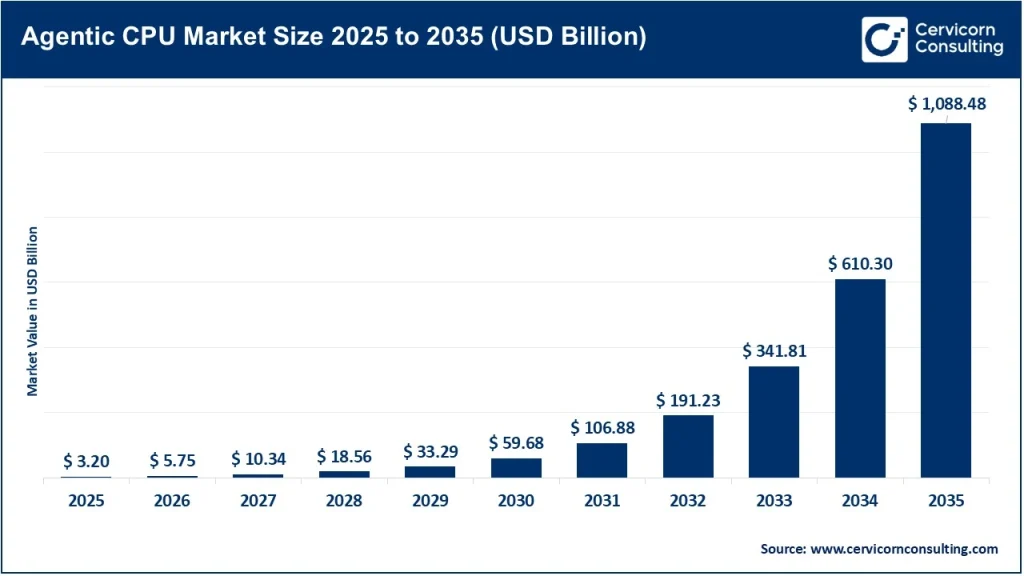
The global agentic CPU market was valued at USD 3.20 billion in 2025 and is projected to reach approximately USD 1,088.48 billion by 2035, growing at a robust CAGR of 79.1% during the forecast period from 2026 to 2035.
What Is the Agentic CPU Market?
The Agentic CPU market refers to the ecosystem of processors specifically designed or optimized to support autonomous artificial intelligence (AI) agents capable of reasoning, planning, decision-making, and executing complex tasks with minimal human intervention. Unlike traditional CPUs that primarily handle sequential computing workloads, agentic CPUs are engineered to manage AI-driven workflows involving real-time inference, contextual understanding, memory management, multi-agent coordination, and edge intelligence.
Agentic computing is emerging as the next phase of AI evolution, where intelligent systems move beyond responding to prompts and become autonomous digital workers capable of performing tasks independently. As enterprises increasingly deploy AI assistants, autonomous robots, industrial automation systems, and intelligent edge devices, demand for CPUs capable of supporting agentic AI workloads continues to rise.
Agentic CPU Market Growth Factors
The growth of the agentic CPU market is being fueled by rapid adoption of generative AI, autonomous AI agents, edge AI computing, intelligent robotics, digital twins, Industry 4.0 initiatives, smart manufacturing systems, AI-powered cybersecurity platforms, and enterprise automation. Increasing demand for real-time decision-making at the edge, rising investments in AI infrastructure, expansion of hyperscale data centers, growth in autonomous vehicles, proliferation of AI-enabled IoT devices, and advances in heterogeneous computing architectures are encouraging organizations to deploy processors optimized for agentic workloads. Furthermore, government investments in semiconductor manufacturing, national AI strategies, sovereign computing initiatives, and growing demand for energy-efficient AI processing are accelerating innovation in next-generation CPUs capable of supporting autonomous and continuously learning AI agents.
Get a Free Sample: https://www.cervicornconsulting.com/sample/2973
Why Is the Agentic CPU Market Important?
The agentic CPU market is becoming critical because AI systems are evolving from passive tools into autonomous entities capable of executing tasks independently.
Key reasons for its importance include:
1. Enabling Autonomous AI Systems
Agentic CPUs provide the computational foundation required for AI agents that can reason, plan, and act without constant human supervision.
2. Supporting Edge Intelligence
Industries increasingly require AI processing at the edge where latency, bandwidth, and privacy concerns limit cloud dependency.
3. Improving Operational Efficiency
Businesses use AI agents for customer service, logistics optimization, cybersecurity monitoring, and workflow automation, reducing operational costs.
4. Accelerating Industrial Automation
Factories, warehouses, and smart infrastructure systems require autonomous processors capable of handling continuous decision-making.
5. Advancing Human-Machine Collaboration
Agentic CPUs enable intelligent assistants capable of understanding context, learning preferences, and executing sophisticated workflows.
Market Dynamics Driving Adoption
Several technological shifts are accelerating market expansion:
- Large language models (LLMs)
- Multi-agent AI systems
- Autonomous robotics
- AI-powered digital twins
- Intelligent edge devices
- Smart manufacturing
- Autonomous vehicles
- AI-driven cybersecurity
- Industrial IoT
- Neuromorphic and heterogeneous computing
As AI models become more sophisticated, processing requirements continue to increase, creating demand for high-performance CPU architectures.
Major Companies in the Agentic CPU Market
NVIDIA Corporation
Company Overview
NVIDIA has become one of the most influential companies in AI computing. While widely recognized for GPUs, the company has aggressively expanded into CPU technologies through its Grace CPU platform.
Fiscal 2025 revenue reached approximately $130.5 billion.
Specialization
- AI infrastructure
- Accelerated computing
- Data center processors
- Autonomous systems
Key Focus Areas
- Grace CPU architecture
- AI factories
- Agentic AI platforms
- Data-center computing
Notable Features
- High-bandwidth memory integration
- Energy-efficient AI processing
- AI-centric system architecture
- Strong software ecosystem
Estimated Market Share
NVIDIA dominates AI infrastructure spending globally and maintains leadership in AI accelerator ecosystems.
Global Presence
Operations span:
- North America
- Europe
- Asia-Pacific
- Middle East
- Latin America
Intel Corporation
Company Overview
Intel remains one of the world’s largest processor manufacturers and is heavily investing in AI-enabled CPU architectures.
Intel reported approximately $52.85 billion in annual revenue for 2025.
Specialization
- Enterprise CPUs
- Edge computing
- Industrial processors
- AI acceleration
Key Focus Areas
- Xeon processors
- AI-enabled data centers
- Foundry services
- Edge AI infrastructure
Notable Features
- Strong enterprise ecosystem
- Broad software compatibility
- Industrial-grade reliability
- Global manufacturing capabilities
Estimated Market Share
Intel continues to maintain substantial presence across enterprise and data-center CPU markets.
Global Presence
- Americas
- Europe
- Asia-Pacific
- Middle East & Africa
Advanced Micro Devices (AMD)
Company Overview
AMD has emerged as a major challenger in AI infrastructure through its EPYC server CPUs and AI computing platforms.
AMD generated approximately $34.6 billion in revenue during 2025.
Specialization
- High-performance CPUs
- AI servers
- Edge computing
- Data-center solutions
Key Focus Areas
- EPYC processors
- AI infrastructure
- Enterprise computing
- Cloud optimization
Notable Features
- High core-count architecture
- Competitive power efficiency
- Strong cloud adoption
- Advanced chiplet design
Estimated Market Share
AMD continues gaining market share in enterprise servers and AI workloads.
Global Presence
- North America
- Europe
- Asia-Pacific
- Latin America
Qualcomm Incorporated
Company Overview
Qualcomm is increasingly positioning itself as an important player in AI-enabled edge and data-center computing.
Fiscal 2025 revenue reached approximately $44.3 billion.
Specialization
- Mobile AI processors
- Edge AI
- Intelligent IoT
- Data-center CPUs
Key Focus Areas
- On-device AI
- AI PCs
- Autonomous systems
- Data-center expansion
Notable Features
- Energy-efficient architectures
- Mobile-to-data-center scalability
- Advanced AI inference capabilities
- Low-power processing
Estimated Market Share
Qualcomm is strengthening its position within edge AI and AI PC markets.
Global Presence
- Americas
- Europe
- Asia-Pacific
- Middle East
Arm Holdings plc
Company Overview
Arm provides the processor architecture powering billions of devices worldwide and plays a critical role in agentic computing.
Specialization
- CPU architecture licensing
- Edge computing
- AI processors
- Mobile computing
Key Focus Areas
- AI-ready CPU designs
- Energy-efficient computing
- Edge intelligence
- Autonomous systems
Notable Features
- Low-power consumption
- Extensive ecosystem support
- Scalability
- High-performance cores
Estimated Market Share
Arm architecture powers the majority of mobile devices and is rapidly expanding across AI servers and edge systems.
Global Presence
- Europe
- North America
- Asia-Pacific
- Middle East
Leading Trends and Their Impact
Rise of AI Agents
Organizations are deploying autonomous AI agents capable of completing workflows independently.
Impact
- Increased CPU demand
- Greater inference workloads
- Need for real-time decision-making
AI PCs and Personal Agents
Consumer devices are increasingly integrating local AI processing capabilities.
Impact
- Growth in AI-enabled CPUs
- Enhanced privacy
- Reduced cloud dependence
Edge AI Expansion
Industries are moving AI processing closer to data sources.
Impact
- Lower latency
- Faster automation
- Increased processor deployment
Heterogeneous Computing
Future systems combine CPUs, GPUs, NPUs, and accelerators.
Impact
- Higher efficiency
- Better workload distribution
- Enhanced AI performance
Autonomous Robotics
Robots increasingly require local reasoning capabilities.
Impact
- Growing demand for agentic processors
- Expansion of industrial automation
- Increased computing requirements
Digital Twin Technology
Digital replicas of physical assets require continuous AI processing.
Impact
- Greater CPU utilization
- Enhanced predictive analytics
- Industrial efficiency improvements
Successful Examples of Agentic CPU Adoption Around the World
AI Data Centers in the United States
Hyperscale cloud providers deploy advanced CPU architectures to support autonomous AI agents operating at scale.
Applications include:
- Customer service automation
- Enterprise AI assistants
- Cloud-native AI operations
Smart Manufacturing in Germany
German manufacturers are integrating AI agents into industrial production environments.
Benefits include:
- Predictive maintenance
- Autonomous quality control
- Process optimization
Intelligent Robotics in Japan
Japan uses AI-powered robots across healthcare, manufacturing, and logistics sectors.
Outcomes include:
- Labor efficiency
- Operational automation
- Reduced human intervention
Smart Cities in Singapore
Singapore deploys AI-enabled infrastructure for transportation, utilities, and public services.
Applications include:
- Traffic optimization
- Public safety monitoring
- Resource management
Autonomous Logistics in China
Chinese logistics providers increasingly use AI agents for route planning and warehouse management.
Benefits include:
- Faster deliveries
- Lower transportation costs
- Improved efficiency
Global Regional Analysis
North America
North America currently leads the agentic CPU market due to:
- Strong semiconductor ecosystem
- Presence of leading AI companies
- Large-scale cloud infrastructure
- Significant R&D spending
Government Initiatives
United States CHIPS Programs
Government initiatives encourage domestic semiconductor production and advanced processor development.
Key objectives include:
- Supply-chain resilience
- AI competitiveness
- Advanced manufacturing expansion
National AI Investments
Federal agencies continue funding:
- AI research
- Supercomputing programs
- Advanced computing infrastructure
Market Impact
North America remains a global innovation hub for agentic computing.
Europe
Europe is rapidly expanding AI and semiconductor capabilities.
Key Growth Drivers
- Industrial automation
- Smart manufacturing
- Robotics deployment
- Digital transformation
Government Initiatives
European Chips Act
The European Union is investing heavily in semiconductor independence.
Goals include:
- Increasing chip production capacity
- Strengthening AI competitiveness
- Supporting next-generation processor development
AI Regulatory Frameworks
Europe emphasizes:
- Responsible AI
- Ethical deployment
- Trustworthy automation
Market Impact
Europe is becoming a major market for industrial agentic CPU applications.
Asia-Pacific
Asia-Pacific represents the fastest-growing regional market.
Growth Drivers
- Massive electronics manufacturing
- Smart factory investments
- Robotics leadership
- AI infrastructure expansion
Government Initiatives
China
National AI strategies support:
- Domestic semiconductor innovation
- AI self-sufficiency
- Intelligent manufacturing
Japan
Government-backed robotics and automation programs encourage AI processor adoption.
South Korea
Investments focus on:
- Advanced semiconductors
- AI computing infrastructure
- Next-generation manufacturing
India
India’s semiconductor and AI missions support:
- Local chip development
- AI startup growth
- Digital transformation
Market Impact
Asia-Pacific is expected to become the largest production and consumption center for agentic CPUs.
Latin America
The region is gradually adopting AI-powered infrastructure.
Key Drivers
- Digital transformation
- Smart logistics
- Cloud adoption
Government Support
Countries are introducing:
- Innovation grants
- Technology modernization programs
- Digital economy initiatives
Market Impact
Demand is rising for AI-enabled edge computing solutions.
Middle East & Africa
The region is increasingly investing in AI infrastructure and smart city projects.
Growth Drivers
- National AI strategies
- Smart government initiatives
- Digital infrastructure modernization
Government Initiatives
United Arab Emirates
Investments focus on:
- AI leadership
- Autonomous services
- Smart city development
Saudi Arabia
Large-scale digital transformation programs support advanced computing adoption.
Market Impact
The region is emerging as a promising market for agentic computing deployments.
Future Outlook of the Agentic CPU Market
The agentic CPU market is expected to witness substantial growth over the next decade as organizations transition from traditional automation toward autonomous AI systems. Increasing adoption of AI agents, intelligent robotics, AI-powered edge devices, and enterprise automation platforms will continue driving processor innovation. Companies such as NVIDIA, Intel, AMD, Qualcomm, and Arm are expected to play pivotal roles in shaping next-generation computing architectures capable of supporting increasingly sophisticated autonomous AI workloads. As governments worldwide strengthen semiconductor and AI initiatives, agentic CPUs are likely to become foundational infrastructure for the future digital economy.
To Get Detailed Overview, Contact Us: https://www.cervicornconsulting.com/contact-us
Read Report: Medical Aesthetics Market Revenue, Trends, and Strategic Insights by 2035
Read About: