


Table of Contents
ToggleAdvanced Biofuel Market Size
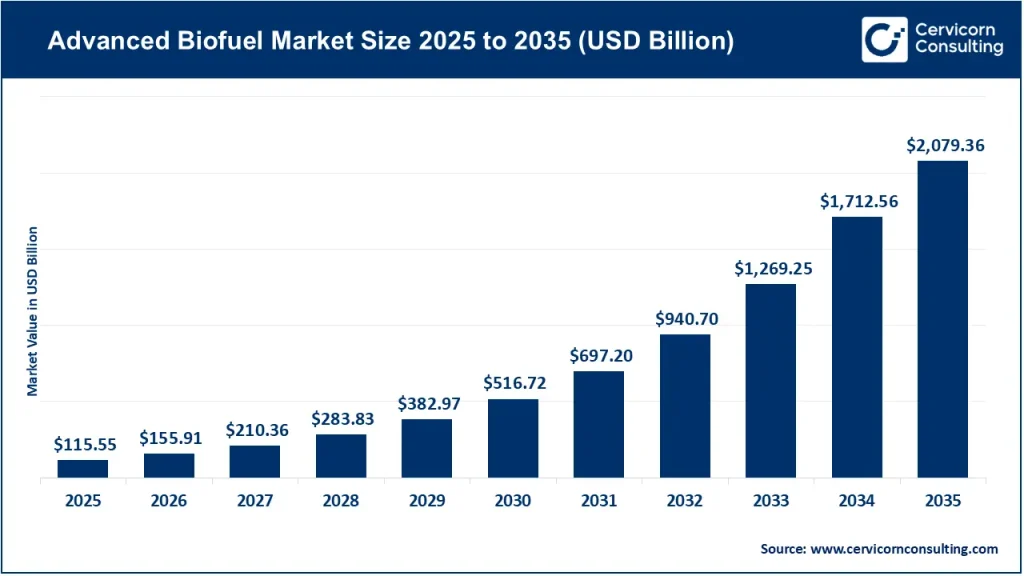
The global advanced biofuel market was valued at approximately USD 115.55 billion in 2025 and is projected to reach nearly USD 2,079.36 billion by 2035, growing at a CAGR of 33.51%.
Advanced Biofuel Market Growth Factors
The advanced biofuel market is experiencing rapid growth due to increasing global commitments toward carbon neutrality, supportive government mandates for renewable fuels, rising demand for sustainable aviation fuel (SAF), growing investments in second- and third-generation biofuel technologies, expanding utilization of agricultural residues and municipal waste as feedstocks, technological advancements in enzymatic hydrolysis and gasification, increasing corporate sustainability initiatives, higher fossil fuel prices, stricter emissions regulations across transportation sectors, and continuous research into algae-based biofuels that promise higher energy yields with significantly lower environmental impact.
What is the Advanced Biofuel Market?
The advanced biofuel market refers to the global industry involved in producing, distributing, and commercializing biofuels manufactured from sustainable, non-food feedstocks. These feedstocks include:
- Agricultural residues
- Forestry waste
- Municipal solid waste
- Algae
- Industrial waste
- Energy crops grown on marginal lands
Advanced biofuels include:
- Cellulosic ethanol
- Renewable diesel
- Biojet fuel (Sustainable Aviation Fuel)
- Biobutanol
- Renewable gasoline
- Biomethane
Unlike first-generation biofuels produced from corn or sugarcane, advanced biofuels significantly reduce lifecycle carbon emissions while avoiding food-versus-fuel concerns.
These fuels are increasingly integrated into transportation, aviation, marine shipping, railways, heavy industries, and power generation.
Get a Free Sample: https://www.cervicornconsulting.com/sample/2700
Why is the Advanced Biofuel Market Important?
Advanced biofuels are becoming increasingly important because they address one of the world’s biggest environmental challenges—decarbonizing sectors that are difficult to electrify.
Their importance includes:
Lower Greenhouse Gas Emissions
Many advanced biofuels reduce lifecycle CO₂ emissions by 60–90% compared to conventional fossil fuels.
Sustainable Aviation
Commercial aviation has limited electrification options. Sustainable aviation fuel (SAF), produced from advanced biofuels, is becoming the preferred solution.
Circular Economy
Advanced biofuels convert agricultural waste and municipal waste into valuable energy, reducing landfill dependence.
Energy Security
Countries reduce dependence on imported crude oil by utilizing locally available biomass resources.
Rural Economic Development
Farmers gain additional income by selling agricultural residues previously considered waste.
Industrial Decarbonization
Heavy industries increasingly utilize renewable fuels to meet ESG commitments.
Advanced Biofuel Market Size
The global advanced biofuel market is expected to witness significant expansion during the forecast period as investments accelerate across renewable energy projects. Increasing production capacity for renewable diesel and sustainable aviation fuel, combined with supportive government incentives, is expected to drive long-term market growth. Rising adoption across aviation, marine transport, and heavy-duty logistics will continue to strengthen demand, making advanced biofuels one of the fastest-growing renewable fuel segments worldwide.
Leading Companies Operating in the Advanced Biofuel Market
| Company | Specialization | Key Focus Areas | Notable Features | 2025 Revenue (Approx.) | Market Share (Approx.) | Global Presence |
|---|---|---|---|---|---|---|
| Advanced Biofuel Solutions | Waste-to-fuel technologies | Municipal waste conversion | Circular economy innovations | USD 80–100 Million | Small emerging player | Europe |
| BP | Renewable fuels and SAF | Renewable diesel, biofuels, aviation fuels | Strong refinery integration | USD 190+ Billion | 10–12% | Over 70 countries |
| Clariant | Cellulosic ethanol technology | Sunliquid® technology | Advanced enzyme platform | USD 5.5 Billion | 4–6% | Europe, Americas, Asia |
| ExxonMobil | Renewable diesel and algae research | Low-carbon fuels | Major investments in algae biofuels | USD 340+ Billion | 12–15% | More than 100 countries |
| Gevo | Sustainable aviation fuel | Renewable hydrocarbons | Net-zero fuel production platform | USD 35–50 Million | Emerging | North America, Europe |
Leading Trends Transforming the Advanced Biofuel Market
1. Sustainable Aviation Fuel (SAF) Expansion
Airlines worldwide are committing to net-zero emissions.
Advanced biofuels now represent the largest source of commercially available SAF.
Market Impact
- Massive investments in SAF plants
- Long-term airline purchase agreements
- New refinery conversions
2. Renewable Diesel Production Growth
Oil refiners are converting conventional refineries into renewable diesel facilities.
Impact
- Increased biofuel production capacity
- Reduced diesel emissions
- Higher demand for waste feedstocks
3. Waste-to-Energy Technologies
Municipal solid waste is becoming a valuable feedstock.
Impact
- Lower landfill volumes
- Improved urban waste management
- Additional revenue streams
4. Algae-Based Biofuel Innovation
Algae produce significantly higher oil yields than traditional crops.
Impact
- Higher productivity
- Lower land requirements
- Greater sustainability
5. Carbon Capture Integration
Several advanced biofuel facilities are integrating carbon capture technologies.
Impact
- Carbon-negative fuels
- Increased carbon credit opportunities
- Improved ESG performance
6. Artificial Intelligence in Biofuel Production
AI optimizes fermentation, enzyme efficiency, and feedstock utilization.
Impact
- Higher production efficiency
- Lower operational costs
- Better yield prediction
7. Increased Corporate Investments
Major oil companies are diversifying into renewable fuels.
Impact
- Faster commercialization
- Large-scale infrastructure development
- Enhanced global production capacity
Impact of Advanced Biofuel Adoption Across Industries
Aviation
Sustainable aviation fuel is becoming the fastest-growing advanced biofuel application.
Benefits include:
- Reduced lifecycle emissions
- Regulatory compliance
- Enhanced airline sustainability
Marine Industry
Shipping companies are increasingly adopting bio-based marine fuels.
Benefits include:
- Lower sulfur emissions
- Compliance with IMO regulations
- Reduced carbon intensity
Heavy Transportation
Heavy trucks increasingly utilize renewable diesel.
Benefits include:
- No engine modifications
- Immediate emissions reduction
- Improved fuel efficiency
Industrial Manufacturing
Factories use renewable fuels for process heating.
Benefits include:
- Lower emissions
- ESG compliance
- Reduced fossil fuel dependence
Successful Examples of the Advanced Biofuel Market Around the World
Neste (Finland)
Neste has become one of the world’s largest producers of renewable diesel and sustainable aviation fuel. The company utilizes waste oils and animal fats to produce renewable fuels with significantly lower lifecycle emissions. Its products are supplied across Europe, North America, and Asia-Pacific, making it a benchmark for commercial-scale advanced biofuel production.
Impact
- Global leader in renewable diesel
- Major SAF supplier
- Significant reduction in transportation emissions
Gevo (United States)
Gevo focuses on producing net-zero hydrocarbon fuels, particularly sustainable aviation fuel. The company integrates renewable energy, carbon capture, and advanced fermentation technologies to create low-carbon fuels.
Impact
- Commercial SAF production
- Carbon-neutral fuel pathways
- Long-term airline supply agreements
Clariant Sunliquid® Plants (Europe)
Clariant’s Sunliquid® technology converts agricultural residues such as wheat straw and corn stover into cellulosic ethanol without relying on food crops.
Impact
- Commercial-scale cellulosic ethanol
- High feedstock flexibility
- Reduced greenhouse gas emissions
BP Renewable Fuel Projects
BP has invested heavily in renewable diesel and sustainable aviation fuel production through refinery modernization and strategic partnerships.
Impact
- Expansion of renewable fuel capacity
- Global supply chain development
- Integration with existing energy infrastructure
ExxonMobil Algae Biofuel Research
ExxonMobil continues investing in algae-based biofuel research aimed at producing renewable fuels with higher energy density and lower environmental impacts.
Impact
- Long-term innovation
- High-yield biomass production
- Potential commercialization of algae fuels
Global Regional Analysis of the Advanced Biofuel Market
North America
North America represents one of the largest advanced biofuel markets globally due to extensive government support, abundant biomass resources, and significant investments by major energy companies.
Market Drivers
- Renewable Fuel Standard (RFS)
- Sustainable Aviation Fuel incentives
- Renewable diesel expansion
- Corporate decarbonization initiatives
Government Initiatives and Policies
- Renewable Fuel Standard (RFS)
- Inflation Reduction Act (IRA)
- Clean Fuel Production Tax Credits
- Low Carbon Fuel Standards (LCFS) in states such as California
Market Outlook
The United States continues to lead in renewable diesel production, sustainable aviation fuel investments, and advanced biomass technologies.
Europe
Europe remains a major market driven by ambitious climate policies and strong renewable energy legislation.
Market Drivers
- Net-zero commitments
- Circular economy initiatives
- Strong sustainability regulations
- Advanced waste management infrastructure
Government Initiatives and Policies
- Renewable Energy Directive (RED III)
- European Green Deal
- Fit for 55 Package
- ReFuelEU Aviation initiative
Market Outlook
Countries including Germany, Finland, Sweden, France, and the Netherlands continue expanding advanced biofuel production while encouraging sustainable aviation fuel adoption.
Asia-Pacific
Asia-Pacific is projected to experience the fastest growth due to rapid industrialization, expanding transportation sectors, and increasing investments in renewable energy.
Market Drivers
- Growing energy demand
- Agricultural waste availability
- Government biofuel blending mandates
- Rising aviation sector
Government Initiatives and Policies
China
- National Carbon Neutrality Goals
- Renewable Energy Development Plans
India
- National Biofuel Policy
- Ethanol Blending Programme
- SATAT initiative for compressed biogas
Japan
- Green Growth Strategy
- SAF commercialization roadmap
Australia
- Renewable Energy Target
- State-level bioenergy programs
Market Outlook
India and China are expected to become major advanced biofuel producers through agricultural residue utilization and sustainable fuel investments.
Latin America
Latin America possesses significant biomass resources and established biofuel expertise.
Market Drivers
- Sugarcane industry
- Agricultural waste
- Export opportunities
- Renewable fuel mandates
Government Initiatives and Policies
Brazil
- RenovaBio Program
- National Biofuel Policy
Argentina
- Biodiesel blending mandates
- Renewable energy incentives
Market Outlook
Brazil continues expanding into second-generation ethanol while strengthening renewable diesel production.
Middle East & Africa
The region is gradually entering the advanced biofuel market through renewable energy diversification and waste management initiatives.
Market Drivers
- Economic diversification
- Aviation growth
- Municipal waste utilization
- Hydrogen integration
Government Initiatives and Policies
United Arab Emirates
- UAE Energy Strategy 2050
- National Hydrogen Strategy
Saudi Arabia
- Saudi Green Initiative
- Circular Carbon Economy framework
South Africa
- Biofuels Industrial Strategy
- Renewable Energy Independent Power Producer Programme (REIPPPP)
Market Outlook
Growing investments in sustainable aviation fuel, waste-to-energy facilities, and renewable fuel infrastructure are expected to accelerate market growth across the region.
Emerging Opportunities in the Advanced Biofuel Market
Several emerging opportunities are expected to shape the next phase of market expansion:
- Commercialization of Sustainable Aviation Fuel (SAF): Increasing airline commitments and government blending mandates are creating substantial demand for SAF production facilities.
- Advanced Feedstock Development: Utilization of algae, municipal solid waste, forestry residues, and industrial waste offers scalable and sustainable alternatives to conventional feedstocks.
- Biorefinery Expansion: Integrated biorefineries capable of producing multiple renewable products, including biofuels, biochemicals, and bio-based materials, are improving profitability and resource efficiency.
- Carbon Credit Markets: Producers adopting carbon capture and low-carbon production technologies can generate additional revenue through carbon trading mechanisms.
- Public-Private Partnerships: Collaborations between governments, energy companies, airlines, and technology providers are accelerating commercialization and infrastructure development.
- Technological Innovations: Advances in synthetic biology, enzyme engineering, gasification, pyrolysis, and AI-driven process optimization are expected to improve conversion efficiency while reducing production costs.
Future Outlook of the Advanced Biofuel Market
The future of the advanced biofuel market is expected to be driven by continuous technological innovation, increasing investments in renewable fuel infrastructure, and stronger global climate policies. Growing demand for sustainable aviation fuel, renewable diesel, and low-carbon marine fuels will create new opportunities for producers and technology providers. Improvements in feedstock availability, biorefinery efficiency, and carbon capture integration will further enhance the competitiveness of advanced biofuels. As governments strengthen decarbonization targets and industries seek practical alternatives to fossil fuels, advanced biofuels are expected to play a central role in achieving global energy security and long-term sustainability goals.
To Get Detailed Overview, Contact Us: https://www.cervicornconsulting.com/contact-us
Read Report: Fusion Reactor Market Revenue, Trends, and Strategic Insights by 2035